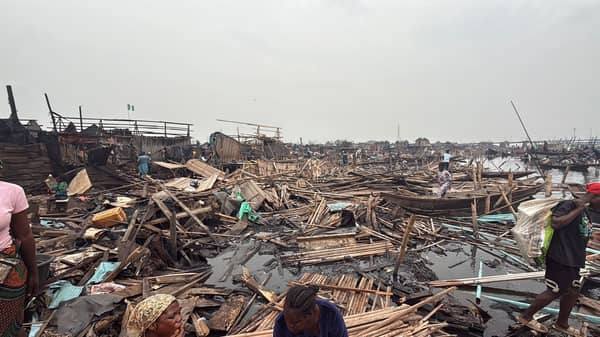
An advocacy group, the Radical Agenda Movement in the Nigerian Bar (RAMINBA), has called on the Lagos State Government to stop what it described as the illegal demolition of buildings in the Makoko community of Lagos State.
The group said the demolitions were being carried out despite a “valid and subsisting” judgment delivered by Justice Ogazi of the Lagos Division of the Federal High Court.
The chairperson of RAMINBA, Ayodele Adémiluyi, and the Secretary, Abiodun Kolawole, made the call yesterday, urging the Lagos State Government to comply with the court order.
According to them, while the state government initially demolished structures located within 100 metres of power lines in Makoko in line with the court’s ruling, it allegedly exceeded the scope of the judgment by pulling down houses situated far from the power lines.
RAMINBA said the continued demolition of such buildings amounted to a violation of the court order. The group urged the Lagos State Government to exercise restraint and comply fully with the judgment, stressing the need to uphold the rule of law.
Also, the Centre for Children’s Health Education, Orientation and Protection (CEEHOPE) Nigeria, Health of Mother Earth Foundation) and Corporate Accountability and Public Participation Africa (CAPPA) strongly condemned the demolition of homes in the Makoko waterfront community.
The groups said the alleged forced demolitions reportedly led to the deaths of two babies and an adult, the mass displacement of residents, and the arrest of a community leader who was advocating restraint and due process.
In a statement yesterday, the organisations described the incidents as part of a troubling pattern of disregard for the constitutional rights to life and wellbeing of marginalised residents struggling to survive despite years of neglect by the state government.
They also drew attention to the arrest of Mr Oluwatobi Aide, also known as Woli, a youth leader in the community. Aide was reportedly picked up by security agents on Monday, January 12, 2026, and is currently being detained at the Area F Police Station, Ikeja, after a brief detention at the Rapid Response Squad office in Alausa.
According to witnesses, Aide approached officials of the demolition team to appeal for at least a few hours to allow residents to retrieve their belongings after it became clear that the exercise had extended beyond the originally communicated corridor and power-line perimeter. Rather than address the concerns raised, security agents allegedly arrested him.
Since his arrest, Aide, who was tear-gassed during the demolitions and hospitalised last week, has reportedly suffered a further deterioration in his health while in detention.
Condemning both the demolitions and the arrest, Director of HOMEF, Nnimmo Bassey, said: “We view these latest attacks on vulnerable populations and the urban poor as the most violent manifestations of the Lagos government’s contempt for people it treats as expendable, to be cleared for elite profit and at the pleasure of land speculators and the wealthy.
“The thuggish arrest of community members and the forced displacement of families who have always known Makoko as home underscore the helplessness of struggling Nigerians. We see this assault as comparable to what citizens suffer at the hands of bandits in some parts of the country. This state-driven campaign of land grabbing and displacement is repugnant and must be halted.”
Executive Director of CEEHOPE, Betty Abah, said Makoko’s experience was not an isolated case.
“Over the past year, the Lagos government has carried out similar demolition exercises in communities such as Oko-Baba, Ayetoro (parts of Makoko), Otumara, Baba-Ijora, Oworonshoki and Precious Seeds, displacing tens of thousands of low-income residents, particularly women and children.
“In several cases, demolitions were carried out without prior notice, consultation or provision of alternative accommodation, and in defiance of pending court cases or injunctions. Earlier evictions in Badia East, Otodo-Gbame, Maroko, Monkey Village, Ilaje-Bariga and Ifelodun reveal a long-standing pattern of forced evictions that have shattered livelihoods, uprooted families and exposed women and children to heightened risks of violence, hunger and poverty,” Abah added.