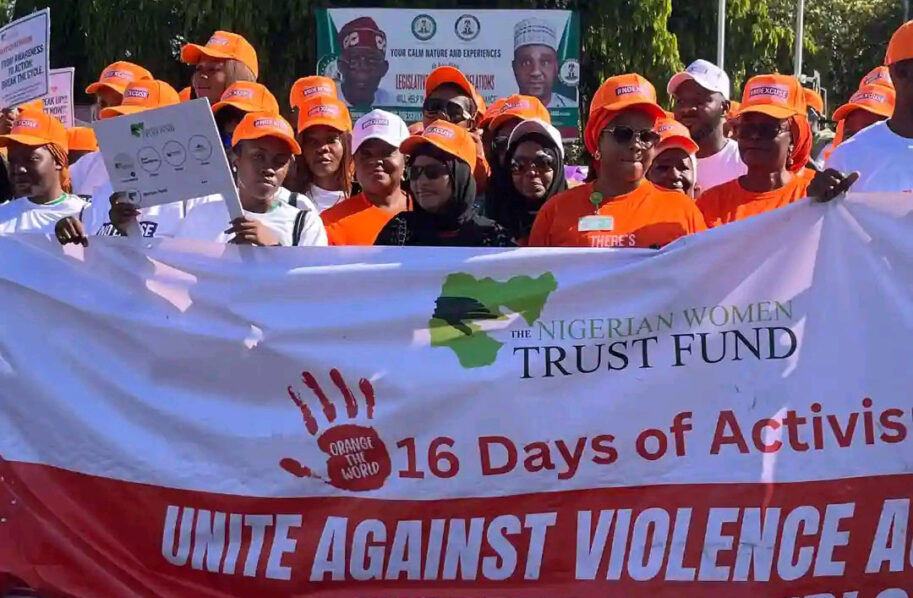
Scores of women took to the streets of Abuja yesterday to demand urgent action against the rising cases of gender-based violence (GBV) in Nigeria.
The march, organised by United Nations Women in collaboration with the National Assembly of Nigeria, marked the 16 Days of Activism Against Gender-Based Violence, a global campaign aimed at ending violence against women and girls.
Participants carried placards with inscriptions such as “No Tolerance to Rape, Sexual Violence, Child Sexual Abuse, and Sex Trafficking,” “No one has the right to control your body without your consent,” and “Say no to coercion, harassment, and exploitation,” among others.
The event featured a solidarity walk with over 1,000 participants, including policymakers, civil society organisations, activists, and members of the public.
The march began at the House of Representatives Wing of the National Assembly and concluded at the Nigeria Police Force Headquarters in Abuja.
Addressing journalists, Kafilat Ogbara, Chairperson of the House Committee on Women Affairs, called for continuous efforts to combat GBV beyond the 16 Days of Activism.
“Our studies indicate that one in three women globally are victims of gender-based violence,” Ogbara said. “Reports from the National Demographic and Health Survey reveal that 30 per cent of women aged 15 to 49 in Nigeria have experienced physical violence, with many suffering abuse from intimate partners.”
She urged the Inspector General of Police, Kayode Egbetokun, to ensure justice for GBV victims across police stations nationwide while calling for stronger legislative measures and societal commitment to address the issue.
Ogbara added: “There is no excuse for violence against our women and girls. They are our mothers, daughters, and family. We are saying no to all forms of violence, including lecturers exploiting students, bosses harassing staff, and fathers or uncles abusing children. It must stop.”
Inspector General of Police Kayode Egbetokun, who received the women’s petition, reiterated the police force’s commitment to eradicating GBV.
“As we join the international community in marking the International Day for the Elimination of Gender-Based Violence, this occasion reminds us that combating GBV is a collective effort involving everyone in society,” he said.
Egbetokun highlighted persistent abuses, including domestic violence, sexual assault, and harmful traditional practices like genital mutilation, and assured that the police would remain committed to their gender policy introduced in 2006.
The Speaker of the House of Representatives, Abbas Tajudeen, reaffirmed the commitment of the 10th House to intensify the fight against gender-based violence and violence targeting women and girls.
Tajudeen said, “I want to say it categorically clear that the National Assembly will do everything humanly possible to ensure that all forms of violence against women and girls are drastically reduced, if not completely eliminated, in the very near future.”
He further announced that the House of Representatives would actively participate in the forthcoming national action plan against violence towards women.
“We will send our representatives. We will also participate actively in ensuring that pro-poor policies are enacted to significantly reduce the incidences of violence of all kinds against women, against children, against girls,” he stated.