
 Get Guardian on Google
A coalition of civil society organisations, the Coalition for Good Governance and Accountability (CCSGGA), has raised concerns over the alleged failure of the North-West Development Commission (NWDC) to distribute intervention materials procured for its 2026 programmes.
The coalition also accused the Commission’s leadership of administrative inertia, poor coordination and governance failures, alleging attempts to divert public resources meant for the seven North-West states.
It called on relevant security agencies to investigate the allegations and take appropriate action.
The civil society groups specifically accused the Commission’s leadership of failing to commence an approved recruitment exercise and alleged that the Governing Board had not held meetings for about two consecutive quarters.
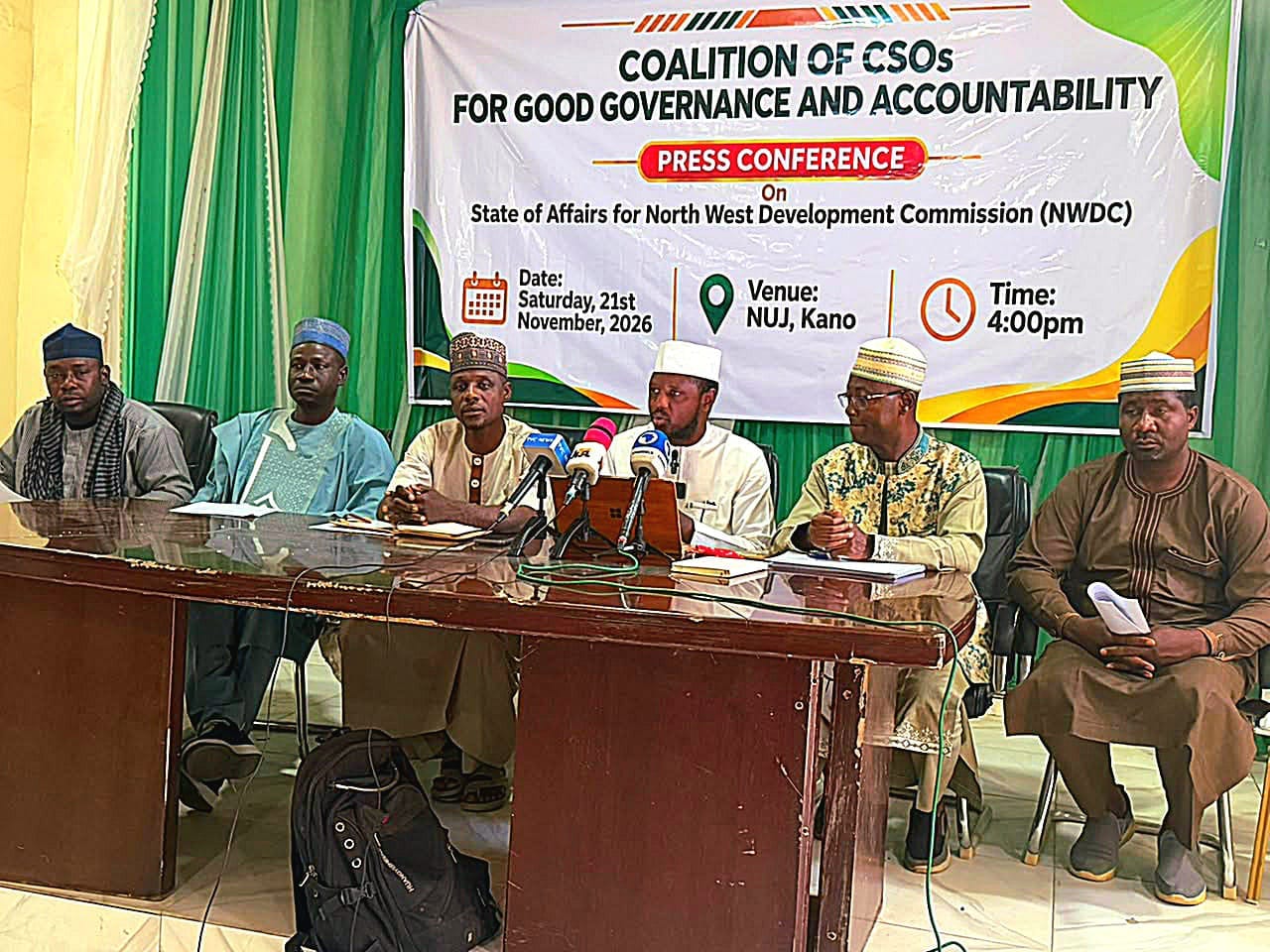
Addressing journalists at a press conference in Kano at the weekend, the coalition said its inspection of the Commission’s warehouses revealed large quantities of intervention materials, including Hilux vehicles, tractors, fertilisers, solar-powered irrigation pumps, food items and streetlights, which had yet to be distributed to intended beneficiaries.
Led by its chairman, Dr Abdussalam Muhammad Kani, and secretary, Comrade Akibu Hamisu, the coalition expressed concern that resources procured to address critical development challenges across the seven North-West states remained in warehouses while intended beneficiaries faced economic and humanitarian difficulties.
“We consider it unacceptable for institutional disagreements, administrative bottlenecks or a lack of effective leadership coordination to stand in the way of development interventions intended to address the pressing needs of millions of people across the seven North-Western states,” the coalition said.
Beyond the undistributed materials, Kani expressed concern over the Commission’s alleged failure to commence recruitment despite securing approval from the Federal Character Commission (FCC) and other relevant regulatory agencies.
According to the coalition, months after the approvals were granted, the Commission had yet to publish recruitment advertisements, open an application portal, announce vacancies or provide a timeline and selection criteria for prospective applicants.
The group maintained that the NWDC could not effectively discharge its statutory responsibilities without the required manpower and institutional capacity.
The coalition also questioned the state of governance within the Commission, alleging poor coordination between the Governing Board and Management.
Kani said the reported failure of the Board to hold meetings for about two consecutive quarters raised concerns, particularly as the NWDC Establishment Act, 2024, provides for quarterly meetings.
He called on the Board Chairman, Hon. Lawan Sama’ila Abdullahi Yakawada, to convene an urgent meeting to address the administrative and operational challenges affecting the Commission.
The coalition also requested an opportunity to meet with the chairman to hear his explanation for the alleged delays and establish whether other individuals or circumstances were hindering the effective discharge of his responsibilities.
“We invite him to explain these matters so that, as a coalition, we can engage the appropriate stakeholders in the collective interest and development of the North-West,” Kani said.
Presenting the coalition’s 10-point demands, Hamisu urged the NWDC Board and Management to immediately commence the approved recruitment exercise and publicly disclose available positions, application procedures, timelines and selection criteria.
He said the recruitment process must be transparent, merit-based and consistent with Federal Character principles to ensure equitable representation among the seven states.
The coalition also called on the National Assembly, particularly its committees on regional development and public accounts, to investigate the status of the intervention materials and ensure their transparent and equitable distribution.
Hamisu further urged the Minister of Regional Development to facilitate the appointment of Executive Directors in accordance with the law, arguing that the Commission needed a complete leadership and management structure to function effectively.
He said the coalition also wanted independent oversight by the Economic and Financial Crimes Commission (EFCC) and other relevant agencies to strengthen accountability and build public confidence, rather than create an adversarial relationship.
The civil society groups stressed that the establishment of the NWDC must translate into tangible improvements in the lives of people across the North-West, rather than remain an administrative achievement without corresponding benefits to the population.
“The NWDC was established to advance the collective development interests of the North-West. Its resources and interventions must therefore be managed in the public interest and delivered to the people they are intended to serve.
“No individual interest should take precedence over the collective development aspirations of the region. Public resources must not remain indefinitely in warehouses when communities across the seven states urgently need them, and approved employment opportunities must not remain hidden from the public they were meant to benefit,” the coalition said.
Efforts to obtain a response from the Commission’s management were unsuccessful, as several phone calls and text messages sent to its Managing Director, Prof. Shehu Abdullahi Ma’aji, were not answered.