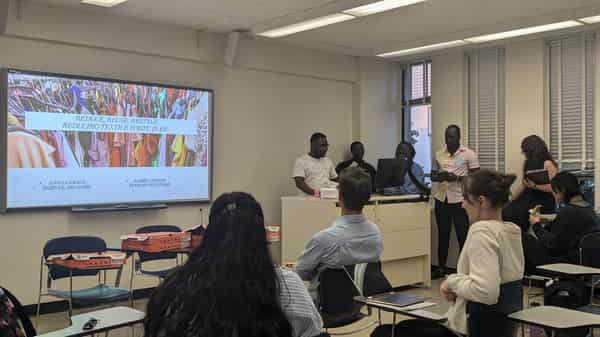
A sustainability project led by Nigerian chartered accountant and carbon accounting specialist, Feyisayo Michael Ogunyemi, has drawn attention to the role universities can play in addressing textile waste through the application of Environmental, Social and Governance (ESG) principles and carbon accounting tools.
Ogunyemi, working with an interdisciplinary student team at Eastern Illinois University (EIU) in the United States, delivered a presentation titled “Reduce, Reuse, Restyle: Reducing Textile Waste in EIU”. The project was developed as part of an advanced sustainability and environmental communication programme and focused on practical, measurable approaches to reducing textile waste on campus and within the surrounding community.
Textile waste is among the fastest-growing sources of landfill pressure globally and a significant contributor to greenhouse gas emissions, largely driven by fast fashion and short clothing life cycles. The EIU project examined this challenge through an ESG lens, linking environmental impacts with governance and behavioural factors that influence consumption patterns within institutional settings.
The presentation analysed how clothing consumption among students contributes to waste generation and associated carbon emissions.
Ogunyemi and his team highlighted that universities, as large and structured communities, are well positioned to influence sustainable behaviour while also embedding accountability mechanisms that align with institutional sustainability goals.
As part of the proposed solution, the team outlined a series of campus-level interventions, including regular clothing swap events, the establishment of textile collection and recovery points, and hands-on repurposing workshops designed to extend garment life cycles.
These initiatives were supported by student-focused awareness campaigns aimed at encouraging responsible consumption and reducing dependence on fast fashion.
A central feature of the project was the introduction of a simplified carbon accounting model designed to quantify emissions avoided through textile reuse and reduced disposal. The model demonstrated how extending the life of garments and diverting textiles from landfill could translate into measurable carbon savings.
According to the presentation, such quantification is essential for moving sustainability initiatives beyond symbolic action towards data-driven decision-making.
Ogunyemi argued that integrating carbon accounting into campus sustainability projects strengthens transparency and supports governance structures by allowing institutions to track progress against defined targets.
He noted that universities have a unique opportunity to test circular economy models in controlled environments, generating insights that can be scaled to wider communities.
The project also addressed the governance dimension of ESG, recommending that student-led sustainability initiatives be aligned with formal institutional policies.
The team proposed that EIU integrate textile waste reduction into its broader sustainability framework, ensuring continuity, accountability and long-term impact beyond individual student cohorts.
Faculty members and fellow students commended the presentation for its analytical depth and practical focus. Observers noted that the project stood out for combining environmental analysis, carbon measurement and communication strategy, rather than relying solely on awareness-raising.
The interdisciplinary nature of the team, which brought together students from different academic and cultural backgrounds, was also cited as a strength.
The EIU initiative adds to Ogunyemi’s growing body of work in sustainability accounting, energy systems and environmental policy.
His professional background in carbon accounting and ESG finance informed the project’s emphasis on measurement, governance and implementation, areas that are increasingly central to global sustainability practice.
More broadly, the project reflects a growing trend in higher education towards applied sustainability research that links academic learning with real-world environmental challenges.
As universities face rising expectations to demonstrate tangible climate action, initiatives such as the EIU textile waste project illustrate how ESG frameworks and carbon accounting tools can be applied at institutional level.
At a time of intensifying global climate concerns, the project also highlights the role of emerging researchers from Africa and other regions in shaping sustainability discourse within international academic institutions.