 Follow Us on Google News
 Follow Us on Google Discover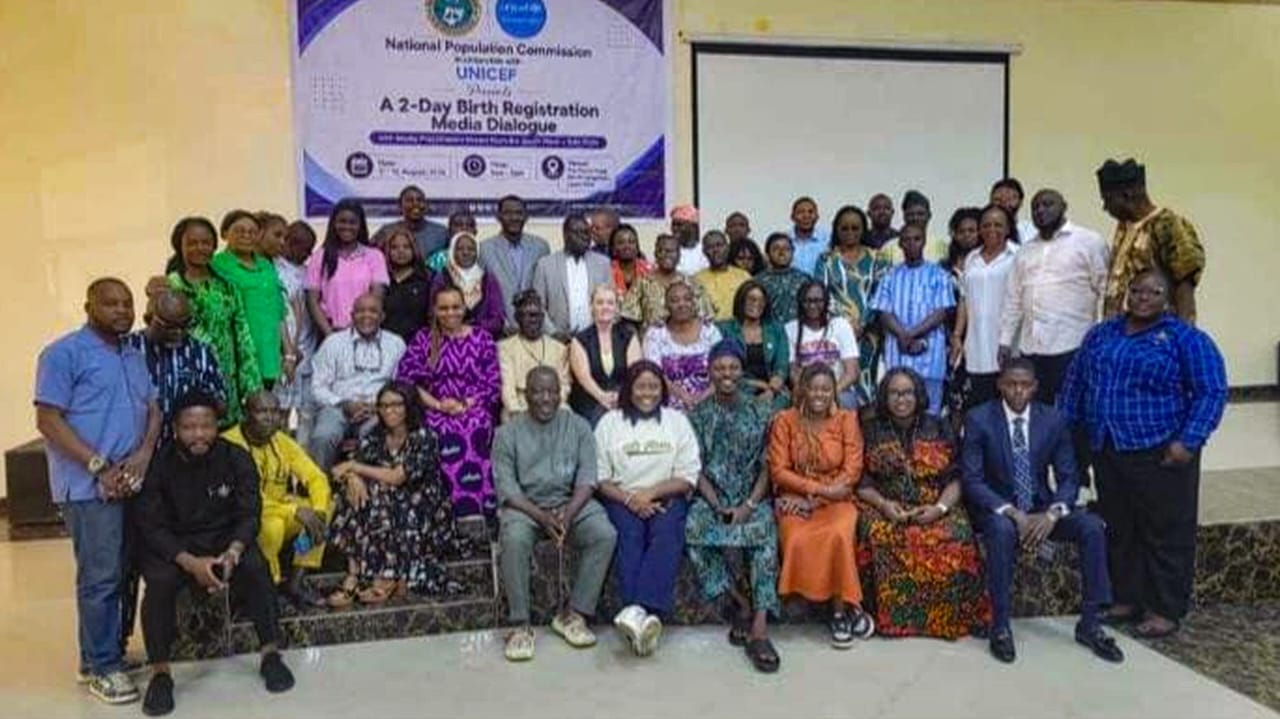
Stakeholders have been charged to support efforts at protecting the legal rights and future of children in Nigeria by ensuring that all parents and caregivers embrace birth registration.
This task was given at a two-day Birth Registration Media Dialogue organised by the National Population Commission (NPC) in collaboration with the United Nations Children’s Fund (UNICEF) in Sangotedo, Lagos
The dialogue, themed “Giving Every Child a Legal Identity by Driving Birth Registration in Nigeria,” brought together journalists from the South-West and Edo State to strengthen media advocacy for the registration of children under one year of age.
For Lagos, Ogun, Oyo, Osun, Ondo, Ekiti and Edo States alone, no fewer than 3.5 million children are said to be unregistered.
Rising from group discussions at the event, facilitators and participants identified traditional rulers and religious leaders as critical stakeholders that are strategically positioned to scale up birth registration by sensitising their subjects and faithfuls on the need register their child with the NPC.
Various speakers at the programme warned that the absence of legal identity for children continues to deny millions access to essential services and opportunities.

Addressing the participants, Chief of UNICEF Lagos Field Office, Celine Lafoucriere, described birth registration as far more than an administrative exercise, saying it is the legal foundation upon which a child’s rights, identity and future are built.
According to her, millions of children across the seven states remain invisible to government records despite being alive, loved by their families and, in many cases, born in health facilities.
“A birth certificate is not a piece of paper. It is a child’s ticket into school. It is what allows a doctor to put a name on a patient file. It is how a family proves their child is theirs,” she said.
She noted that children without birth certificates often face lifelong barriers to education, healthcare, passports, inheritance and even the right to vote in adulthood.
The UNICEF officially charged journalists to move beyond statistics by telling human-centred stories capable of changing public perception and increasing birth registration.
“Many parents do not know that birth registration is free. Many do not know it can be done at the nearest health facility or within their community. Your stories can bridge that information gap,” she added.
Also speaking, UNICEF Child Protection Specialist, Mr. Denis Onoise, said an effective civil registration and legal identity system is essential for both individual rights and national development.
Onoise explained that birth registration generates legally recognised records, establishes a child’s identity through information such as name, sex, place and date of birth, and provides continuous demographic data for planning government programmes in health, education, housing and social protection.
He said the responsibility for establishing and maintaining a functional civil registration and legal identity system rests primarily with the government, stressing that reliable birth and death registration remains critical to evidence-based governance.
Onoise outlined the objectives of the partnership compact driving the initiative to include strengthening birth and death registration processes, ensuring interoperability among identity management agencies, decentralising registration services, improving accessibility and promoting grassroots participation alongside accurate data collection.
In her remarks, UNICEF Communication Officer, Blessing Ejiofor, said the media dialogue was designed to equip journalists with accurate data and practical knowledge on birth registration while connecting them with key stakeholders, including health workers, community registrars and parents.
She urged participants to leave the workshop with “a clear, data-backed understanding of why millions of children in Southwest Nigeria and Edo remain unregistered and what that is costing them.”
Also speaking, Lagos State Director of the National Population Commission, Abiola Kekere-Ekun, urged journalists to go beyond reporting government activities by taking the birth registration campaign directly to communities.
Kekere-Ekun said the media has a crucial role in sustained advocacy, public enlightenment and holding relevant institutions accountable for delivering efficient registration services.
He added that accurate birth registration is indispensable for effective governance, noting that reliable demographic data enables government to plan adequately for schools, healthcare, social protection and other public services.
The NPC director called on parents and caregivers to ensure every child is registered within the first year of life, describing legal identity as the gateway to citizenship, inclusion and lifelong access to rights and opportunities.
The partnership involves the NPC, the Association of Local Governments of Nigeria (ALGON), the National Identity Management Commission (NIMC), UNICEF and Barnksforte Technologies Limited, developers of the electronic Civil Registration and Vital Statistics (eCRVS) platform.
One of the participants, Lekan Akindoju, the Secretary of the Nigeria Union of Journalists (NUJ), Osun State Council, agreed that the media is instrumental to creating awareness, noting that leaders of thoughts including traditional and religious leaders are also very critical to making birth registration more acceptable by parents.

