
 Get Guardian on Google
Jega, Kukah urge Nigerians to demand accountability from politicians
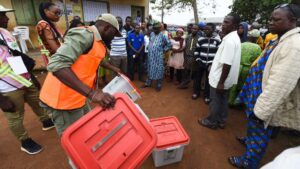
Socio-Economic Rights and Accountability Project (SERAP) has sued the National Data Protection Commission (NDPC) and the Independent National Electoral Commission (INEC) at the Federal High Court in Abuja over alleged manipulation of the preliminary Register of Voters through the use of artificial intelligence (AI)-generated photographs by some electoral officials.
Meanwhile, former Chairman of the Independent National Electoral Commission (INEC), Prof. Attahiru Jega, and Catholic Bishop of Sokoto, Matthew Kukah, have called for greater public accountability, institutional transparency and responsible political communication ahead of the 2027 general elections.
SERAP is asking the court to compel the NDPC to independently investigate suspected AI-generated photographs, alterations to personal data and unverifiable records allegedly discovered in INEC’s preliminary voters’ register.
The suit, marked FHC/ABJ/CS/2863/2026, was filed last week following INEC’s acknowledgement of questionable registration records and suspected AI-generated photographs in the preliminary register.
In the suit filed on behalf of SERAP by its lawyers, Oluwakemi Agunbiade, Kehinde Oyewumi, Andrew Nwankwo and Valentina Adegoke, the organisation is seeking an order of mandamus compelling the NDPC to obtain and examine relevant documents, records and electronic data held by INEC to establish the nature and extent of the alleged irregularities and determine whether the Nigeria Data Protection Act 2023 was violated.
It is also asking the court to compel the commission to exercise its enforcement powers, including issuing corrective orders, imposing appropriate fines and sanctions, and facilitating remedies or compensation for voters affected by any established violations.
SERAP argued that the alleged irregularities raised serious concerns about the security of Nigerians’ personal data and the reliability of the voters’ register ahead of the 2027 general elections.
INEC had reportedly undertaken to complete its verification, adjudication, and data cleanup processes before certifying the final Register of Voters on December 15, 2026.
No date has been fixed for the hearing.
JEGA and Kukah made the call at a public symposium in Abuja, jointly organised by The Kukah Centre (TKC) and the National Institute for Legislative and Democratic Studies (NILDS), with co-funding from the European Union (EU) under its Support to Democratic Governance in Nigeria (EU-SDGN) Programme.
The symposium, with the theme ‘Political Communication, Election Security and the Future of Nigerian Democracy’, brought together electoral officials, academics, political communication experts and civil society leaders to examine issues that could influence public confidence and electoral credibility in the 2027 elections.
In his message to participants, Bishop Kukah, said the future of Nigeria’s democracy would largely depend on the decisions and actions taken by citizens and political leaders in the present.
“Nigerian democracy has a future, but this future will be determined by the present,” Kukah said.
He urged Nigerians to take greater responsibility for the country’s democratic development by critically scrutinising political candidates and demanding accountability from them during electioneering.
Kukah stressed the need for citizens to ask critical questions and seek clear commitments from politicians before entrusting them with public offices.
Jega, who chaired the symposium, emphasised the critical role of effective communication by electoral management bodies in building public confidence in the electoral process.
For the former INEC chairman, timely, transparent and credible communication is essential to sustaining public trust, particularly in an electoral environment where misinformation and competing political narratives could influence perceptions of electoral institutions and their decisions.