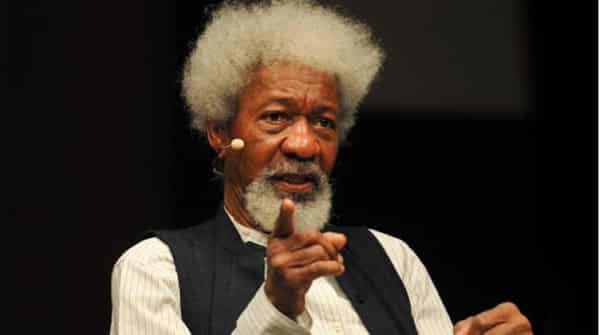
Nobel laureate, Professor Wole Soyinka, has criticised President Bola Ahmed Tinubu over Nigeria’s military involvement in the recently halted coup attempt in the Republic of Benin.
Soyinka, speaking yesterday in Lagos at the 20th Wole Soyinka Centre for Investigative Journalism (WSCIJ) Awards, warned that such actions carry implications for regional stability and Nigeria’s own security posture.
Delivering a short address, Soyinka rendered a deeply reflective speech touching on governance, human rights, security excesses, and the growing dangers of misinformation.
Soyinka expressed concern over what he described as “another unnecessary military entanglement next door”, adding that the attempted coup in Benin should be a lesson for Nigeria to strengthen democratic safeguards rather than deploy troops reflexively.
He cautioned that instability in neighbouring states always reverberates within Nigeria, stressing that authorities must act with restraint and clarity of purpose.
According to him, “What happens in Benin inevitably affects us. Instability anywhere in the region echoes across our own sense of security.”
The playwright also issued strong criticism of the widespread demolitions that have taken place across Lagos in recent months, describing the treatment of displaced residents as lacking in empathy and basic human dignity.
He recounted receiving photographs and testimonies of families rendered homeless, saying the cycle of displacement had become disturbingly routine.
Soyinka noted that while he understood the necessity of removing structurally unsafe buildings or addressing flood-prone areas, such actions must be carried out with humane evacuation procedures and proper consideration for the vulnerable.
“Let us not strip away the humanity of the people affected,” he said, stressing that development must never be implemented without compassion.
Soyinka equally described witnessing what appeared to be an excessively large security battalion assigned to a young individual close to the Presidency, an entourage he said was “sufficient to take over a small country”.
The level of force, he argued, raises troubling questions about power, privilege and the misuse of state security architecture.
“I was astonished,” he said, recalling his attempts to reach the National Security Adviser to understand why a non-office holder required such an intimidating retinue.
“Children must understand their place. They are not elected leaders, and they must not inherit the architecture of state power simply by proximity.”
Turning to the media, Soyinka praised journalists for their resilience in holding power to account but urged the profession to strengthen editorial discipline amid a climate he described as polluted by misinformation.
He warned that unchecked social media falsehoods could escalate global tensions, stating that “the next great conflict may well be triggered by the misuse of social platforms.”
He called for a renewed commitment to truth, verification and professional standards, asserting that credible journalism remains one of the nation’s strongest defences against chaos.