 Follow Us on Google News



 Follow Us on Google Discover
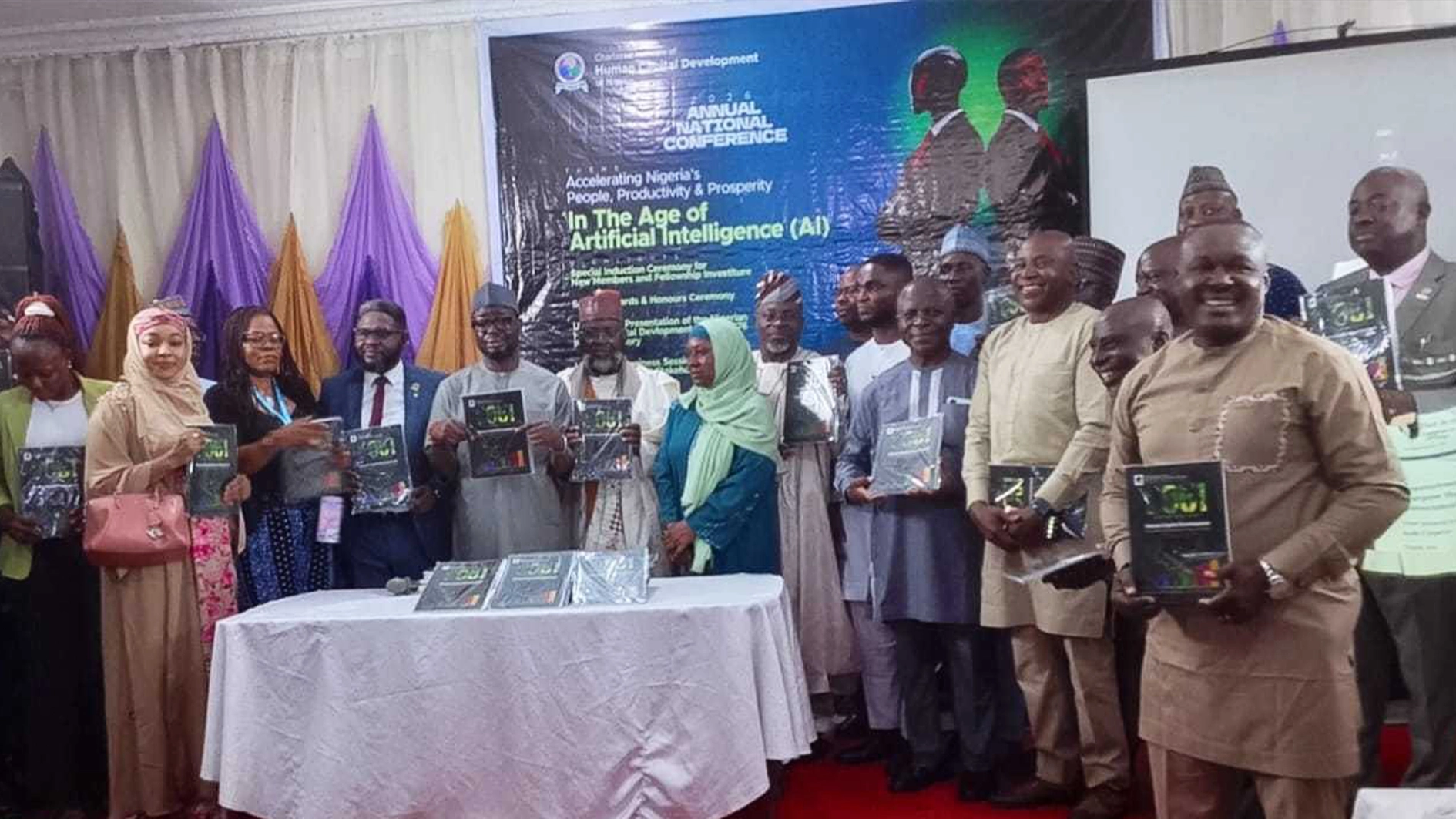
Stakeholders in human capital development have called for sustained investment in healthcare, education, skills acquisition, and early childhood development to reduce poverty and improve productivity in Nigeria.
They made the call at the 2026 Annual National Human Capital Development Conference organised by the Chartered Institute of Human Capital Development of Nigeria (CIHCDN) in Abuja on Thursday.
The conference, themed “Accelerating Nigeria’s People, Productivity and Prosperity in the Age of Artificial Intelligence (AI),” examined strategies for improving people’s capabilities and strengthening the economy.
Declaring the conference open, the Minister of Humanitarian Affairs and Poverty Reduction, Dr Bernard Doro, said human capital development was central to poverty reduction, noting that 63 per cent of Nigerians lived in multidimensional poverty, according to 2022 data.
“Currently, we’re using the 2022 data that tells us that Nigeria has 63 per cent of multidimensional poverty. So, to try and get those numbers down, the place of human capital development cannot be over-emphasised,” he said.
Doro said equipping citizens with relevant skills would improve productivity, create better livelihood opportunities and contribute to national prosperity.

He also stressed the importance of early childhood development, describing the first six years of life as critical to preparing individuals for learning and future productivity.
“Human capital development does not start when people have already grown. In fact, you start from age zero to six,” he said.
The Chairman of the Board of Trustees and Governing Council of CIHCDN, Cyril Ogboli, called for a coordinated, long-term approach to human capital development, warning that the existence of numerous government programmes did not necessarily translate into better outcomes for citizens.
He spoke during the unveiling of the Human Capital Development Policy Advisory and Implementation Framework for Nigeria 2051–2076, tagged “The Continuity Horizon”.
Ogboli said the proposed framework would strengthen policy continuity, coordinate existing interventions and ensure that investment in people produced measurable improvements in living standards.
Illustrating the gap between official statistics and actual outcomes, he cited the example of a nine-year-old girl who attends school but cannot read a simple sentence.
“The question is not, do we have enough programmes? The question is, is our people’s potential actually being converted into capability, opportunity and prosperity?” he asked.
He identified malnutrition, poor foundational learning, graduates without practical competence and skilled workers lacking the infrastructure to work effectively as obstacles to productivity and economic advancement.
The framework proposes a development pathway linking potential, health, learning, capability, opportunity, productivity and prosperity. Ogboli argued that a weakness at any stage could undermine the benefits of investment in subsequent stages.
It recommends clearly defined responsibilities for government institutions, transparent funding arrangements, independent performance assessments and periodic reviews.
It also proposes a National Human Capital Index to measure progress, with results independently verified before the index is used to rank states or guide funding decisions.
Ogboli urged policymakers to protect spending on early childhood development, nutrition, foundational learning and primary healthcare, particularly amid fiscal constraints.
He also proposed a Federal Ministry of Human Capital Development to coordinate existing programmes without taking over the responsibilities of ministries overseeing education, health, labour and other sectors.
The proposed ministry would establish shared targets, connect data, coordinate activities across states and report progress, while existing institutions retained their mandates.
Ogboli further advocated recognition of skills acquired outside formal education, including through traditional apprenticeship systems, which he said had helped build successful Nigerian businesses.
Speaking during the business session, Human Systems Engineer, Victor Prince Dickson said human capital development required a combination of intellectual ability, practical competence and strong personal values.
He described human capital as the capacity of an individual to generate positive economic and social value by solving real-world problems.
Dickson identified three essential components of a productive individual: the head, representing intelligence; the heart, representing compassion and human relationships; and the hands, representing practical competence.
He said the process should begin at birth, with primary healthcare protecting children’s development, families providing emotional stability and values, and schools building the knowledge and practical skills needed for productive lives.
He also called for educational curricula to reflect Nigeria’s long-term development priorities, warning against training students without a clear understanding of the skills the country would need in the coming decades.
On artificial intelligence, Dickson warned that technological advances could disrupt employment, making it necessary to prepare workers to adapt to changing workplace demands.
He stressed that technical training should be complemented by empathy, courage and problem-solving abilities to help Nigerians remain productive in an increasingly technology-driven economy.
The stakeholders called for stronger collaboration among government institutions, schools, employers and development partners to translate investment in people into higher productivity, improved livelihoods and sustained poverty reduction.

