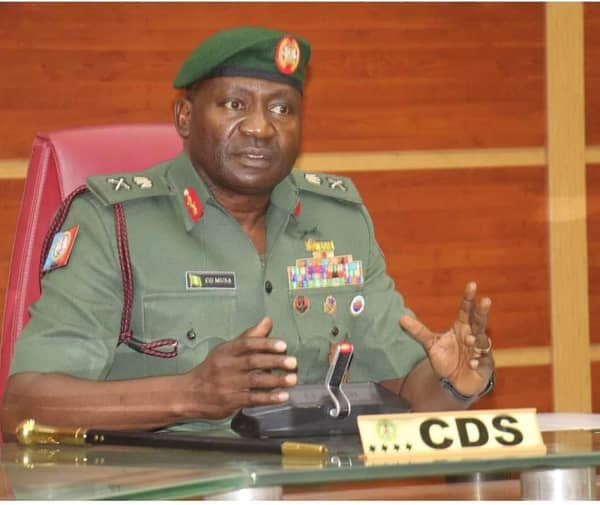
President Bola Tinubu has nominated General Christopher Gwabin Musa as the new Minister of Defence, following Monday’s resignation of Alhaji Mohammed Badaru Abubakar.
The President’s letter to Senate President Godswill Akpabio described General Musa as a seasoned and battle-tested commander whose leadership is expected to reinforce Nigeria’s defence posture at a time of mounting insecurity.
General Musa, who turns 58 on December 25, served as Chief of Defence Staff (CDS) from 2023 to October 2025.
He is widely regarded as one of the military’s most experienced operational commanders and is a recipient of the Colin Powell Award for Soldiering (2012).
Born in Sokoto in 1967, he completed his primary and secondary schooling in the state before attending the College of Advanced Studies, Zaria.
He joined the Nigerian Defence Academy (NDA) in 1986, graduated with a Bachelor of Science degree in 1991 and was commissioned as a Second Lieutenant the same year.
Over the course of his career, he has held several critical appointments, including General Staff Officer 1, Training and Operations, HQ 81 Division; Commanding Officer, 73 Battalion; Assistant Director, Operational Requirements, Department of Army Policy and Plans; and Infantry Representative on the Training Team, HQ Nigerian Army Armour Corps.
In 2019, Musa served as Deputy Chief of Staff, Training and Operations, Headquarters Infantry Centre and Corps; Commander, Sector 3, Operation Lafiya Dole; and later Commander, Sector 3 of the Multinational Joint Task Force (MNJTF) in the Lake Chad Basin.
In 2021, he was appointed Theatre Commander, Operation Hadin Kai, and subsequently Commander, Nigerian Army Infantry Corps, before his elevation to Chief of Defence Staff by President Tinubu in 2023.
Earlier on Monday, President Tinubu held a closed-door meeting at the State House with the immediate past CDS, marking the retired officer’s first public visit to the Villa since his removal from office on October 24, 2025.
Monday’s meeting with General Musa was widely viewed as part of broader consultations with key security actors, serving and retired, as the President weighs fresh strategies to reinforce counter-terrorism and anti-kidnapping operations.
Musa, who arrived at the Presidential Villa in the afternoon, was escorted into the President’s office wing by a senior security official.
Neither he nor State House aides addressed journalists after the meeting, leaving its agenda undisclosed.
The discreet engagement came at a time when Nigeria is grappling with a disturbing uptick in violent attacks across the North-West and North-Central regions.
In recent days, bandits abducted schoolgirls in Kebbi State, attacked worshippers during a religious gathering in Eruku, Kwara State, and kidnapped Catholic schoolchildren in Minna, Niger State, incidents that have heightened public anxiety and renewed calls for decisive action.
Security officials say the latest wave of violence underscores the evolving and overlapping nature of Nigeria’s threats, which now stretch from banditry and kidnapping-for-ransom to terror-linked assaults on rural communities.
The Tinubu administration has recently pursued tighter coordination among the armed forces, police and intelligence agencies in a bid to dismantle criminal networks and restore stability.
With public confidence shaken by recent events, expectations are high that the government will soon unveil strengthened measures to protect vulnerable communities and stem the surge in abductions.