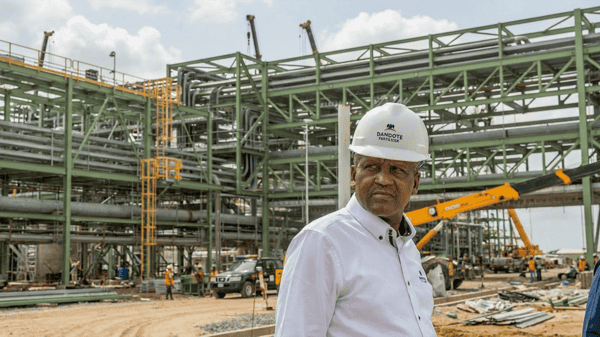
Aliko Dangote doesn’t need any introduction to Nigerians and indeed Africans. He is generally believed to be the richest man in Africa and his wealth is from entrepreneurship and investment that can be fact-checked.
He isn’t one of those the iconic Mahatma Ghandhi once classified as “sinners” who become “wealthy without work”. He has become a global citizen of Nigerian extraction. But today isn’t a day to talk about Dangote’s profile.
I am quite curious and concerned about what he has been lamenting about. I think it is important for us as informed citizens to do some contextual reporting about his business, which is supposed to be part of building Nigeria’s and indeed Africa’s brand reputation.
The question: who is afraid of Dangote’s Refinery isn’t supposed to be regarded as a provocative question in the world of local or foreign direct investments. It is supposed to be a rhetorical question about the way we are going as a nation.
The simple question seeks to shed some light on some elephants we have found in our rooms. We can reframe more questions to answer the original question here.
I understand that is the way we are: we ask more questions to answer questions – to avoid answering the original questions. Here are some of them: Should there be any reasons to be afraid of Dangote’s refinery that we are told should solve Nigeria’s lingering and age-old energy crisis? Is the Dangote’s Refinery a threat to the moribund refinery being refurbished in Port Harcourt, we were told would be ready since 2022? Is Dangote’s Refinery a boon or a bane to Nigeria? Will the powerful Nigeria’s No.1 enemies, the untouchable oil thieves in Nigeria be excited about successful production from Dangote’s Refinery?
Will the very influential scoundrels called fuel subsidy mafia members who have always seized Nigeria’s commonwealth like the promise of Dangote’s refinery? Isn’t it expedient for the almighty NNPCL to rise in protection of Dangote’s Refinery? When will the NNPCL executive management who channelled the federal government’s 20% investment in Dangote’s Refinery address the recent outcry and allegation by Aliko Dangote that the international oil companies (IOCs) had conspired to frustrate operations of his new refinery? When will the Minister of Petroleum Resources address the concerns raised by Dangote, Nigeria’s most significant investor?
Why is there some curious grave silence even in the mainstream media about the lamentation of Dangote? As the lingo goes here, is Dangote on his own? When will the Federal Government assure the anxiety and even curiosity of the international community and the foreign direct investors that Nigeria is indeed safe for Foreign Direct Investments we badly need? Who will defuse tension arising from Dangote’s travails and tell concerned Nigerians and even intending investors that investments are safe here?
Before we ask more questions about the travails of Africa’s foremost investor, let’s examine some facts to deconstruct the concerns here.
The Dangote Petroleum Refinery
In the beginning when a glimmer of hope emerged on the refinery, we were told that the $20 billion Dangote Oil Refinery is a 650,000 barrels per day (BPD) integrated refinery project under construction in the Lekki Free Zone near Lagos, Nigeria. It is expected to be Africa’s biggest oil refinery and the world’s biggest single-train facility.
We were also elated that the pipeline infrastructure at the Dangote Petroleum Refinery is the largest anywhere in the world, with 1,100 kilometres to handle 3 billion standard cubic feet of gas per day. The refinery alone has a 435MW power plant that is able to meet the total power requirement of Ibadan DisCo, for instance.
What is more, we had great expectation as we were further told that the modern refinery will meet 100% of the Nigerian requirement of all refined products and also have a surplus of each of these products for export. The facility is to produce diesel, jet fuel, Premium Motor Spirit (petrol), polypropylene, among others.
As expectations began to rise and rise, we were told in February 2024 to calm down as only government approval delayed its kick-off. Indications had emerged then that lingering regulatory approvals had stalled Dangote Petrochemical Refinery’s plan to release aviation fuel (Jet A1) and diesel for sale in the Nigerian market in January.
A week after the January 31 timeline set by the management of Africa’s largest refinery to begin sale of its petroleum product in the local market, the refinery was still battling to cross the hurdles of the several layers of regulatory approvals.
On January 12, 2024, Dangote refinery announced that it had commenced the production of diesel and aviation fuel. In a statement, Dangote thanked President Bola Tinubu for his “support, encouragement, and thoughtful advice” and said the products would be released “once regulatory approvals” were issued.
However, by February 7, 2024, the plant had yet to pump out either diesel or aviation fuel. Officials of the Nigerian Midstream and Downstream Petroleum Regulatory Authority (NMDPRA) confirmed that the refinery had yet to complete required regulatory processes.
Meanwhile, on January 15, 2024, seven major oil marketers registered with the refinery for lifting and distribution once commercial terms were finalised. Independent marketers and PETROAN also opened discussions for product supply.
Curiosity deepened on January 29, 2024, when reports emerged that the refinery was set to import crude oil from the United States, a sign of the competitiveness of American barrels. Bloomberg reported that Trafigura Group sold two million barrels of WTI Midland to the refinery for February delivery.
With the fate of the refinery clouded in uncertainty, the lingering question remains:
When will Nigeria’s leadership address Dangote’s allegations and reassure citizens and investors about the survival of the nation’s most significant industrial project?