 Follow Us on Google News
 Follow Us on Google Discover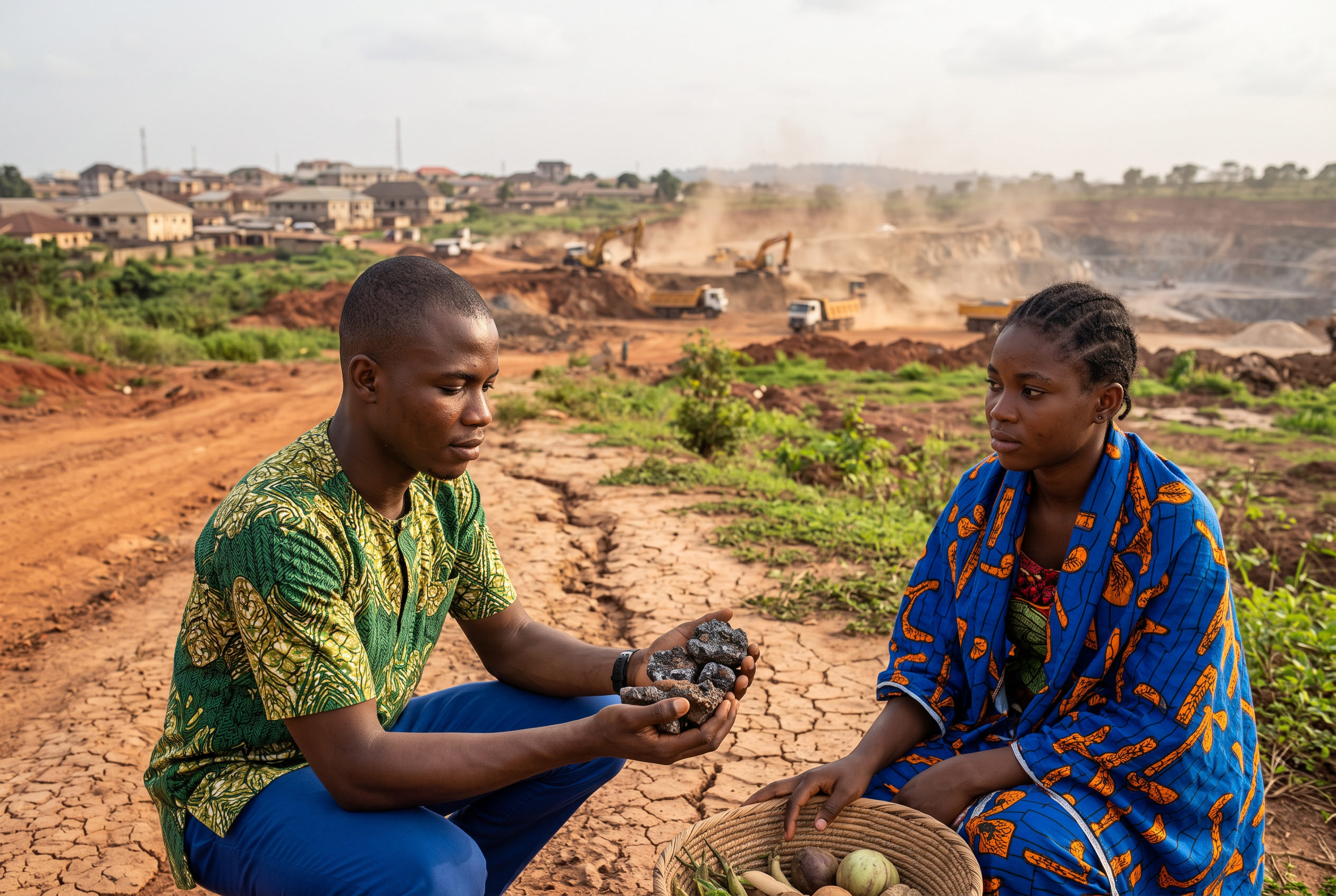
Welcome, and thank you for sitting down with me. Why is Africa rich but poor? I first heard the question from a keke driver in Onitsha, who asked it while steering around a pothole large enough to bathe in, and I have not stopped chewing on it since. This article is the conclusion of months of research and years of experience reporting on how the continent earns and spends its money, and I promise to give you numbers you can repeat at the next family gathering.
He was not asking for a lecture, of course. He wanted to know why the ground beneath his tyres held oil, gas, gold and lithium while the road on top of it held nothing but rainwater.
It is a fair question. It is also a slightly misleading one, because it treats “rich” and “poor” as two answers to the same question when they are really answers to two different ones. Rich describes what Africa owns. Poor describes what Africans earn. A family can sit on a large plot in Ikoyi and still struggle to pay school fees, and nobody would call that a contradiction. They would call it a cash flow problem.
So that is the frame I want to give you. We will look at what the continent actually holds, which country sits at the bottom of the global table and which sits at the top of the African one, who is collecting the interest on Africa’s loans, and what single problem ties all of it together. I have also built a seven-step test near the end that you can run on any country, or indeed on your own state.
Shall we?
What Africa Actually Owns: The Wealth Behind the Question
Start with the inventory, because nobody disputes it.

The United Nations Environment Programme credits Africa with about 30 per cent of the world’s mineral reserves, roughly 12 per cent of its oil and 8 per cent of its natural gas. It holds around 40 per cent of the world’s gold and as much as 90 per cent of its chromium and platinum. The Democratic Republic of Congo alone mines about 70 per cent of the planet’s cobalt, the metal inside the phone you may be reading this on. Côte d’Ivoire and Ghana together grow close to 60 per cent of the world’s cocoa.
Then there is the land and the people. The African Development Bank has long pointed out that the continent holds around 60 per cent of the world’s uncultivated arable land, and its population of roughly 1.5 billion is the youngest on earth, with a median age of about nineteen. If natural endowment alone made nations wealthy, Kinshasa would look like Zurich.
It does not, and the reason is visible in any Lagos supermarket.
Walk down the confectionery aisle and pick up an imported chocolate bar. The cocoa in it may well have left Ondo or Cross River in a jute sack, sold by the tonne. It came back wrapped in foil, priced by the gram, and the difference between those two prices was earned in Belgium or Switzerland. Rather like a tailor who sells his cloth and then rents back the suit, the continent sells the cheap end of the chain and buys the expensive end.
President Tinubu made the same point to the Africa Minerals Strategy Group in September 2024, warning in a statement carried by the Federal Ministry of Information that shipping out unprocessed minerals has kept the continent underdeveloped and that the whole value chain needs to be located at home. Whatever your politics, the arithmetic is hard to argue with.
The trade data backs him up. A senior official at the continental free trade secretariat told the Guardian that most African states send out unprocessed goods and buy back finished ones, and that trade between African countries sat below 20 per cent of the total. We do not even sell much to each other.
That is the stock. Now for the flow.
What Is the No. 1 Poorest Country, and Why Is It African?
By income per person, the poorest country in the world is South Sudan.
The International Monetary Fund’s April 2026 estimates put its output at roughly $488 per person for the year. At about ₦1,330 to the dollar, that is ₦649,000 a year, or close to ₦54,000 a month, for everything: food, rent, medicine, transport. Burundi usually sits just above it, and depending on which dataset and which month you consult, Yemen, Afghanistan, the Central African Republic, Malawi and Madagascar trade places nearby. The names shuffle. The neighbourhood does not. Most of the bottom ten are African in every ranking I checked.
Here is what makes South Sudan such a painful illustration. It is not resource-poor. It gained independence in 2011 sitting on some of the largest oil reserves in sub-Saharan Africa, and oil has supplied the overwhelming majority of government revenue ever since. But the crude has to travel through a pipeline across Sudan to reach the sea, and when war broke out next door the flow was choked. Civil conflict at home did the rest. An African Development Bank assessment reported this year put poverty at about 92 per cent of the population.
Oil in the ground. Nothing in the pocket.
A word of caution on the rankings, though (I learnt this the hard way after quoting the wrong list on radio). Income per person is an average, and averages hide a great deal. It also depends on which exchange rate is used and whether the figure is adjusted for local prices. On the adjusted measure, known as purchasing power parity, South Sudan is still last in Africa, so the conclusion holds, but the dollar figure roughly triples.
And poverty is not only a matter of small countries far away. When our own National Bureau of Statistics ran its largest ever multidimensional poverty survey, it found 133 million Nigerians, 63 per cent of the population, deprived across health, education, living standards and work. The range inside the country was startling, from 27 per cent in Ondo to 91 per cent in Sokoto. Nigeria is nowhere near the bottom of the income table, yet it houses more poor people than South Sudan has citizens, ten times over.
So “poorest” depends on whether you count dollars per head or heads without enough dollars. Both matter.
Who Owns Most of Africa’s Debt Today?
This is the section where I had to unlearn something.
Like many Nigerians, I assumed the answer was China. It is not. Start with our own books, because the Debt Management Office publishes them in admirable detail. According to its creditor-by-creditor breakdown for the end of March 2026, Nigeria owed $51.9 billion abroad. Multilateral lenders held about 46 per cent of that, with the World Bank Group alone accounting for $19.8 billion. Eurobond investors held $18.5 billion, just under 36 per cent. All bilateral lenders combined held under 13 per cent, and the two Chinese state banks, Exim Bank of China and China Development Bank, were owed about $5.5 billion between them.
China is our largest single government creditor. It is roughly a tenth of the external total.
The continental picture is similar. Analysis of World Bank debt statistics by the ONE Campaign shows that about 43 per cent of Africa’s external public debt is owed to private creditors (bondholders, commercial banks and commodity traders), around 34 per cent to multilateral institutions such as the World Bank, the IMF and the African Development Bank, and about 23 per cent to other governments. Chinese public and private lenders together hold roughly an eighth. A 2022 study by the British charity Debt Justice reached much the same split and added a detail that stuck with me: private lenders were charging African governments an average of about 5 per cent interest, against 2.7 per cent on Chinese loans.
So who owns most of it? In a word, the market. Pension funds in London and New York, asset managers, banks.
Why does the identity of the lender matter? Because of price and patience. The World Bank’s concessional window lends over decades at very low rates. Eurobond investors have recently charged Nigeria close to 10 per cent a year, in dollars, with the full principal due on a fixed date. And when things go wrong, a government can negotiate with twenty finance ministers in a room in Paris far more easily than with thousands of anonymous bondholders, as Zambia and Ghana both discovered.
The consequence is brutal in its simplicity. A recent Guardian column argued that about two thirds of African countries now spend more on servicing loans than on health or education, and that the continent’s debt problem is better understood as a development problem. Africa was due to pay around $89 billion in external debt service in 2025. Nigeria’s own 2026 budget sets aside ₦15.81 trillion for debt service, close to a quarter of all spending.
One last twist that rarely makes the headlines. Of Nigeria’s ₦166.79 trillion total public debt at the end of June 2026, about ₦91.59 trillion, or 55 per cent, was domestic. It is owed to Nigerian banks, insurers and pension fund administrators. If you have a retirement savings account, a slice of the national debt is owed to you.
Why Is Africa Rich but Poor? The Direct Answer
Here is the paragraph to keep if you keep only one.
Africa is rich but poor because it is wealthy in assets and weak in the machinery that turns assets into income. The continent owns about 30 per cent of the world’s mineral reserves, large oil and gas fields, most of the world’s spare farmland and its youngest workforce, yet it sells most of that endowment raw, so the profitable stages of refining, manufacturing, branding and shipping are captured elsewhere. What does come in is thinned further before it reaches a household: UNCTAD estimates that $88.6 billion a year slips out through illicit financial flows, external creditors (led by private bondholders, then the World Bank and IMF, then China) collect a similar amount in debt service, and governments that live on resource royalties instead of taxes face little pressure to account for the rest. Add colonial borders and railways designed to move ore to ports and not goods between neighbours, roughly 600 million people without electricity, conflict in resource zones such as eastern Congo and South Sudan, and rapid population growth that divides every gain among more people, and you have a continent whose balance sheet is strong and whose payslip is thin. The countries that have escaped the pattern, notably Botswana, Mauritius and Seychelles, did so through stable institutions and deliberate policy, not better geology.
That is the answer. Rich in stock, poor in flow, and the pipe between the two leaks at every joint.
Which Is the No. 1 Richest Country in Africa, and by What Measure?
Ask this at a bar in Abuja and you will start a fight, usually with a South African.
The truth is that there are three legitimate winners. By total output in dollars, South Africa leads in 2026 at roughly $480 billion on the IMF’s April figures, followed by Egypt at about $430 billion and Nigeria at about $377 billion. By output adjusted for local prices, Egypt edges ahead of Nigeria and South Africa drops to third. And by income per person, which is the measure that tells you how people actually live, the winner is a country of 127,000 souls in the Indian Ocean.
Seychelles. Around $17,675 per person.
It has no oil worth mentioning and no gold mines. It has beaches, fish, a well-run financial sector and a population smaller than Surulere’s. Mauritius, second on that list, built its prosperity on sugar, then textiles, then tourism and banking. Neither would feature in a geologist’s list of blessed nations, and that tells you something important about where wealth really comes from.
African Economies Compared: Total Output Versus Income per Person in 2026
| Country | Total output (nominal GDP) | Population | Output per person (dollars) | Output per person (naira, approx.) | What it shows |
|---|---|---|---|---|---|
| South Africa | $480 billion | 64.0 million | $7,503 | ₦9.98 million | Largest economy, deep inequality |
| Egypt | $430 billion | 110.1 million | $3,904 | ₦5.19 million | Large and diversified, heavily indebted |
| Nigeria | $377 billion | 242.6 million | $1,556 | ₦2.07 million | Big total, thin share per head |
| Seychelles | $2.25 billion | 0.13 million | $17,675 | ₦23.51 million | Tiny economy, highest income |
| South Sudan | $6.07 billion | 12.4 million | $488 | ₦0.65 million | Oil-rich, poorest per person |
The table shows that size and prosperity are almost unrelated: Nigeria’s economy is about 168 times larger than that of Seychelles, yet the average Seychellois commands more than eleven times the income of the average Nigerian. The naira column is my own conversion at roughly ₦1,330 to the dollar, so treat it as a guide and not a published statistic.
I keep coming back to that Nigerian row. A $377 billion economy sounds enormous until you divide it among 242 million people, at which point it becomes about ₦172,000 per person a month, before a single kobo is lost to anything. Being the giant of Africa is a statement about weight. It says nothing about fitness.
What Is Africa’s Biggest Problem Holding Back Its Wealth?
I have put this question to economists, traders in Alaba, a retired permanent secretary and my own mother. I got corruption, colonialism, bad leaders, the IMF, tribalism and “we do not love ourselves.”
All of those are real. None of them is the root.
If I must name one thing, it is weak institutions, by which I mean the dull, unglamorous systems that convert public money into public goods: a tax office that collects, an audit office that publishes, courts that enforce contracts, a power regulator that keeps the lights on, a procurement system where the lowest honest bid wins. Where those work, resources become roads. Where they do not, resources become private jets.
Akinwumi Adesina, then president of the African Development Bank, put it more sharply at this newspaper’s fortieth anniversary lecture. As the Guardian’s report of his keynote on earning global respect records, he rejected the whole idea of a resource curse and pointed to Norway, Qatar and Saudi Arabia as proof that minerals do not doom anyone. The difference, he said, is governance, transparency and accountability. He also made a remark I have never forgotten, that a politician commissioning a borehole on television is advertising government failure, because in this century every home should have piped water.
Three symptoms flow from that single cause, and you will recognise all of them.
The first is leakage. UNCTAD’s estimate of $88.6 billion a year in illicit outflows equals about 3.7 per cent of African output, and nearly half of it is tied to the export of commodities such as gold, diamonds and platinum that are under-invoiced or smuggled. In naira that is around ₦118 trillion a year, comfortably more than Nigeria’s entire external debt.
The second is darkness. The International Energy Agency counts roughly 600 million Africans without electricity. You cannot refine cobalt, mill rice at scale, run a cold chain for tomatoes from Kano or keep a server farm alive on generators. Every factory that never opened for want of power is a wage that was never paid.
The third is expensive money. Because lenders judge African governments as risky, they charge more, which makes the governments riskier, which raises the price again. Rather like a market woman borrowing from a daily contribution collector at ruinous rates because the bank will not look at her, the borrower who most needs cheap credit is the one least likely to be offered it.
Could I be wrong about the order? Possibly. A reasonable person might put conflict or history first. But notice that Botswana shared the colonial history, sat landlocked beside apartheid South Africa and still built one of the continent’s highest incomes on diamonds, because it set the rules for the revenue before the revenue arrived.
Institutions first. Everything else follows.
How to Test Whether Any African Country Is Rich or Poor
Now for something you can use. Whenever a headline announces that some country is the richest or poorest in Africa, run these seven checks before you share it. Each takes a few minutes and all the data is free.
- Find the total output in dollars from the IMF’s World Economic Outlook database, and note the month of the release, because rankings shift between the April and October editions.
- Divide that figure by the population to get output per person, then multiply by the current exchange rate (about ₦1,330 at the time of writing) so the number means something in naira.
- Look up the same figure adjusted for purchasing power, since $1,500 buys far more garri in Ibadan than bread in Johannesburg, and see whether the ranking changes.
- Check the poverty headcount from the national statistics office, and treat any country where more than 40 per cent of people are poor as poor regardless of its total output.
- Compare debt service with government revenue using the debt office’s own reports, and worry when repayments swallow more than 30 per cent of what the treasury collects.
- Examine the export list for the top three products, and if all three leave the country unprocessed, assume most of the value is being earned abroad.
- Confirm what share of households have grid electricity for at least twelve hours a day, because below about 50 per cent no serious manufacturing base can survive.
The first three steps give you the measurements and the last four give you the verdict. Nigeria, by my reading, currently fails at least three of those four.
If you are presenting this to a class, a town union meeting or a client, a few styling tips will help it land. Put total output and output per person side by side as two bar charts of identical width, perhaps 12 centimetres each on an A4 slide, so the audience sees the ranking flip in front of them. Use one strong colour for the country you are discussing (our green works nicely) and a soft grey for the rest. Keep it to five bars. Label in naira as well as dollars, in a typeface no smaller than 18 point, because the moment a Nigerian audience sees a figure in millions of naira per person the abstraction disappears. And leave white space around the poverty figure. It deserves room.
I used exactly that layout at a secondary school in Enugu last year. A girl in the second row looked at the two charts, frowned and said, “So we are big, but we are not rich.” I could not have put it better.
Final Thoughts on Why Africa Is Rich but Poor
So, back to my keke driver and his pothole.
The honest answer I owe him is that the wealth under his road is real, and so is the poverty on top of it, and the two are connected by a long chain of institutions that have not been doing their job. Africa holds close to a third of the world’s minerals and its youngest workforce. It also contains the world’s poorest country, owes private creditors more than any other class of lender, loses nearly $89 billion a year through the back door and leaves 600 million people in the dark. Its largest economy is South Africa and its richest people live in Seychelles, which should tell us that size and geology decide very little.
What decides it is conversion. Raw into refined. Royalties into roads. Loans into assets that outlast the repayment schedule.
I find that encouraging, strange as it may sound. Geology cannot be changed, but rules can, and several African countries have already shown how. Nigeria’s refinery capacity, its mining licence reforms and the growing transparency of its debt reporting are small steps in the right direction, and they are worth watching closely. None of this is destiny.
Here is where I would begin:
- Read one primary source this month, whether the Debt Management Office’s quarterly report or your state’s published budget, and note how much goes to debt service against health and education.
- Buy the processed Nigerian version whenever one exists at a fair price, from local chocolate and packaged rice to cement and refined fuel, because every purchase rewards the factory that kept the value at home.
- Ask every candidate who wants your vote two questions: what will be processed locally under your watch, and where will the accounts be published.
Related Articles
If you would like to see the same puzzle at national scale, I traced the specific assets behind our own balance sheet in why Nigeria is so wealthy on paper, from gas reserves to diaspora remittances, and why so little of it reaches the average household.
For the mirror image, my earlier piece asking whether Nigeria is a rich or poor country sets our total output against poverty, inequality and living standards, and it pairs naturally with the seven-step test above if you want to work through the Nigerian numbers yourself.
Key Takeaways
- Africa is rich in assets and poor in income because it exports raw materials, loses about $88.6 billion a year to illicit flows and pays roughly the same again in external debt service.
- South Sudan is the world’s poorest country per person, South Africa is Africa’s largest economy and Seychelles has its highest income, which shows that resources and size do not determine prosperity.
- Private creditors hold about 43 per cent of Africa’s external debt, far more than China, and the lasting fix is stronger institutions that process resources locally and publish where the money goes.
Frequently Asked Questions About Why Africa Is Rich but Poor
Why is Africa rich but poor?
Africa is rich in what it owns, including about 30 per cent of the world’s mineral reserves, but poor in what it earns, because most of that wealth leaves as raw exports, interest payments and illicit transfers. The gap is a conversion problem caused by weak institutions, thin industry and costly borrowing, not a shortage of resources.
What is the no. 1 poorest country?
South Sudan is the poorest country in the world by income per person, at about $488 a year in the IMF’s April 2026 estimates. Burundi usually ranks just above it, and most of the bottom ten are African.
Who owns most of Africa’s debt?
Private creditors, mainly international bondholders and commercial banks, hold about 43 per cent of Africa’s external public debt. Multilateral lenders such as the World Bank hold roughly 34 per cent and other governments, led by China, about 23 per cent.
What is Africa’s biggest problem?
The biggest problem is weak institutions that fail to turn resource income into power, schools, factories and jobs. Corruption, raw exports and expensive debt are all symptoms of that same conversion failure.
Which is the no. 1 richest country in Africa?
South Africa is the richest by total output, with an economy of about $480 billion in 2026. Seychelles is the richest per person at roughly $17,675 a year.
Is Nigeria richer than South Africa?
Not in 2026, when the IMF puts Nigeria’s economy at about $377 billion against South Africa’s $480 billion. Per person the gap is wider, at roughly $1,556 for a Nigerian and $7,503 for a South African.
How much does Africa lose to illicit financial flows each year?
UNCTAD estimates the loss at $88.6 billion a year, equal to about 3.7 per cent of the continent’s output. Nearly half is tied to exports of commodities such as gold, diamonds and platinum.
Does China own most of Africa’s debt?
No, Chinese lenders hold roughly an eighth of Africa’s external public debt, far less than private bondholders. China is, however, the largest single government lender to the continent and to Nigeria.
How much does Nigeria owe and to whom?
Nigeria’s external debt stood at $51.9 billion at the end of March 2026, with the World Bank Group and Eurobond investors holding nearly three quarters of it. More than half of total public debt is domestic, owed to local banks, pension funds and other investors.
Has any African country turned resources into lasting wealth?
Botswana is the usual example, having used diamond income to fund schools, roads and national savings since the 1970s. Mauritius and Seychelles grew rich with few minerals at all, through tourism, finance and manufacturing.
How many Nigerians are poor?
The National Bureau of Statistics counted 133 million Nigerians, or 63 per cent of the population, as multidimensionally poor in its 2022 survey. The share ranged from 27 per cent in Ondo to 91 per cent in Sokoto.
Can Africa stop being poor?
Yes, and countries such as Botswana, Mauritius and Morocco show that steady institutions and local processing can raise incomes within a generation. The practical priorities are reliable electricity, value added before export, cheaper borrowing and transparent public accounts.

