 Follow Us on Google News
 Follow Us on Google Discover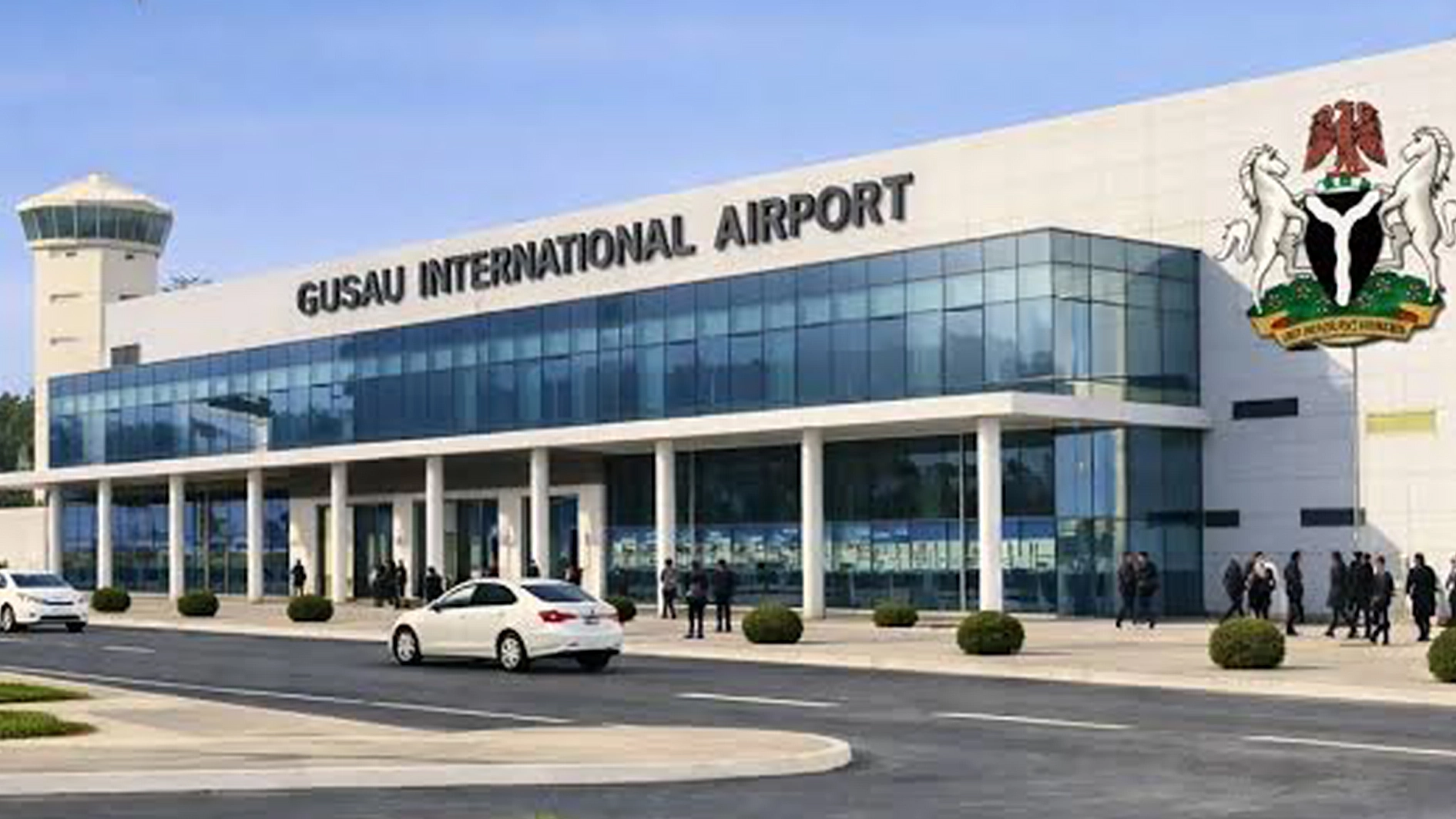
By Louis Achi
It is no longer a question of whether Zamfara State will have an international airport or not. Governor Dauda Lawal has settled that question by delivering the Gusau International Airport—a world-class facility with the standards expected of a modern international gateway. More significantly, he has done so without borrowing, turning what had long been an aspiration of a people into a reality with the huge potential to alter the economic trajectory of the state.
The more consequential question now is what Zamfara State intends to do with the opportunities the airport has unlocked. An international airport is certainly not an end in itself. Its real value lies in the economic activity it is able to attract, the markets it opens, the movement of people and goods it facilitates, and the investments it makes possible.
This presents Governor Dauda Lawal with an opportunity to think beyond the airport itself and develop a new, well-planned urban layout around the Gusau International Airport, much like the towns and commercial districts that have emerged around major airports elsewhere. Such a planned development could incorporate hotels, logistics and cargo facilities, warehouses, agro-processing industries, commercial centres, residential communities, conference and hospitality facilities, and other businesses that depend on reliable air connectivity. Properly planned, the airport can then become the anchor of a new economic district rather than simply another piece of transport infrastructure.
Governor Dauda Lawal has, in the course of delivering the airport project, demonstrated a focused approach to infrastructure development: he identified a major deficit, committed public resources to addressing it and pursued the project through to operational readiness. The ₦75 billion project was delivered without borrowing, reinforcing the administration’s stated commitment to financing major infrastructure through available public resources rather than commercial bank loans.
The contrast with the experience of Asaba International Airport is instructive. Conceived in 2008, the Delta State project took several years to complete and underwent additional works after the original construction. The original contract was reported at ₦27.7 billion, while other contemporary accounts put the total investment in the airport at more than ₦100 billion.

The comparison is not intended to diminish the achievement of Asaba Airport, but to underscore the importance of how different governments manage capital projects. For Zamfara State, the achievement is not merely having an international airport; it is an illustration of what disciplined management of public resources can accomplish when expenditure is tied to clearly defined development priorities.
On June 20, 2024, Governor Lawal, alongside the Minister of Aviation and Aerospace Development, Festus Keyamo, had performed the groundbreaking ceremony for the airport. Two years later, the project has moved from construction to commercial operations.
On Monday, September 21, 2026, the Zamfara State Government entered into an Air Route Development Partnership Agreement with XEJet Limited for scheduled commercial flights between Gusau International Airport and Nnamdi Azikiwe International Airport, Abuja. Under the agreement, XEJet is expected to operate twice-weekly flights. Operations have since commenced in October. The agreement has changed the character of the airport project. It is no longer an intention, but a reality with economic implications for the state.
The immediate question which is legitimate: why does an inland state such as Zamfara State need an international airport? The better question is what kind of economy does the state want to build and what infrastructure would that economy require?
For decades, geographical distance has imposed a significant cost on economic activity in Zamfara. From Abuja, the journey to the state by road can take more than seven hours, while travelling from Sokoto Airport by road can take almost as long, particularly because of the poor condition of sections of the road. For investors, professionals, businesses, government officials and development organisations, reaching Gusau often meant committing several hours to road travel. Insecurity has compounded the problem, making journeys not only longer but also more uncertain and costly.
The airport does not eliminate these challenges, but it removes one of the most significant barriers to doing business in the state. Faster and more predictable access can make it easier for investors to visit, businesses to operate, professionals to move in and out, and government and development agencies to maintain regular engagement with the state. The broader economic value will ultimately depend on how effectively Zamfara converts that improved access into investment, trade and new economic activity.
The value of Gusau International Airport will ultimately not be measured by the number of aircraft that land there, but by what develops around the facility. It should therefore be viewed as economic infrastructure whose commercial relevance will depend on roads, telecommunications, electricity, security, hospitality, agriculture, industry and financial services working together. And this is where the next phase of the project becomes critical.
For Zamfara, agriculture provides perhaps the clearest opportunity to demonstrate what the airport can add to the state’s economy. The state has substantial agricultural capacity, and the greater opportunity lies in building businesses around farming—processing, packaging, storage, logistics, finance, marketing and access to higher-value markets.
The airport should not be viewed as a channel for transporting bulk millet, maize or other low-value commodities that are more efficiently moved by road. Its agricultural role would be better suited to high-value and time-sensitive products, processed foods, agricultural samples, specialised inputs, seedlings and other goods where speed and reliable access can influence commercial value.
The planting of ornamental plants for export, which is a multi-billion-dollar industry, is worth pursuing.
Mining presents another major opportunity. Zamfara State’s mineral resources have attracted considerable investor attention, particularly with the emergence of lithium as a strategic mineral in the global energy and technology industries. In July 2026, Governor Dauda Lawal inaugurated the $200 million Zamfara Lithium Mining and Processing Plant in Boko, Zurmi Local Government Area, a joint investment involving ZAM Mining Company Ltd, Bima Mines Ltd, Jinlide Mining Co. Ltd and other partners. The facility represents an important shift from the extraction and movement of raw minerals towards local processing and value addition.
The Gusau International Airport can complement this emerging mining ecosystem by making it easier for investors, technical specialists, financiers and equipment suppliers to reach the state. It can also support the movement of high-value, time-sensitive mineral products, specialised mining equipment, technical personnel and business executives where air transport is commercially justified. This becomes particularly relevant as Zamfara seeks to develop processing, export and other higher-value activities around its mineral resources.
Tourism offers another avenue. Zamfara State possesses historical, cultural and religious assets that could support a growing visitor economy, but attractions alone do not create tourism businesses. Visitors need access, accommodation, security, transport and information. The state government is building a five-storey hotel in Gusau, adding to the accommodation infrastructure required for increased visitor traffic. Hotels, restaurants, conference facilities, vehicle-hire companies, tour operators, travel agencies and cultural enterprises could all benefit as more visitors come into the state for business, government engagements, religious activities, cultural events and leisure.
The Hajj and Umrah dimension is equally significant. In May 2026, Zamfara recorded its first Hajj flight from Gusau International Airport, with 415 intending pilgrims travelling directly to Saudi Arabia. The development demonstrated that the airport already has a practical role beyond its prospective commercial passenger service.
The recent regulatory milestones are significant. The Nigerian Civil Aviation Authority inspected and approved the airport’s facilities, equipment, security and safety arrangements, while its Instrument Flight Procedures passed the International Civil Aviation Organisation’s rigorous 17-step Quality Assurance process. Completing all 17 steps is a strong indication that the airport’s operational procedures have met the required technical and safety standards.
For Governor Dauda Lawal, these milestones illustrate an important dimension of his leadership. His exposure to major infrastructure and investment environments is reflected in an approach that goes beyond constructing the physical asset to ensuring that it meets the technical, regulatory and operational requirements necessary to function effectively. The 17-step ICAO Quality Assurance process is therefore significant not only as a regulatory milestone, but as evidence of the attention to detail required to take the airport from construction to credible and internationally compliant aviation operations.
For the people of Zamfara State, the airport represents more than an airport. It is an economic asset and a powerful symbol of a state opening itself to new opportunities. Every flight announced for Gusau will also put the name of Zamfara before new audiences, creating visibility for its businesses, investment opportunities and tourism potential.
The runway has acquired a deeper meaning. It symbolises a new Zamfara State—no longer waiting to take off, but already on the runway.

