 Follow Us on Google News



 Follow Us on Google Discover
By Oluwafemi Adekoya
Nigerians are very prayerful and religious people. It’s evident in the number of religious institutions and affiliations around us, as well as the competition to break records for the longest prayers or the biggest auditoriums to serve God.
But a non-Nigerian would be shocked by the kinds of prayers we say daily. If we are not praying for electricity to be restored so that our refrigerated food does not get spoilt, we’d find some people praying for provision or blessings even when there’s no work or ‘hustle’ to be blessed.
At the national level, we’ve been urged many times to pray against insecurity and terrorists, or sometimes for the naira to gain some stamina against the dollar. We pray over almost everything but ignore the part where we need to roll up our sleeves and take responsibility.
“Africans are notoriously religious,” wrote the Kenyan philosopher and theologian, John S. Mbiti. It was not an insult; it was an observation about a people whose faith saturates daily life, language, family, politics, business and even the way they greet the morning.
Nigeria embodies that description. We pray before interviews, examinations, journeys, surgeries, contracts and elections. We declare that “God will provide,” “God will protect us,” and “God will heal us.” These are not empty words. Faith gives millions of Nigerians courage in a country where institutions often fail, and uncertainty is routine.

But there is a dangerous version of faith: the belief that God should do what government, institutions, communities and individuals have the power—and duty—to do. That is not spirituality. It is abdication dressed in religious language. I remember my lecturer during my days at the University of Ibadan constantly reciting the age-old proverb that “God will not do for men what they should do for themselves” whenever we tried to renounce responsibility or pray our way out of a situation that should have been dealt with by common sense.
Even the United States, which printed “In God We Trust” on its currency, does not interpret the motto as an excuse to abandon planning, regulation, science or personal responsibility. Americans trust God, but they also build institutions, enforce laws, fund research, inspect bridges, regulate aviation and demand accountability from leaders.
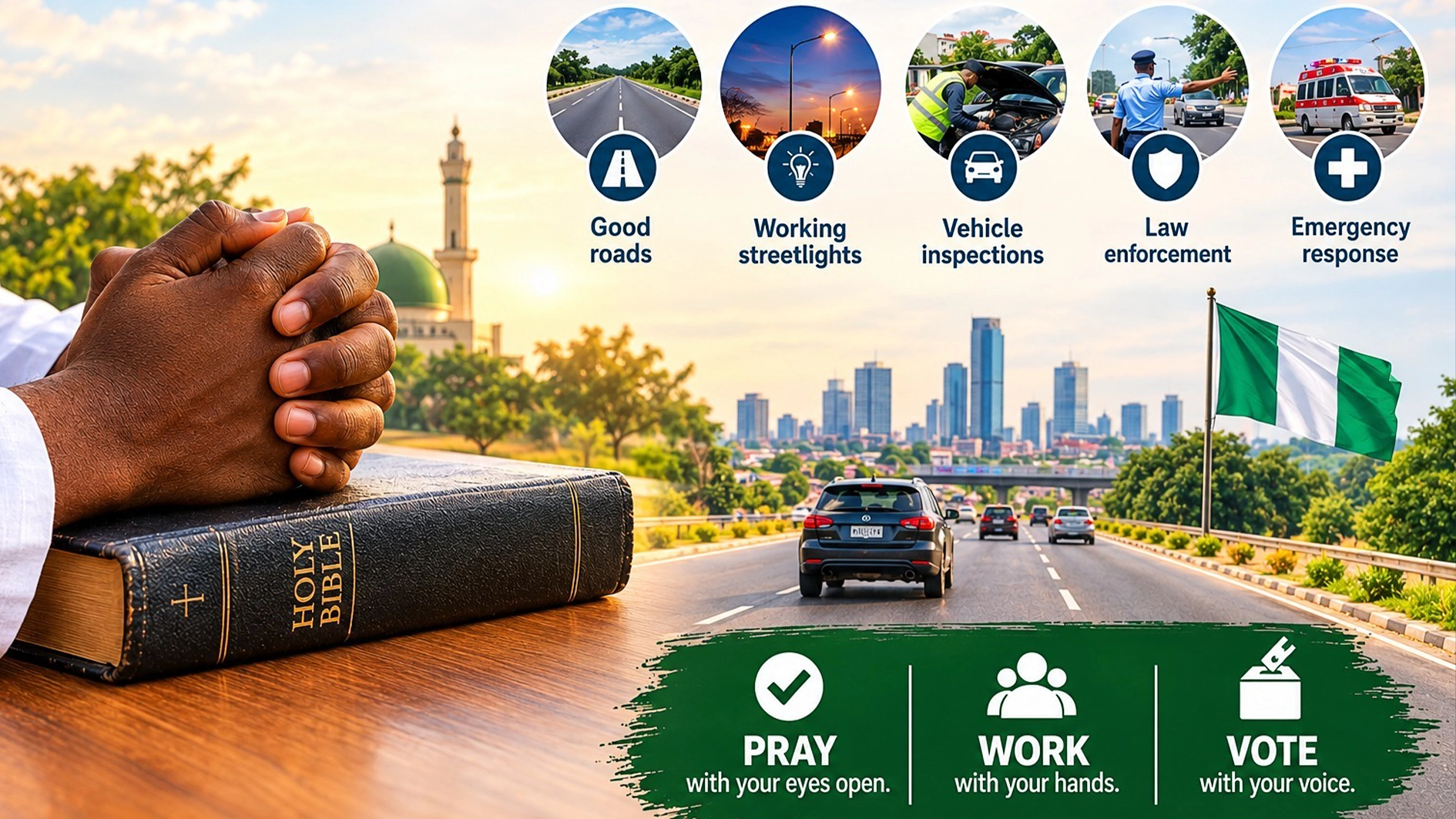
Nigeria must recover that balance. We should pray—but pray with our eyes open, our hands working and our votes counting.
A caveat: this is not an argument against God, religion, prayer or religious bodies. Nigeria’s churches, mosques and faith-based organisations provide education, healthcare, relief, moral guidance and community in ways the state often cannot. In moments of grief, sickness and insecurity, prayer is not superstition; it is human.
Mbiti’s point was that religion in Africa is not a Sunday activity. It is woven into the fabric of existence. African life, culture and belief form an integrated whole. That spiritual depth is a strength.
A people who believe that life has meaning beyond money and power should not be ashamed of it.
The problem begins when faith replaces responsibility. When a commuter prays publicly for safe roads but refuses to hold the government accountable to fix them; when a family spends its savings on “spiritual attacks” while ignoring treatable hypertension; when citizens pray against kidnapping but do not demand policing reform; when a nation prays for economic growth while celebrating corruption—then “In God we trust” becomes a national alibi.
God may be our ultimate refuge, but He is not meant to be the contractor who repairs federal roads, the doctor who supplies oxygen, the engineer who fixes the grid, or the politician who refuses to steal public funds.
So, we pray and sometimes fast before travelling. But the deeper question is this: why should a routine journey require an act of spiritual survival?
A functioning society would have well-designed roads, functioning streetlights, enforced speed limits, vehicle inspections, emergency response services and drivers who fear consequences. Prayer should accompany such a system—not substitute for it.
Imagine if we treated aviation the way we treat road transport. No one would accept an airline whose pilots skip maintenance because “God is in control.” Yet on Nigerian roads, we often normalise broken vehicles, overloaded buses, untrained drivers and unlit highways, then ask God to bridge the gap created by human negligence. This year alone, the number of accidents involving heavy-duty trucks and fuel tankers is enough to prompt a government review of the issues and a call for a national emergency.
Road safety officials and even the VIO will look past an overloaded vehicle or danfo but hound a better-looking private vehicle for papers and all sorts of certifications. Private vehicle owners are punished for missing a day to renew their papers, even when the vehicle is right in their homes, while commercial vehicles are the privileged lot who oil the local economy.
Medicine offers another revealing example. Nigerian doctors and hospitals often say, “We treat, God heals.” It is a humble and beautiful statement. It acknowledges the limits of human knowledge while affirming the omnipotence of the supreme being.
But notice the order of the sentence: we treat. Doctors diagnose. They prescribe. They operate. They monitor. They use evidence, training and technology. Only then do they leave the outcome to God.That is the proper relationship between faith and action. A diabetic patient should take insulin, follow medical advice and pray. A mother with malaria should get tested and receive appropriate treatment, not first spend days chasing a “spiritual husband” in a prayer house. A man with chest pain should reach a hospital, not wait for a prophet to interpret the pain.
Nigeria’s health challenges are not merely spiritual. They include underfunded primary healthcare, shortage of specialists, poor emergency services, counterfeit drugs, weak health insurance and the exodus of medical professionals. Prayer is powerful, but prayer cannot manufacture blood for a bleeding accident victim. Prayer cannot replace a functioning ambulance. Prayer cannot train a surgeon overnight. Palm oil cannot replace blood even though they look seemingly alike.
When we say “God will heal,” we must not mean “let us do nothing until God intervenes.” God has already given humanity knowledge, vaccines, antibiotics, surgical skills, public health systems, and the intelligence to prevent disease. Rejecting those gifts is not faith; it is negligence.
The most costly form of religious fatalism is political. Too often, Nigerians respond to bad leadership with resignation: “God will change things,” “God will expose them,” “God will provide a leader.”
God may well do all of those things. But in a democracy, God also expects citizens to register, vote, scrutinise budgets, attend town halls, support credible candidates, report corruption and refuse to sell their future for a bag of rice or a few thousand naira.
A country cannot pray and fast its way out of a bloated cost of governance. It cannot speak in tongues its way out of a corrupt procurement system. It cannot anoint its way out of insecurity if those responsible for intelligence, policing, justice and community protection are incompetent or compromised.
If we leave everything to God, we may unintentionally leave everything to those who exploit God’s name.
The American motto “In God We Trust” did not stop the United States from investing heavily in science, infrastructure, law enforcement and institutional accountability. The phrase has appeared on U.S. currency since the Civil War era and became the official motto in 1956. Yet American society generally separates spiritual trust from practical problem-solving.
When an American bridge collapses, there are investigations, engineering reviews, lawsuits, regulatory reforms and political consequences. When a drug fails, scientists demand evidence. When a public official abuses power, journalists, courts, legislators and civil society push back.
That does not make America perfect. Far from it. It has its own crises of violence, inequality and political division. But the lesson is not that Nigeria should blindly copy America. The lesson is that a society can hold religious conviction while still insisting on competence, evidence and accountability.
“In God we trust” should mean: we trust God with the outcomes we cannot control. It should not mean: we refuse to control the outcomes we can.
Nigeria is not suffering because its people pray too much. We may be suffering because we sometimes allow prayer to become an escape from difficult action.We pray for jobs, but do we build the skills, industries and policies that create them?
We pray for security, but do we support community policing, intelligence reform, justice and the protection of informants? We pray for education, but do we insist that public schools have teachers, laboratories, libraries and safe classrooms? We pray for power supply, but do we demand maintenance, investment, transparency and punishment for sabotage? Many are reeling under the Band A billing system. We pray for a better Nigeria, but do we vote as if the future depends on it?
As the Book of James says, faith without works isdead. That biblical warning applies to nations as much as individuals. A country that prays but does not plan is like a farmer who asks God for a harvest while refusing to plant seeds.
Religious leaders also carry responsibility. Pastors and imams should not only promise miracles; they should teach stewardship, civic duty, honesty and excellence. A pulpit that tells people to wait for God while ignoring bad governance can become a tool of social paralysis. A pulpit that tells people to pray and participate in building society can become a force for national renewal.
“In God we trust” is a profound phrase only when it is paired with another truth: God trusts us with responsibility. Nigeria does not need less God. It needs less excuse-making in God’s name.
We should continue to pray before every journey. But we should also insist that the road does not become a graveyard. We should pray over sickness, but we should also strengthen hospitals and respect medical evidence. We should pray for leaders, but we should also make them accountable for public trust and our commonwealth.

