 Follow Us on Google News



 Follow Us on Google Discover
By Kalu Okoronkwo
The National Agency for Food and Drug Administration and Control (NAFDAC) was established in 1993 in the aftermath of Nigeria’s devastating 1990 paracetamol syrup poisoning disaster, which was associated with at least 109 child deaths linked to diethylene glycol contamination. Its creation represented a critical institutional intervention intended to strengthen public protection against unsafe medicines and other hazardous consumer products.
More than three decades after its establishment under Decree No. 15 of 1993 and subsequent amendments, the existence of NAFDAC has not eliminated the threat of substandard and falsified medicines, adulterated foods and potentially hazardous beverages.
This contradiction raises a fundamental question that goes beyond the existence of regulatory laws or the visibility of enforcement operations. How effectively has NAFDAC translated its statutory mandate into tangible protection for human life? The persistence of unsafe products in the marketplace demands an incisive examination of regulatory oversight, enforcement capacity, institutional accountability and the gap between the promise of public protection and the realities confronting Nigerian consumers.
NAFDAC’s establishment was an important response to the need for effective regulation of medicines, foods, beverages and other products within its statutory mandate. But creating an agency, however necessary, is not the same as eliminating the problem it was designed to address. Legislation can confer authority, institutions can establish procedures, and regulators can recruit inspectors and acquire laboratory equipment. The ultimate test is whether these mechanisms consistently protect the public.
That distinction became painfully clear during the My Pikin teething medicine disaster of 2008–2009. A joint investigation involving Nigerian public-health authorities and international experts identified 57 poisoning cases, with 54 dead, among children aged between one to three years. Investigators detected diethylene glycol contamination in samples of the implicated medicine recovered from patients’ homes and in batches associated with its manufacturer. NAFDAC initiated a recall, and the manufacturing facility was shut down.

The U.S. Centers for Disease Control and Prevention (CDC) described the incident as Nigeria’s second and largest diethylene glycol-associated poisoning outbreak since 1990. The tragedy remains especially disturbing because the victims were young children whose caregivers had reason to believe they were administering medicine to relieve discomfort. The product was not merely defective merchandise; it was a substance entrusted with a therapeutic purpose that instead became associated with fatal poisoning.
In recent years, concerns about falsified medicines, unwholesome foods and unsafe beverages have continued to expose weaknesses in Nigeria’s product safety environment. Reports of enforcement operations and product seizures point to the scale of the challenge. But the discovery of unsafe products does not, by itself, establish how many people have been harmed or does it prove regulatory negligence in every case.
In Lagos, Onitsha, Port Harcourt, Aba, Kano and other commercial cities, the circulation of unwholesome products raises questions about the effectiveness of inspection, surveillance, distribution controls and the enforcement of existing standards. According to figures attributed to NAFDAC’s enforcement operations, products valued at approximately N22.73 billion were destroyed between January and August 2026.
During the same eight-month period, the agency reportedly recorded 5,542 enforcement activities, conducted 213 raids, documented 821 product-seizure entries, closed or sealed 179 premises and made 52 arrests. It also handled 474 new cases, concluded 295 cases and carried out 22 destruction exercises.
These figures suggest considerable enforcement activities, but their public health significance depends on what they reveal about the effectiveness of regulation.
How many dangerous products were intercepted before reaching the markets and to the consumers? How many investigations resulted in successful prosecutions? And how effectively were the supply chains behind the offences dismantled? Such questions are essential because the number of raids conducted or the value of goods destroyed cannot, on their own, establish that the public is safer.
The My Pikin investigation offers a sobering illustration of the limits of reactive enforcement. The CDC report found that 28 per cent of the affected children had received the implicated medicine after the recall had been announced. This finding underscores the importance of rapid public communication, effective product tracing and the timely removal of dangerous products from circulation. A recall is indispensable, but its success depends on whether the warning reaches consumers and whether the affected product can be withdrawn before further exposure occurs.
When a product itself becomes the source of danger, consumers may have little means of protecting themselves. They depend on regulators, manufacturers, distributors and retailers to ensure that what reaches the market is safe.
Consider the case of a young man who reportedly developed complications and died after taking antimalarial medication purchased from a pharmaceutical outlet. Without verified details, the cause of his death cannot responsibly be attributed to a falsified or contaminated medicine. Nevertheless, such an account raises an important question: what safeguards can consumers rely on when a product purchased for treatment may itself pose a risk?
The same concern extends beyond medicines. Imagine a family buying palm oil to prepare a favourite meal, unaware that the product may have been adulterated. Consider parents purchasing fruit for their children without knowing whether it was handled or stored safely before reaching the market. For millions of Nigerians, these concerns reflect a wider anxiety about the safety and authenticity of products consumed daily in homes, workplaces, markets and healthcare facilities.
Recent enforcement operations have brought these risks into sharper focus, including investigations into suspected illegal production and repackaging of alcoholic and energy drinks using materials bearing the names of established brands.
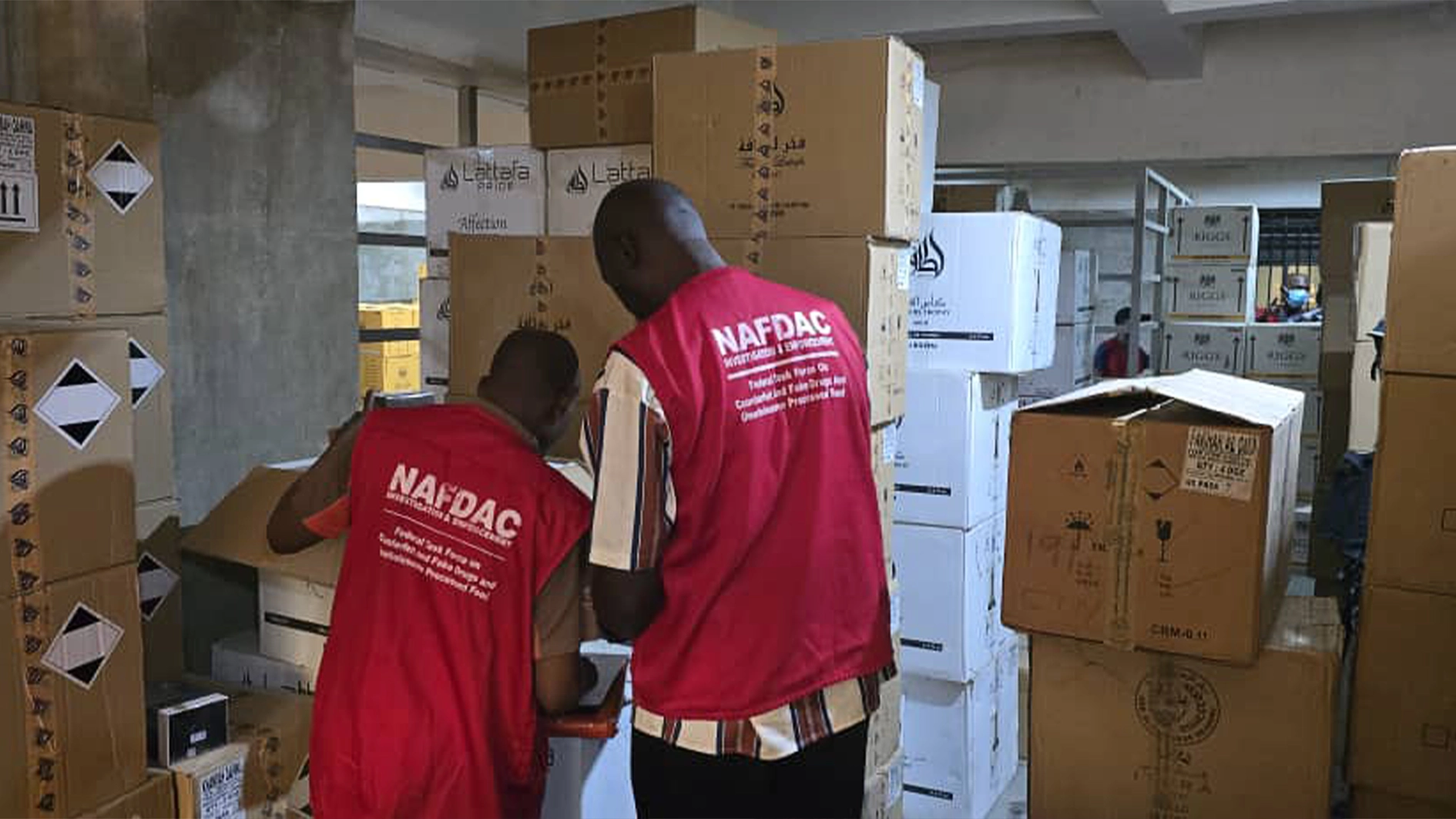
At Zamfara Plaza, within the BBA Trade Fair Complex along the Badagry Expressway in Ojo, Lagos State, NAFDAC operatives reportedly uncovered a suspected illicit production or repackaging facility housed in a two-storey building. The operation followed intelligence gathering and surveillance concerning suspected counterfeiters operating within the Trade Fair International Market.
Two suspects, identified in reports as Chibuzor Okafor and William John, were arrested. Officials reportedly recovered drums, filters, packaging materials, a heating device and other equipment suspected to have been used in the operation. According to NAFDAC, some of the suspects were caught in the act.
Speaking during the raid, the Assistant Director of the agency’s Investigation and Enforcement Directorate, Mr Kunle Ojo, expressed concern about the scale of the discovery. “What we have discovered today is a lot, and it’s mind-boggling. We are here to protect the lives of many Nigerians,” he said.
One of the most troubling aspects of the operation emerged from an explanation reportedly offered by one of the suspects. Okafor, who identified himself as a drinks dealer, told journalists that he changed the bottles in which drinks were contained. “I deal on drinks. I change the bottle of the drink. It’s not that the bottle is not good. It’s the drink in there, because the other one is already damaged. So that’s why we are putting it to the next bottle,” he said.
The account raises a fundamental question for consumers: what exactly was inside those bottles, and could buyers establish whether the contents were genuine, properly manufactured and safe to consume? The answer depends on evidence from the investigation and, where necessary, laboratory analysis. The broader concern, however, is clear: packaging can create an impression of authenticity that the contents may not justify.
In Ondo State, many families are still grieving following the loss of loved ones after drinking contaminated local brew. No fewer than 49 people died with 182 hospitalised, after consuming Monkey Tail, a very popular local brew suspected to have been caused by methanol poisoning. The incident highlights the dangers posed by unregulated alcoholic drinks in the market.
Okoronkwo is a communications strategist, a leadership and good governance advocate dedicated to impactful societal development and can be reached via:[email protected].

