
 Get Guardian on Google
By Oluwafemi Adekoya
My daily commute to and from work presents two experiences. In the morning, one can literally see the PSP operators trying to evacuate the waste along the Itire axis all the way to Apapa-Oshodi Expressway, especially at the Ilasa axis. The return journey presents a different scenario. It’s as if the waste were never evacuated. It makes one wonder if the Centre of Excellence is losing its war against waste.
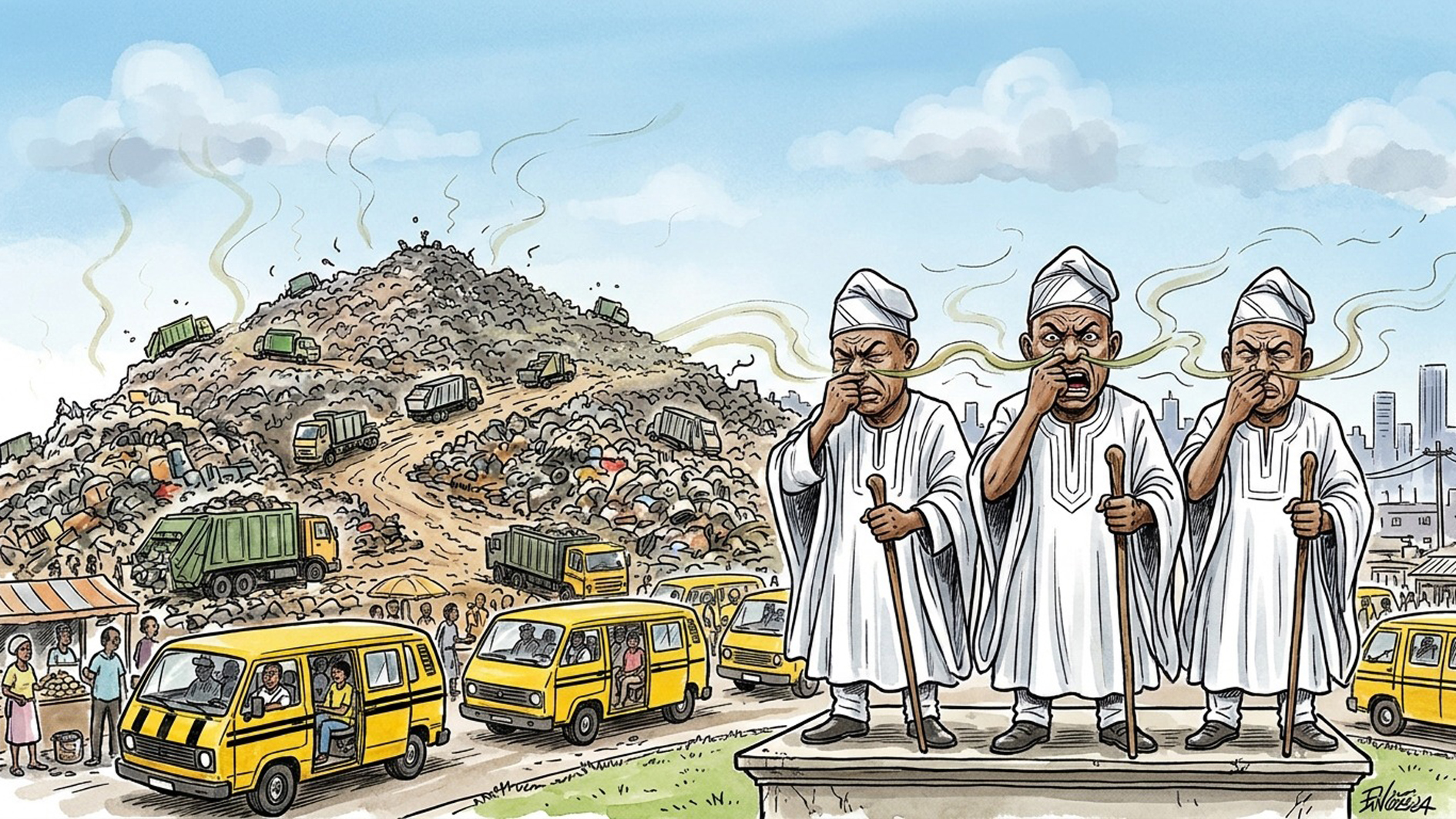
The truth is, however, glaring: Lagos risks losing control of one of the most basic functions of a modern city: keeping its streets, drains, markets and neighbourhoods free of refuse. The evidence is visible in the middle of the roads, under bridges, along canals and outside markets, where waste returns almost as quickly as it is cleared. It’s no longer a sanitation problem but an emergency that should be treated as such.
The warning signposts have done nothing to deter the bad behaviour of roadside dumping. Aside from the nuisance of Lagos louts, the waste crisis questions whether Lagos can still guarantee public health, protect its drainage system, preserve its coastal environment and maintain the confidence of residents in public institutions. A review of the recent governorship debate raised critical issues and solutions, even though the candidates agreed that the system is under strain.
The Lagos Waste Management Authority (LAWMA) claims that Lagos generates between 13,000 and 14,000 metric tonnes of waste daily, a burden intensified by dense settlement, limited land and rising consumption. The authority also launched a 60-day emergency cleanup operation to remove refuse from major highways and public spaces, while deploying night-time evacuation teams and surveillance to deter illegal dumping. But I dare to say the emergency cleanup is already overwhelmed.
The uncomfortable truth is that Lagos is increasingly reacting to waste after it has already been dumped. The state’s own environment agency has described roads, road medians, markets and motor parks as places disfigured by refuse from residents who do not patronise authorised Private Sector Participation (PSP) operators. The cycle is familiar: a black spot is cleared, residents return within hours or days, and the pile grows again.
This is what “losing control” looks like. It does not mean the state has abandoned waste management altogether. It means the system no longer reliably prevents dumping, collects waste on schedule, reaches every neighbourhood fairly, or persuades residents that compliance is worthwhile. When people see uncollected refuse, broken or absent bins, blocked drains and inconsistent enforcement, they conclude—often rationally—that dumping on the roadside is the only available option.
During the guber debate, Gbadebo Rhodes-Vivour of the African Democratic Congress described Lagos as “a state that stinks,” arguing that the deterioration in refuse collection reflects years of poor management rather than population growth alone. His most important claim was that Lagos once managed waste more effectively despite a growing population. He cited an alleged decline from about 1,000 collection trucks under former Governor Babatunde Fashola to about 200, and argued that centralisation had weakened local-government participation.
The precise figures deserve verification before they become campaign folklore. But the underlying point is valid: capacity, accountability and local presence matter. A megacity cannot manage waste from a distant command centre alone. Rhodes-Vivour’s proposal to return a greater role to local governments and require household waste separation is therefore worth taking seriously, especially because separation can make recycling economically viable and reduce the volume sent to landfills.
Deputy Governor Obafemi Hamzat and the All Progressives Congress candidate offered a different but complementary diagnosis. He argued that Lagos must move beyond collecting refuse only to dump it in landfills, because the state’s waste volume and limited land make material recovery essential. He pointed to plans for transfer stations at Olusosun and Solus III in Alimosho, a material recovery facility at Erekiti, and similar facilities planned for other locations.
Hamzat also conceded that waste management remains a challenge, citing inadequate collection trucks, reception facilities and transfer stations. That candour matters. Lagos does not need slogans about a “smart city” if residents cannot obtain a reliable bin, pay a fair fee, see a collection truck on schedule, or report a missed pickup without frustration.
Funso Doherty of the Nigeria Democratic Congress widened the debate further. He argued that waste is accumulating faster than it is being collected, and that the problem includes liquid and human waste, not only household refuse. He also raised concerns about pollution from the Olusosun dumpsite and its effects on nearby communities. This is an important corrective to a narrow conversation about plastic sachets and roadside heaps. Waste management includes drainage, faecal sludge, markets, hospitals, construction sites, waterways and the people who live beside dumpsites.
It is tempting for officials to frame the crisis primarily as a failure of resident attitude. There is truth in that. Some households and businesses evade PSP fees, refuse to use approved operators, or treat road medians as free disposal sites. LAWMA has repeatedly urged residents to patronise assigned PSP operators, pay promptly and stop using highways and road medians as dumping grounds.
But attitude is shaped by service. A resident who pays for collection but does not receive it cannot reasonably be treated as the principal offender. A trader who has no nearby bin, a tenant whose landlord has not enrolled the building, or a market woman whose waste is collected irregularly will eventually dump waste somewhere. The state cannot demand civic virtue while delivering civic failure. In my CDA, the former PSP operator was sacked for not providing service after payment. The present PSP operator is held to his contract and held accountable for its weekly operations on a group WhatsApp platform. Payment compliance has also improved when residents saw service being delivered.
Lagos has shown before that it can build systems at scale. The PSP scheme for domestic waste collection began in 1997 with pilots in Kosofe and Bariga, before being extended across the state; LAWMA took over its management in 2007. The scheme’s enduring lesson is that private operators can expand collection capacity, but only when contracts are clear, tariffs are fair, coverage is monitored and residents trust the service.
Lagos needs a five-part plan, implemented publicly and measured monthly.
Guarantee universal collection access. Every street, market, school, motor park and low-income neighbourhood should have a named PSP operator, a published collection schedule, an affordable payment option and a functioning complaint line. No resident should be asked to obey a rule the state has not made usable.
Restore neighbourhood-level accountability. Local governments, community development associations, market associations, traditional institutions, landlords and artisans should co-own local sanitation targets. LAWMA has already proposed mobilising these stakeholders to curb indiscriminate dumping; the challenge is to give them real authority, data and support rather than ceremonial roles.
Put bins where people actually generate waste. Lagos needs densely placed, regularly emptied public bins at transport hubs, markets, bus stops, pedestrian areas and commercial corridors. A bin that overflows is not waste infrastructure; it is an invitation to litter.
Separate waste at source and create markets for recyclables. Households, schools and businesses should be required and supported to separate organic waste, plastics, paper and residual waste. Buy-back centres, aggregation points and partnerships with informal waste pickers can turn separation into income rather than an additional burden. Rhodes-Vivour’s recycling proposal and Hamzat’s material-recovery agenda should be merged into one practical programme.
Enforce fairly, transparently and proportionately. Repeat commercial dumpers, construction sites and market operators should face firm sanctions. But petty offenders should first receive warnings, community-service options and access to proper disposal points. Criminalising poverty without providing alternatives will not clean Lagos; it will simply deepen resentment.
Changing public attitude requires more than radio jingles. Lagosians respond to visible fairness. When a resident sees a truck arrive on schedule, a bin emptied before it overflows, a drain cleared before the rains, and a market cleaned without favouritism, compliance becomes easier to defend.
The state should also make the cost of dumping socially visible and
enforcement must be predictable. Night surveillance and arrests may deter some offenders, but they cannot replace functioning services. LAWMA’s recent operations in Ikeja and Mosan-Okunola, including apprehensions for dumping on road medians, should be paired with clear publication of where residents can legally dispose of waste and how to enrol with PSP operators.
Lagos has the money, talent and civic energy to manage its waste. What it lacks is not ambition but consistency: a system that reaches every community, a fee structure residents regard as fair, infrastructure placed where people live and trade, and firm enforcement without being cruel.
The governorship candidates have identified parts of the answer. Rhodes-Vivour is right that decentralisation and recycling deserve a place in the solution. Hamzat is right that Lagos must invest in recovery facilities and reduce dependence on landfills. Doherty is right that the crisis extends beyond visible refuse to liquid waste, pollution and the communities living beside dumpsites.
But Lagos does not need another debate about who cares more. It needs a public compact: the government will provide accessible collection, bins, drainage protection and fair enforcement; residents, businesses and markets will pay and dispose properly.
If that bargain is not restored quickly, roadside dumping will become more than an eyesore. It will become proof that Africa’s largest city economy can build bridges and towers, yet still lose control of the refuse at its feet. Èkó ò ní bàjẹ́ o!