
 Get Guardian on Google
By Rasheed Ojikutu
Let politicians know that Nigeria is not their personal estate and that the country is bigger than any individual, political party or election.
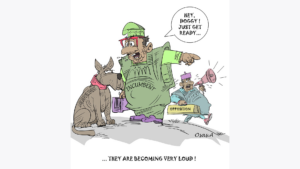
There is a dangerous habit in Nigerian politics that must stop. It is the tendency of politicians, their supporters and political associates to threaten the peace, stability and continued existence of Nigeria whenever an election approaches or the prospect of electoral defeat confronts them or their party.
We have heard it repeatedly: If this candidate loses, Nigeria will be in trouble. If our party is denied victory, the country will boil. This election will determine whether Nigeria continues to exist. If our preferred candidate does not win, there may be no Nigeria to govern.
These statements are often presented as expressions of concern for the country. Sometimes, they are defended as warnings against electoral malpractice, injustice, exclusion or political marginalisation. Yet, whatever the circumstances in which they are made, such declarations can become instruments of intimidation, deepen ethnic and religious divisions, undermine public confidence in democracy and suggest that the survival of our country depends on the fortunes of particular political personalities.
Nigeria must never be reduced to a bargaining instrument in the hands of politicians. No individual owns Nigeria. No political party is the proprietor of the Nigerian state. No ethnic group has an exclusive right to determine who governs the country. No presidential candidate, governor, senator or political godfather possesses the authority to hold the nation hostage because the outcome of an election may not favour him.
Nigeria belongs to its citizens. It belongs to the farmer in Benue who rises before dawn to cultivate the land. It belongs to the fisherman in Bayelsa who ventures onto the waters to earn a living. It belongs to the trader in Lagos who struggles to pay rent and school fees. It belongs to the civil servant in Kano, the teacher in Enugu, the engineer in Kaduna, the artisan in Aba and the young graduate in Ibadan searching desperately for employment.
It belongs to the millions of Nigerians who have never met a president, never sat at a political dinner and never received a government appointment but whose taxes, labour, sacrifices and hopes sustain the politicians and our country.
These citizens do not deserve to have their future threatened whenever politicians disagree over who should occupy the highest offices in the land. As preparations for the 2027 general elections gather momentum, Nigerian politicians must reflect seriously on the language they use, the emotions they stir and the consequences of their words.
The question is straightforward: If you are seeking political office because you love Nigeria and genuinely want to serve its people, why should your ambition become a threat to the country? If your desire is to improve the lives of Nigerians, why should the possibility of losing an election lead you or your supporters to suggest that the nation may cease to exist?
If you believe your policies are superior, why not persuade voters with evidence, a credible programme and a record of achievement? And if you believe an election has been manipulated, why not pursue lawful remedies, present verifiable evidence and demand accountability through constitutional institutions? Why threaten the country? Why should the future of more than 200 million people be placed at risk because one politician may not become president?
Keep Nigeria out of your game. Your ambition is personal, but the consequences of destroying national peace are collective. This is not a defence of electoral malpractice. It is not an endorsement of injustice. It is not an argument against legitimate protests or the right to challenge fraudulent elections. It is an appeal for political maturity, patriotism and respect for the country that gives every politician the opportunity to seek public office. Nigeria is and must remain bigger than everybody.
Politicians seem to be institutionalising a dangerous politics of national existence. Since the restoration of democratic government in 1999, Nigerians have witnessed intense electoral contests, political defections, disputed results, legal battles, ethnic mobilisation, religious rhetoric and occasional violence.
Democracy has survived many of these challenges, but the political language surrounding elections has sometimes suggested that a particular contest is more than an exercise in choosing leaders. It has been portrayed as a struggle for national survival.
There is a distinction between recognising that elections can affect national stability and deliberately suggesting that the country itself may be endangered if a particular candidate loses.
The first can be a responsible warning. The second can become a dangerous political weapon.
Elections matter. They determine who controls public resources, appoints officials, sets policy priorities and directs the affairs of government. Their consequences can be profound.
But elections are not the same as the existence of a country. Nigeria existed before the political parties competing today. It existed before many of the politicians seeking office today were born. It will, with responsible leadership and the commitment of its citizens, continue beyond the political careers of those who currently dominate public debate.
Political parties come and go. Governments change. Presidents leave office. Governors complete their tenures. Senators lose elections. Political alliances collapse. New movements emerge. The country must endure. This principle should be obvious, yet Nigerian political discourse has repeatedly blurred the distinction between the fortunes of a candidate and the survival of the Nigerian state. The danger is that when an election is presented as a battle for national existence, political competition can begin to resemble warfare.
Opponents cease to be fellow citizens with different political preferences. They become enemies who must be defeated at all costs.
Supporters begin to believe that losing is not merely disappointing but intolerable. Political actors may feel justified in using any means necessary to prevent defeat. Their followers may interpret inflammatory language as permission to intimidate opponents, attack communities or reject legitimate institutions.
Once politics reaches this point, democracy becomes vulnerable.
The winner is no longer regarded as a temporary custodian of public authority but as the victor in an existential struggle. The loser is no longer expected to accept defeat peacefully or seek lawful redress but is encouraged to believe that the entire country has been placed in jeopardy.
That is not the foundation of a stable democracy. A democratic society must allow its citizens to disagree passionately without threatening the existence of their common homeland. It must allow a candidate to lose without the country becoming a casualty.
It must allow a party to be defeated without its supporters being persuaded that violence is the only remaining option. Nigeria is a federation of diverse peoples, languages, religions and cultural traditions. Its diversity makes responsible political communication particularly important.
Leaders who understand this responsibility should be careful not to turn electoral competition into a contest between ethnic nationalities, religious communities or geographical regions. The president belongs to the entire country, not merely to the region where he enjoys his strongest support. The same principle applies to governors, legislators and other elected officials.
A political leader who wins an election must govern beyond his electoral base. A political leader who loses must remain a citizen of the same country. The country cannot be held hostage by either outcome.
Ojikutu is a Professor of Statistics (rtd), at the University of Lagos.