 Follow Us on Google News
 Follow Us on Google Discover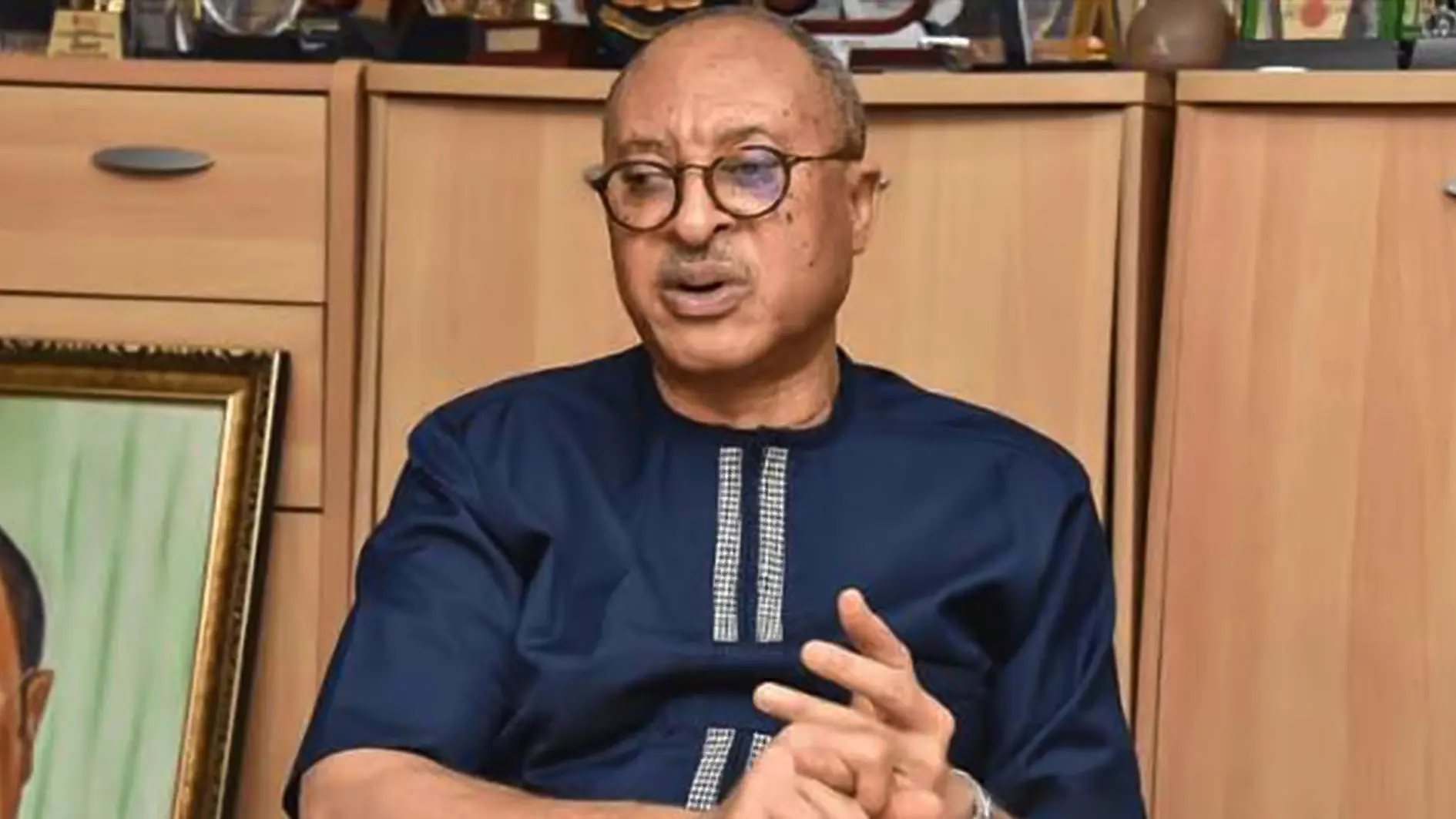
Professor Pat Utomi has warned that Nigeria is facing a dangerous combination of poverty, insecurity, institutional decline and deepening social divisions, saying the country risks a “revenge of the poor” if urgent steps are not taken to address the growing hardship.
Utomi spoke on Wednesday in Victoria Island, Lagos, at a joint briefing organised by the Movement for Credible Elections (MCE) and the Big Tent of the National Consultative Front (NCFront) on the state of the nation and preparations for credible elections in 2027.
The political economist said the condition of Nigerians had become increasingly troubling, with widespread hunger, poverty and anger becoming more pronounced.
“The state of our nation is troubling. The pain, the hunger and the anger in the land is so palpable you could slice it with a blunt knife,” he said.
Utomi cited World Bank poverty figures and an International Monetary Fund (IMF) estimate that about 35 million Nigerians were living with food insecurity, describing the situation as alarming.
He also criticised the state of the country’s infrastructure, particularly major economic corridors.

According to him, the Benin-Asaba section of the Lagos-Onitsha Highway had deteriorated to the extent that a journey which previously took about one hour and 10 minutes now takes more than three and a half hours.
“I have just returned from Delta State and the Benin-Asaba leg of the Lagos-Onitsha Highway, one of the most important economic corridors in the country, is a death trap,” he said.
Utomi also raised concerns over the persistence of insecurity, saying the probe ordered by Oyo State Governor, Seyi Makinde, could potentially expose the involvement of government elements in the deployment of terrorism and kidnapping for political purposes.
He, however, presented the allegation as a matter that the investigation could establish rather than an established fact.
The MCE and Big Tent leader said public confidence in major institutions, including the judiciary, police, Economic and Financial Crimes Commission (EFCC) and Independent National Electoral Commission (INEC), had significantly deteriorated.
“Our institutions are crumbling,” he said, adding that “most people think there is nothing independent about INEC.”
Utomi further linked the country’s economic difficulties to increasing dependence on financial assistance, saying he had personally experienced an increase in desperate appeals for help from Nigerians previously regarded as members of the hardworking middle class.
“We have become a nation of beggars because of poor policy choices by politicians who have prioritised their living in opulence over ensuring the basic needs of people can be met,” he said.
He also condemned what he described as the growing use of ethnic and religious divisions by political actors, warning that hate speech and bigotry were becoming increasingly normalised.
According to him, the level of social distrust and division in the country had reached a disturbing point, saying the situation was worse than what he recalled during previous periods of national crisis.
Utomi also criticised the reaction of government supporters to recent interventions by Catholic bishops on the country’s socio-economic conditions.
He said the bishops were merely offering feedback and urging those in power to respond to the suffering of citizens with “candor and compassion.”
He commended the Northern Christian Association for resisting what he described as attempts to create divisions among Christians over the bishops’ position.
Drawing on biblical and historical references, Utomi warned that widening inequality could ultimately threaten national stability.
He described Nigeria as increasingly resembling “a tale of two cities,” with a wealthy political class existing alongside citizens struggling with severe poverty.
“Such conditions… may see, as I do, the coming revenge of the poor that might take away the peace of all of us,” he warned.
The political economist also accused political actors of weaponising poverty through vote buying, arguing that economic desperation was making citizens vulnerable to short-term financial inducements during elections.
He referenced the recent Osun State election, claiming that 30 lives were lost, and said the development demonstrated the need for citizens to resist electoral malpractice and demand accountability from compromised institutions.
On the 2027 elections, Utomi called on INEC to comply with the Electoral Act, particularly on continuous voter registration.
He alleged that the electoral commission was disenfranchising young Nigerians by unlawfully suspending continuous voter registration, arguing that the commission could not remove 84 days from the period prescribed by law on the grounds of administrative convenience.
“Groups must go to court and people take to the streets if INEC refuses to follow the law. Impunity must end in Nigeria if Nigeria is to survive,” he said.
Utomi said the MCE and Big Tent were working towards deploying technology to strengthen electoral transparency in 2027.
He said the coalition’s objective was to achieve live streaming from polling units across the country while developing “complex redundancy” in the INEC Result Viewing (IReV) system to prevent a recurrence of the glitches experienced during the 2023 general elections.
He urged Nigerians to mobilise ahead of the 2027 elections, calling for a massive turnout as part of what he described as a new journey towards national redemption.

