 Follow Us on Google News


 Follow Us on Google Discover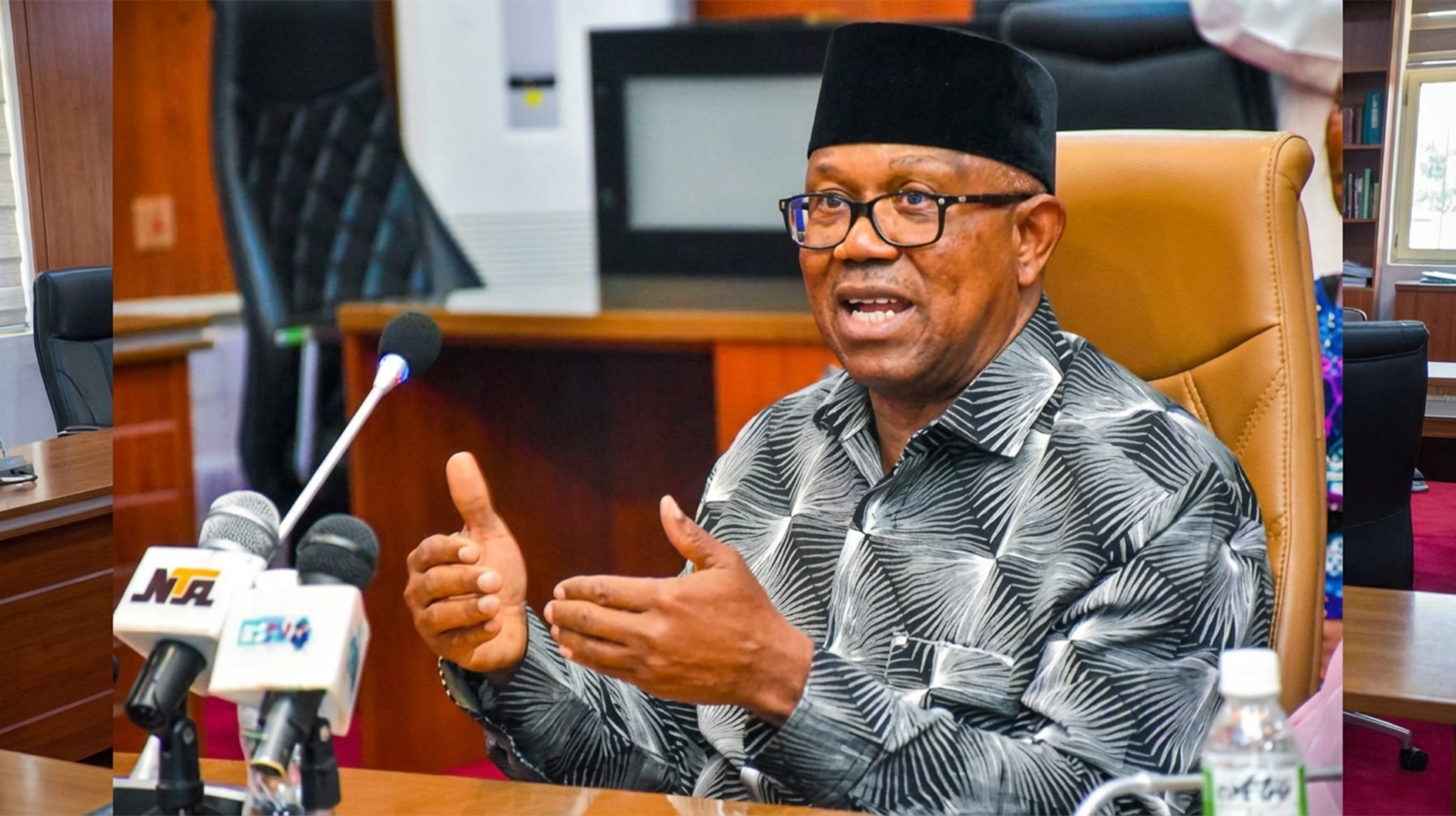
• Electoral body cites N5m fine, 12-month jail term for offenders
• Obi challenges candidates to engage voters on insecurity, poverty, jobs
• Datti: Tinubu, 2027 contenders lack capacity to transform Nigeria
• Akpabio seeks Northern youths’ support for Tinubu, economic reforms
• Duke: 27 years of democracy have failed to improve Nigerians’ lives
There were renewed concerns about the credibility and safety of the 2027 elections yesterday as the presidential candidate of the Nigeria Democratic Congress (NDC), Peter Obi, urged Nigerians to protect their votes, while the Independent National Electoral Commission (INEC) warned politicians against inflammatory rhetoric capable of provoking violence.
Obi charged the electoral umpire to resist political manipulation and ensure that Nigerians’ votes count in the polls.
He spoke in Ogugu, Olamaboro Local Government Area of Kogi State, during a thank-you tour organised to appreciate supporters following the emergence of Peter Ameh as the NDC’s Kogi East senatorial candidate.
The former Anambra State governor, who was received by a large crowd of supporters, urged INEC to conduct the 2027 elections in a free, fair and transparent manner, stressing that the will of the electorate must be respected.
He also urged Nigerians to take responsibility for protecting their votes, saying the integrity of the electoral process ultimately depends on citizens ensuring that their ballots are counted and their choices reflected in the results.

“I am not worried about what the outcome of the 2027 general election will be. What worries me is the people and how they will protect their votes on election day. The votes of the people must be counted,” Obi told journalists.
Obi, who also engaged residents and stakeholders in parts of Kogi, Benue and Enugu states, said the recurrent concerns raised by citizens showed that Nigerians were seeking fundamental improvements in governance rather than extravagant demands.
According to him, residents in Olamaboro in Kogi, Otukpa in Benue and Obollo Afor in Enugu raised similar concerns over insecurity, unemployment, poverty and inadequate access to quality healthcare and education.
He said the consistency of the grievances across communities pointed to broader national challenges that required urgent attention from government.
Obi called for an issue-based presidential campaign, challenging candidates to move beyond political rhetoric and engage Nigerians directly on the problems confronting their communities.
“When I was coming to Kogi State today, I stopped at Obollo Afor, Otukpa Junction, and asked some of our elderly people what their challenges were. This is what I want other presidential candidates to do,” he said.
He said his nationwide engagements had allowed him to hear directly from Nigerians, particularly on education, insecurity, poverty, unemployment, healthcare and food production.
Obi said the next government must prioritise getting children into school, securing communities, improving healthcare and creating opportunities for Nigerians to earn decent livelihoods.
He also decried the level of hunger and poverty in the country, saying Nigeria’s vast agricultural potential could be harnessed to improve food security if farmers received adequate support.
“Look at our rural areas with huge farmlands. Nobody is supporting the farmers in all ramifications to enable them to produce the food we need to feed the nation,” he said.
On the economy, Obi said government had a responsibility to create an enabling environment for traders and small businesses to thrive, noting that economic hardship remained a major concern among citizens.
He reaffirmed his commitment to placing security, healthcare, education and poverty alleviation at the centre of the NDC’s political agenda.
Obi urged voters to assess political candidates based on competence, capacity, character, compassion and commitment to national development rather than sentiment or party affiliation.
He also encouraged Nigerians to participate actively in the 2027 elections by voting and safeguarding their ballots to ensure that the outcome reflects the will of the electorate.
Obi said his engagements with traditional rulers, community leaders, traders and other stakeholders were aimed at rebuilding trust between government and the people.
He said his vision remained that of a Nigeria where government effectively meets the basic needs and expectations of its citizens, declaring: “A New Nigeria is POssible.”
INEC warns politicians against inflammatory campaign rhetoric ahead of 2027
INEC has warned politicians and political parties against using abusive, inflammatory or threatening language during campaigns ahead of the general elections, saying offenders risk fines or imprisonment under the Electoral Act 2026.
The commission also urged the media to expose politicians whose statements could incite violence or intimidate voters, opponents and electoral officials.
INEC’s Chief Press Secretary and Media Adviser to its Chairman, Adedayo Oketola, gave the warning in a telephone interview yesterday.
Oketola said campaign rhetoric becomes electoral intimidation when it moves beyond normal political debate to include threats, hate speech, coercion or calls for violence.
“Under the Nigerian legal framework, rhetoric becomes punishable intimidation when it incites ethnic, religious, or regional hostility through abusive, base, or slanderous language explicitly designed to provoke violent emotions or target specific groups,” he said, citing Section 96 of the Electoral Act 2026.
He also quoted the law as stating: “A political campaign or slogan shall not be tainted with abusive language directly or indirectly likely to injure religious, ethnic, tribal or sectional feelings.”
According to him, the law also prohibits the use of “abusive, intemperate, slanderous or base language, insinuations, innuendoes designed or likely to provoke violent reaction or emotions” during political campaigns.
Oketola said politicians cross the line into intimidation when they threaten voters, opponents or electoral officials with violence, physical harm, economic punishment or social exclusion because of their political choices.
He added that campaign statements capable of creating fear and discouraging people from voting, or preventing particular groups from participating in elections, could also constitute intimidation.
The INEC official said the commission was an election management body rather than a security agency, but noted that the Electoral Act assigned security agencies specific responsibilities during political rallies.
“Beyond inter-agency security coordination, INEC is statutorily empowered to monitor political campaigns and enforce compliance with the Code of Conduct for Political Parties. The Commission can issue formal queries and sanction non-compliant parties within its administrative limits,” he said.
On the penalties for offenders, Oketola said Section 96(7) of the Electoral Act provides for fines and imprisonment.
“Any candidate who commits these offences is liable upon conviction to a maximum fine of N5,000,000 or imprisonment for a term of 12 months,” he said.
He added: “A non-compliant political party is liable to a fine of N10,000,000 in the first instance, and N2,000,000 for each subsequent offence.”
Datti Baba-Ahmed says 2027 contenders lack capacity to improve Nigeria
MEANWHILE, the vice-presidential candidate of the Labour Party (LP) in the 2023 presidential election, Yusuf Datti Baba-Ahmed, has said the major contenders against President Bola Tinubu in the 2027 election lack the capacity to improve Nigeria.
Baba-Ahmed, who was Peter Obi’s running mate in 2023, made the remarks during an appearance on the MicOn Podcast on Saturday, arguing that politicians who had contributed to Nigeria’s current condition could not be relied upon to transform the country.
“I will simply advise Uncle (Tinubu) to please prepare to hand over and move away, but not to the people contesting against him,” he said.
“Because none of them will improve Nigeria. All those people contesting against him too were all in bed together at some point or another — including Peter Obi. At some point, he was in PDP.”
The former lawmaker said he was advocating a “new Nigeria”, arguing that his political record distinguished him from other leading politicians because he had never belonged to a ruling political party.
“Tell me one politician who has never been in a ruling party. I’m the one. Have I ever been in a ruling party?” he asked.
Baba-Ahmed explained that although he was previously a member of the Congress for Progressive Change (CPC), he left the party before its merger with other opposition parties that led to the formation of the All Progressives Congress (APC).
He also commented on the controversy surrounding Tinubu’s records in the United States, questioning former Vice President Atiku Abubakar’s decision to lead criticism of the President over the matter.
Baba-Ahmed queried why Atiku was “at the forefront of tormenting” Tinubu over his records, despite what he described as the former vice-president’s previous silence on the issue.
He said Tinubu had been given an opportunity to lead the country but should not seek to prolong his stay in office.
Baba-Ahmed also accused the President of weakening Nigeria’s political parties, saying his administration had contributed to the destruction of the country’s political structures.
“All he did in three years was to destroy political parties,” he said.
The former LP vice-presidential candidate added that Tinubu had “qualified himself for divine intervention”.
Akpabio urges Northern youths to back Tinubu’s re-election, reforms
HOWEVER, in support of President Bola Tinubu’s re-election, Senate President Godswill Akpabio has reached out to Northern youths, urging them to support the administration’s economic reforms and ensure policy continuity.
Akpabio appealed on Saturday while receiving a high-level delegation of the Northern Ethnic Groups Assembly in Abuja.
He said the reforms introduced by the Tinubu administration, including the removal of fuel subsidy and foreign exchange reforms, were painful but necessary measures to reposition the economy.
According to him, the policies had crossed a critical threshold and were beginning to produce tangible benefits for Nigerians.
“I stand before you not merely as a politician, but as a public servant committed to the prosperity of our nation, and particularly this vital region,” Akpabio told the youth leaders.
“The reforms initiated by President Tinubu are not abstract theories; they are concrete, courageous actions designed to dismantle long-standing structural bottlenecks and unlock Nigeria’s vast potential.”
The Senate President said the removal of fuel subsidy and efforts to stabilise the foreign exchange market were necessary to achieve fiscal sustainability.
He acknowledged that “while these measures initially posed challenges, they were the surgical procedures needed to redirect resources into healthcare, education, and infrastructure.”
Akpabio also claimed that the reforms were producing early positive indicators, including improved revenue collection, increased investor confidence and renewed interest from international partners.
He urged Northern youths to become active participants in governance rather than wait for the future before taking responsibility.
Nigerians better off under military rule, says Donald Duke
FORMER Cross River State governor and presidential candidate of the Peoples Redemption Party (PRP), Donald Duke, has said Nigerians were better off under military rule, arguing that 27 years of civilian administration have failed to deliver meaningful improvements in the lives of citizens.
Duke made the remarks during an interview in Abuja yesterday, where he questioned the cost of governance under the current democratic system and whether it had yielded sufficient dividends for Nigerians.
“The people today, I would tell you, were better off under the military,” he said. “At least governance was not that expensive.”
The former governor said Nigeria’s democracy should be assessed primarily by its impact on citizens’ welfare rather than the existence of democratic institutions.
According to him, many of the challenges confronting the country before the return to civilian rule in 1999 remain unresolved, while some have worsened.
“I’m speaking broadly now. If we focus on the well-being of the people, what we term democracy dividends, how much has been delivered?” he asked.
“We’re still having the same problems we had 27 years ago. It’s getting worse. The number of children out of school has not improved; it’s deteriorating. The healthcare system is not improving; it’s deteriorating.
“Infrastructure deficiency over the last 27 years—are we better off? The question is: are we better off today than we were in 1999? Hardly so. Hardly so.”
Duke identified electricity, unemployment and infrastructure as some of the longstanding challenges that successive civilian administrations had failed to adequately address.
“The problems that existed before 1999—electrification, unemployment—those things are still there. And I don’t see a structured approach towards dealing with these issues,” he said.
He also expressed concern about the value of citizens’ votes, saying the perceived inability of voters to influence governance had encouraged politicians to disregard the needs of the electorate.
“Because your vote doesn’t matter, there’s a tendency to take people for a ride and disregard what is required by the people,” Duke said.

