 Get Guardian on Google
• Jonathan: Why I conceded defeat to Buhari without resistance
• Buhari foresaw Sahel security crisis, opposed foreign intervention, Issoufou says
• Dangote, Rabiu, Nasarawa, Borno, donate N800m to Buhari’s biography, legacy project
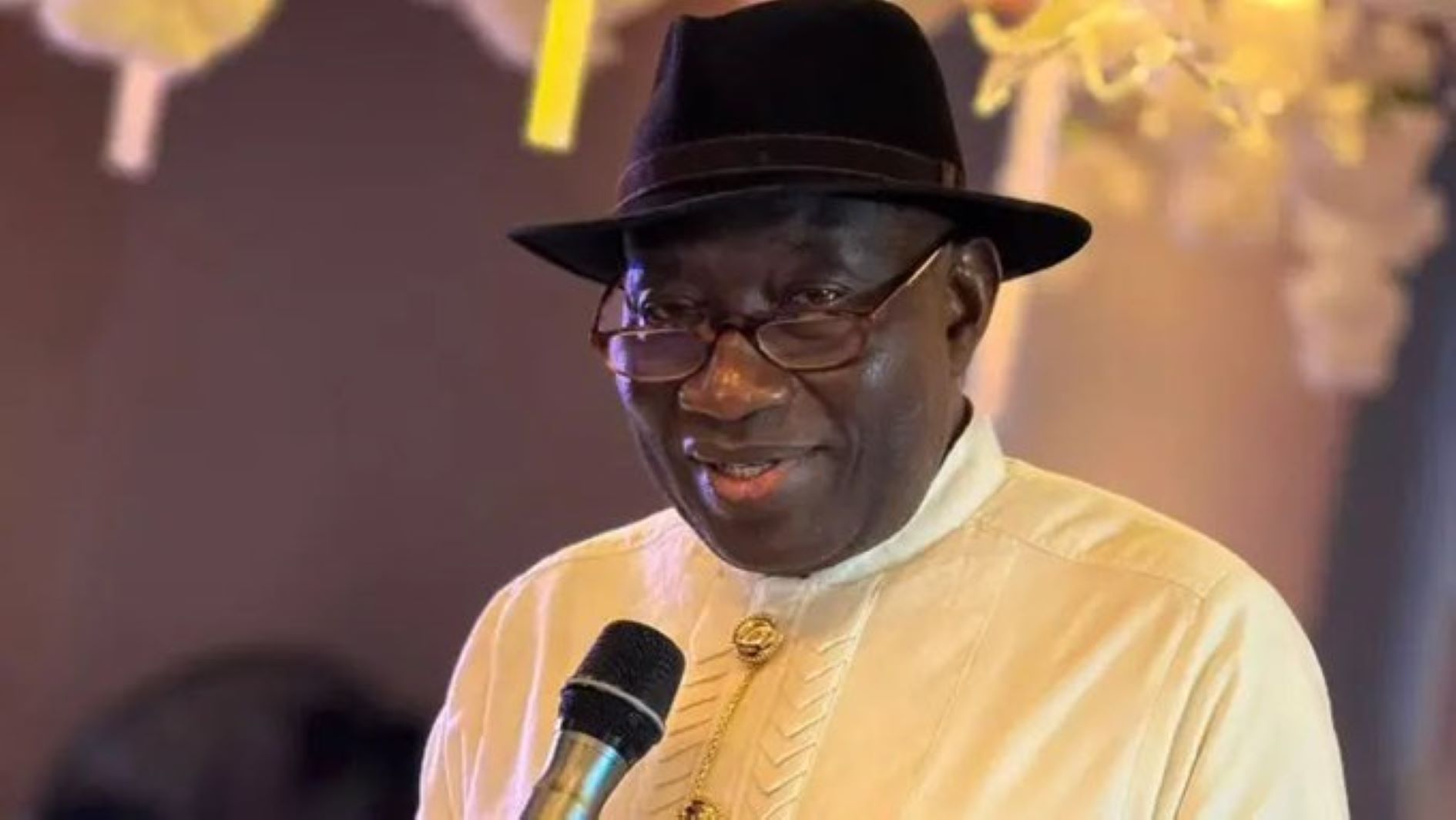
Barely 12 years after the historic concession call by former President Goodluck Jonathan to his challenger, the late President Muhammadu Buhari, to congratulate him on his hard-fought victory while results were being collated, Jonathan yesterday disclosed that his decision to concede defeat and hand over power to Buhari in the 2015 presidential election without resistance was informed by his belief that his successor was a statesman who genuinely loved Nigeria.
Jonathan disclosed this through a former Senate President, Anyim Pius Anyim, who represented him at the public presentation of Muhammadu Buhari: The Authorised Presidential Biography, in Abuja on Thursday. The three-volume biography, written by Dr Udu Yakubu, was presented at an event attended by several political leaders and prominent Nigerians.
Speaking on Jonathan’s behalf, Anyim said the former president contacted him about two hours before the event to inform him that he would be unable to attend. He added that Jonathan had cleared his other engagements to ensure he was properly represented.
Anyim said many Nigerians continued to ask why Jonathan accepted Buhari’s victory without contesting the outcome even in court, recalling that Buhari was widely recognised as the politician who defeated an incumbent president, while Jonathan earned a reputation as the African leader who peacefully relinquished power without controversy.
“It was easy for President Jonathan to say, ‘Look, this is a statesman that I know will love Nigeria.’ So there was no need for any form of contention. That is the story,” Anyim said, adding that Jonathan’s acceptance of the 2015 election results underscored the need to place national interest above party politics.
Anyim further recounted that prior to Jonathan accepting defeat in the 2015 presidential election to avert a political crisis and place Nigeria’s unity and stability above his personal ambition,
Jonathan had facilitated the provision of bulletproof vehicles for Buhari following a bomb attack on his convoy in Kaduna during the 2015 election campaign, despite the two leaders being presidential rivals. He said he informed Jonathan about the incident, prompting the former president to direct that a memorandum be prepared for the procurement of bulletproof vehicles to protect governors and other important public office holders.
“He called me and asked whether I had heard about the bomb incident involving General Buhari’s convoy. He directed that I should bring a memo because we had to buy bulletproof vehicles for governors so that a former Head of State would not die from any form of violent attack,” Anyim recalled.
He described the relationship between Buhari and Jonathan as an important chapter in Nigeria’s political history, demonstrating that political differences should not override national interests. Anyim also recalled that Buhari had used his residence in Abuja as his first campaign office during the period leading up to the 2015 election.
THIS is as Vice President Kashim Shettima and former President of Niger Republic, Mahamadou Issoufou, have reflected on the legacy of the late former Nigerian leader, Muhammadu Buhari, describing his life and political career as an important chapter in Nigeria’s history that offers enduring lessons on leadership, character and public accountability.
While Shettima said Buhari demonstrated that the true measure of leadership lies in personal character rather than the power and privileges of public office, Issoufou urged Nigerians to assess the former President’s legacy objectively, considering his achievements, decisions and controversies.
Shettima, who was represented by the Special Adviser to the President on General Duties, Office of the Vice President, Dr Aliyu Modibbo, said Buhari’s modest lifestyle, personal discipline and devotion to national service distinguished him from many political leaders.
Speaking on the theme, “The Life We Leave to History”, the Vice President recalled lessons from his personal relationship with the late President, particularly his indifference to material possessions and commitment to Nigeria.
“He taught me that the dignity of office depends upon the character of its occupant. He also taught me that a leader’s example continues to speak long after he is out of service,” Shettima said.
He described Buhari’s Spartan lifestyle as remarkable in a political environment where public office is sometimes pursued to satisfy private interests.
Shettima noted that Buhari’s political journey, spanning military leadership and democratic governance, attracted both extraordinary public affection and strong criticism over his policies and decisions. He, however, said the former President’s enduring connection with millions of Nigerians reflected a distinctive leadership disposition that defied conventional political calculations.
Beyond the tribute, the Vice President described the biography as an important contribution to historical documentation, institutional memory and public accountability.
Shettima commended Buhari for authorising the biographical project during his lifetime and participating in the research, noting that his recollections, alongside interviews and documentary evidence, would enrich the historical record.
He added that the 2015 victory demonstrated the importance of political alliances and support beyond a candidate’s traditional regional base. “It was only by extending a handshake across the Niger and forging a national coalition that we were able to win the presidential election in 2015,” Shettima said.
IN his remarks, Issoufou, who chaired the occasion, said the publication provided an opportunity to move beyond mourning and subject Buhari’s life and leadership to objective historical reflection.
He described the three-volume work as a significant contribution to Nigeria’s historical record, particularly for younger generations who did not have personal encounters with the former President.
“Today, in presenting these volumes, we move from mourning to historical reflection. Mourning belongs first to the family, friends and contemporaries. History belongs to everyone, including generations that never knew the man,” he said.
Issoufou cautioned against presenting Buhari’s legacy in absolute terms, insisting that a fair historical assessment must accommodate both his accomplishments and shortcomings. “None of us can claim to have the final word on Muhammadu Buhari. Nor should any biography pretend to do so,” he added.
Issoufou also disclosed that late Buhari foresaw the dangers of foreign military interventions in the Sahel, warning that some foreign forces deployed to combat terrorism could worsen the security crisis they were meant to contain. Issoufou said Buhari had expressed strong reservations about foreign military operations in Libya and the Sahel, describing some foreign actors as “armed missionaries” whose interventions risked spreading conflicts across the region.
Issoufou said Buhari believed that foreign military interventions, particularly those following the crisis in Libya, risked aggravating insecurity across the Sahel and the Lake Chad Basin. “What stayed with me was that Buhari disliked what he called ‘armed missionaries’ who, in his view, after setting Libya on fire, could only fan the embers in the Sahel and the Lake Chad Basin,” he said.
He advocated stronger regional security cooperation through an expanded Nouakchott Process, with Algeria and Nigeria playing pivotal roles. According to him, the crisis of confidence among countries in the region had weakened cooperation and given terrorists a strategic advantage.
Reflecting on his relationship with Buhari, Issoufou described him as a personal friend and African statesman, adding that historical, cultural and geographical ties made Nigerians and Nigeriens almost compatriots. He recalled that Buhari visited Niger on June 3, 2015, less than a week after his inauguration, accompanied by governors from Kebbi, Sokoto, Katsina, Yobe and Borno states.
He also highlighted Buhari’s commitment to regional integration, citing his decision to extend the railway from Kano to Maradi in Niger Republic without requesting financial contributions from the neighbouring country. On security, Issoufou said both leaders recognised in 2015 that the security of Nigeria and Niger was interdependent and supported regional efforts, including the Multinational Joint Task Force, against Boko Haram.
Issoufou further praised Buhari’s commitment to constitutional order, peaceful transfer of power and consultation, describing him as a leader who preferred careful reflection to flamboyant rhetoric. He recalled their differences over the proposed single West African currency and Buhari’s decision to delay Nigeria’s signing of the African Continental Free Trade Area agreement in 2018 before eventually signing it in July 2019.
Earlier, the author, Dr Udu Yakubu, said the three-volume biography was the culmination of more than two and a half years of research, interviews and documentation.
He acknowledged Buhari’s cooperation throughout the process, noting that the former President granted him access to relevant information without compromising his independence as a researcher.
“He gave the work the legitimacy of access without taking away my independence of judgement. I regret that he did not live to see these works completed, but the record now carries his voice,” Yakubu said.
REVIEWING the first volume, “Buhari: The Phenomenon”, Ambassador Dr Chijioke Wigwe described it as an authoritative account of the former President’s life, containing some of his final substantial recorded reflections.
He traced Buhari’s journey from his upbringing in Daura, Katsina State, through his military career and appointment as Federal Commissioner for Petroleum Resources to his emergence as Head of State and eventual return to farming after leaving office.
Wigwe observed that Buhari’s firm and uncompromising disposition shaped his leadership and influenced the circumstances surrounding his removal from power. He said the biography offered an opportunity to examine Buhari’s character and place in Nigeria’s history without sentiment or prejudice.
Also reviewing the second and third volumes, The Presidency and The Reckoning, Ambassador Professor Tijjani Muhammad-Bande identified institutional discipline, accountability and national unity as defining features of Buhari’s leadership.
He recalled the former President’s insistence that public funds spent on government projects must translate into tangible results, as well as his respect for institutional procedures and the constitutional tenure of public officeholders.
Muhammad-Bande further described Buhari as a committed believer in Nigeria’s unity who opposed violent attempts to undermine the country’s territorial integrity.
He said Buhari recognised the constitutional right to peaceful protest but maintained a firm position against taking up arms against the Nigerian state, regarding national unity as a responsibility that transcended ethnic, religious and political divisions.
The three-volume biography examines Buhari’s personal background, military career, political journey and eight-year presidency, providing a historical account of a leader whose legacy continues to attract debate across Nigeria.
Adamu explained that proceeds from the presentation would support research, documentation, archival preservation and public education, including efforts to establish a Muhammadu Buhari Centre for preserving and studying the former president’s life and public service. Buhari died on July 13, 2025, and was buried in his hometown of Daura, Katsina State, two days later.