The sack-me-I-sack-you exchanges between the Ibadan national convention-minted national chairman of the Peoples Democratic Party (PDP) and the Abdurahman Muhammed-led Caretaker Committee of the party effectively heighten the travails of the party, thereby presenting itself as the first trial for the Professor Joash Amupitan-led Independent National Electoral Commission (INEC), LEO SOBECHI reports.
The first time Nigerians witnessed a similar political tussle currently roiling the main opposition Peoples Democratic Party (PDP) was in the post-First Republic experience between Gregory Godwin Dabo Adzuana and Joseph Sarwuan Tarka.
Tarka, one of the founding members of the United Middle Belt Forum, was the Minister for Transport in the military administration of General Yakubu Gowon. His kinsman and former ally, Dabo, being privy to some under-the-table deals, started getting under his (Tarka’s) skin through allegations of corruption, which finally cut short Tarka’s stay in office.
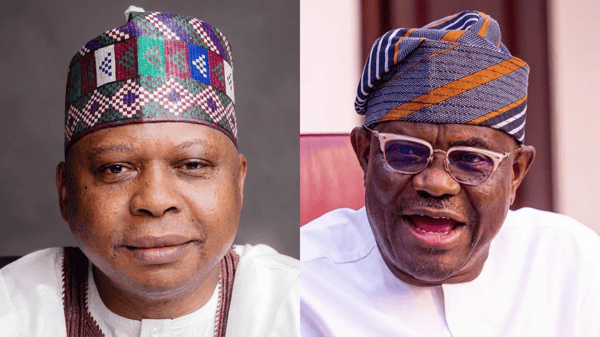
That epic political spat, which gave rise to the cliché ‘if you Tarka me, I Dabo you,’ achieved a parallel recently when senior lawyer Kabiru Tanimu Turaki (KTT) and the current Minister of the Federal Capital Territory (FCT), Nyesom Ezenwo Wike, shredded the embattled PDP into factions.
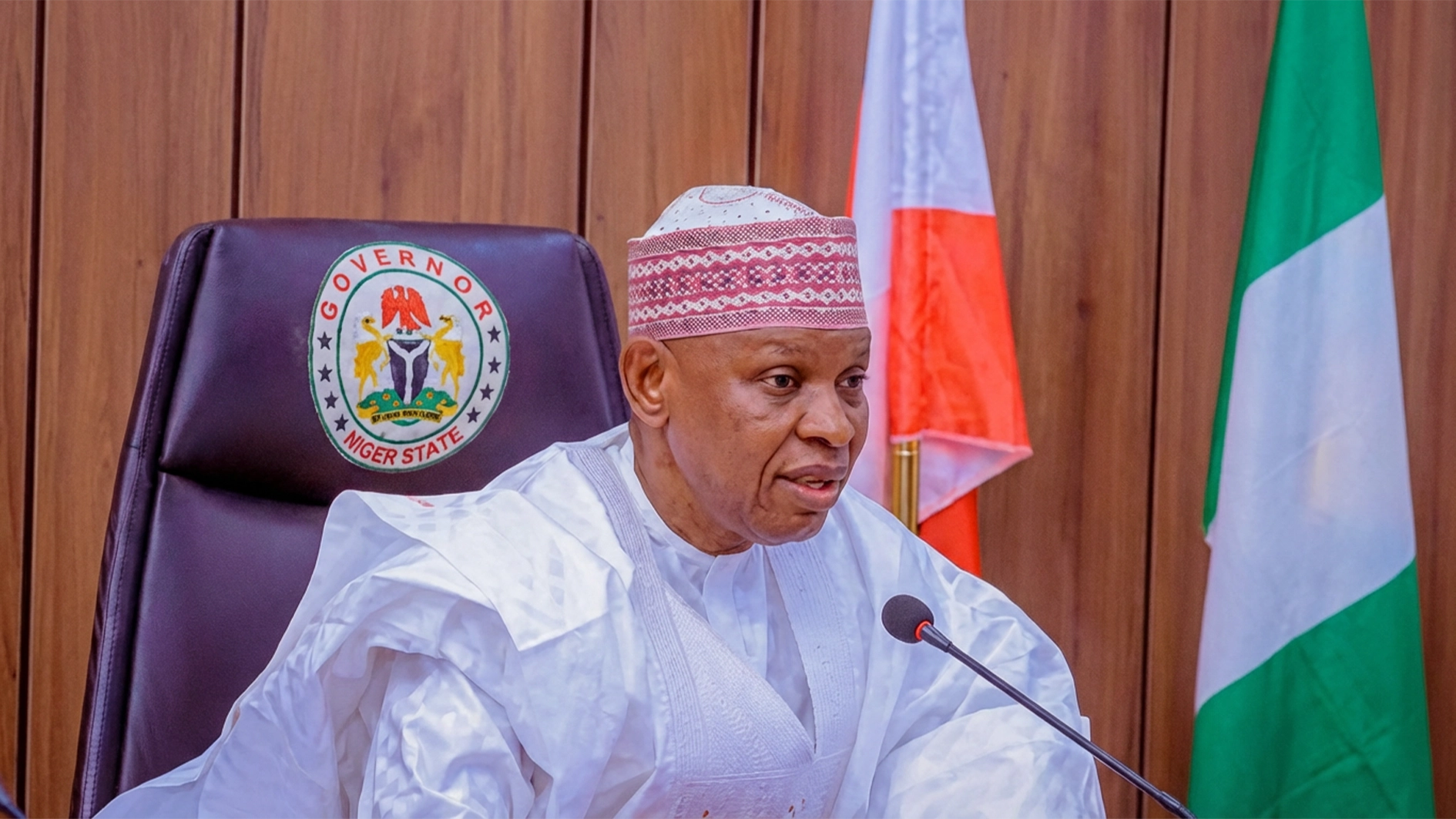
But while the Tarka versus Dabo tangle revolved around a mix of politics and morality, the ongoing dispute between KTT and Wike runs deeply into power gamesmanship, relevance and influence. Wike, though belonging to the All Progressives Congress (APC) Federal Executive Council, courtesy of President Bola Ahmed Tinubu’s political magnanimity, insists that as long as he remains a member of the PDP, he must continue to call the shots, especially by dictating who gets what or does what within the party’s structure.
Put simply, the point of departure pertains to how to deploy the PDP for the clashing ambitions and egos of the protagonists: Wike wants the party to have a life of its own, but not a mind of its own as regards the 2027 presidential race; the Turaki-led National Working Committee (NWC) insists that the party should remain in contention for a rebound to the pinnacle of national politics and governance.
At the middle of this seemingly intriguing complexity and web of conspiracies sits the new INEC chairman, Professor Joash Amupitan. So far, Amupitan, a law teacher, has shown that he is better heeled than his predecessor, Prof Mahmood Yakubu.
Although some tendencies within the embattled PDP believe that Amupitan was merely displaying the optics of impartiality, the conduct of the recent Ekiti State gubernatorial straw poll clearly showed that the new INEC helmsman is not disposed to reading the body language of the Presidency or second-guessing the disposition and intentions of the rules.
Having made his stance clear that elections must be won and lost on the dictates of the electorate, Amupitan’s unapologetic indifference to the nuances of politics seems to convince the two contending forces for the soul of the PDP that he can only be dictated to by the pronouncements of the courts of the land.
PDP stakeholders on both fronts told The Guardian that, despite the claims by the Convention and Caretaker camps, the contending issues would ultimately be determined by the Supreme Court, the court of last instance.
The question, which only time will tell, is whether the apex court ruling, whenever it comes, would affirm the non-justiciability of political party leadership issues or call for a return to an interim organ, possibly the Senator Makarfi Caretaker Committee that resolved a similar division in 2017.
As things stand, virtually all the prominent members of the party are dissatisfied with what the PDP has become, even as some reserve their comments, maintaining that rather than blaming any extraneous influence on the PDP leadership saga, the vaulting ambitions and egos of certain leaders are to blame.
For instance, speaking shortly after the 104th National Executive Committee (NEC) meeting of the Wike wing, the FCT Minister declared: “We won’t allow visitors to destroy a party they did not build.” There was no doubt that Wike was alluding to the troika of Governors Seyi Makinde and Bala Mohammed, who crossed over to the PDP from the Social Democratic Party (SDP) and the All Nigeria Peoples Party (ANPP), respectively.
The FCT Minister railed against the arrowheads of the Ibadan Convention that threw up the Turaki-led NWC, agonising: “You went to a State High Court to sue INEC, asking that your convention must hold.
“You even got an exparte order to override judgments of the Federal High Court. How do you disobey two final judgments and still claim leadership? You held a convention against court orders, and now you are back asking a Federal High Court to recognise you. If INEC already recognises you, what exactly are you going to court for?”
But as the FCT Minister hinged his complaint against the Turaki-led NWC on alleged breaches of court orders, it was obvious that the decision by the Ibadan convention camp to expel him from the party at a time when his chokehold on the Rivers State political structure was crumbling hit him hard.
Yet, by propelling the establishment of a Caretaker Committee led by former leaders of his own faction, namely Abdurahman Mohammed and Senator Samuel Nnaemeka Anyanwu, Wike unwittingly consolidated factionalisation instead of laying the groundwork for inclusivity and the unmitigated healing of the rift.
Perhaps it was based on these shortcomings that a greater number of PDP stakeholders maintain that nothing short of a return to the non-aligned Caretaker Committee led by a former Kaduna State governor, Senator Makarfi, should resolve the entire saga.
It should be noted that the recriminations within the PDP, which became very defined after the party lost the 2015 presidential election, compelled many prominent members to reconsider their membership and ponder other platforms.
For instance, the premature retirement from politics by a former Sokoto State governor, Attahiru Bafarawa, was a clever way of repudiating the goings-on in the PDP. Although some insiders in Sokoto claim that Bafarawa left the PDP in protest against Senator Aminu Tambuwal’s domineering clutch on the state party structure, the recent mass defection by some former PDP governors belies the damaging impact of the rudderless sail of the former ruling party.
It was reported that immediately the Wike faction transformed its leadership into a caretaker committee, some party stakeholders, who claim to belong to neither faction, began meeting to explore a middle course to ensure that the PDP does not collapse.
A member of the Eminent Group, who spoke to The Guardian in confidence, said INEC’s position clearly shows that, except the party complies with the law, it, the electoral body, was not going to be moved by whatever is being said or done.
But the question remains: has INEC spoken otherwise on the matter? “Of course, it’s obvious. They have not attended any of the meetings of either side because neither has complied with the law,” the eminent stakeholder stated.
According to him, the small non-aligned group began meeting aware that the primary process would start around July and August, stressing that within the anticipated timeframe, the two cases already at the Court of Appeal level may attract judgments in January, with a possible recourse to the Supreme Court.
On the implication of the crisis on the PDP structure, especially the defection of governors, the chieftain stated: “For the 2027 general election, I don’t see much problem. But if we have an election in between this time, then there is a problem. So, I don’t blame people who are finding other platforms, like the Osun governor; otherwise, they will be consumed by the current situation.
“As I said, there is a majority of us who are not for either of these two sides driven by ego, because the only way out is a NEC meeting called by at least two-thirds members of the NEC. True leaders are conscious of this, but the ego has gone deep.
“Probably, we need a judgment from the Court of Appeal, which will reinforce that position. Thereafter, people might be more reasonable at that stage. There is no alternative but to properly constitute a caretaker committee in the end. But we have said before that ego is fueling it.
Something must bring people back to reality, and some of us believe that a Court of Appeal judgment in either of the cases will substantially erode the issue of ego.
“I assure you that people like me and many others are talking, because ultimately there is no way out.”
The Amupitan-led INEC okayed the Ekiti State election, but how far that symbolic gesture confers recognition on the Turaki-led NWC continues to be debated by the Wike/Abdulrahman caretaker leadership. Others wonder whether INEC can make a decision on the PDP with the cases still in court.
“Until a matter is exhausted, if you understand the court process, nobody will take any particular decision. And even if it gets to the Supreme Court, there will be a judgment, there will be an order, and INEC will comply with that order. So, the issue of fear of the unknown does not arise,” another member of the non-aligned group declared.”
However, expressing dismay at what has become of the PDP, a former member of the Seventh Senate, Dr Emmanuel Onwe, declared: “The temptation to regurgitate intuitive remarks and analysis is overwhelming, given one’s prior political affiliation and bitter experiences under the miasma of crises called the PDP. But one must resist that temptation and instead provide a pros-and-cons analysis of the current developments in the party.”
On the issuance of expulsion certificates to some members of the party by the Turaki-led NWC, which came as an innovative legal instrument to demonstrate resolve to institute discipline, the former lawmaker said Turaki has taken positive steps to provide clarity and accountability.
“By publicly addressing ‘recalcitrant stakeholders’, he stands a better chance of deterring further factionalism and reducing internal rancour, thereby potentially improving coordination for campaigns and policy messaging.
“Issuing expulsion certificates to high-profile dissenters signals that the new leadership intends to enforce party discipline, which can reassure loyalists and party machinery.
He has signalled to supporters and donors that he is not afraid to take a tough stance that can be read as a commitment to reform and renewal, potentially rekindling confidence among core supporters and financial backers.
“The media and narrative control will perhaps become positive after years of fractious and bitter public wrangling. The symbolic act can help shape the narrative around renewal rather than mere maintenance, aligning with a ‘clean-up’ branding.”
However, Onwe noted that beyond those positive prospects stands a wall of consequences: “Firstly, the risk of fanning internal backlash is high. Expulsions, especially of prominent, vocal and powerfully connected figures, can exacerbate internal rifts, galvanising opposition within the party and risking a disastrous fight to the finish.
“I personally can already perceive opportunistic symbolism, which quite frankly doesn’t augur well. If actions are perceived as symbolic without substantive reforms, for instance, through internal democracy and transparent nomination processes, it may undermine credibility and flush everything down the toilet. Expulsions must follow due process; missteps can lead to reversals in court or credibility damage.”
Apart from former Jigawa State governor Sule Lamido’s pre-Ibadan convention court case, the Wike camp also filed a legal challenge to the same convention that produced the Turaki-led NWC. Many PDP stakeholders hold the view that as a Senior Advocate of Nigeria (SAN), KTT’s election as PDP national chairman must have received the best legal advice.
But with the cases in court and the fact that a Supreme Court pronouncement could tilt the balance either way, it does not seem that the PDP would breathe easily on its way to the beginning of general electioneering for the 2027 general poll. Will the PDP survive and surmount these obstacles?
“The context here is foundational to answering the pertinent questions. Court cases involving party figures can be pivotal in determining control, candidate eligibility and factional boundaries.
“INEC recognition of Turaki will suggest formal acknowledgement of the leadership, which can stabilise the party’s external standing in the eyes of both the law and the public. But against those prospects are some inescapable consequences.
“The first is the question of legitimacy and order. Court-affirmed leadership stabilises the party’s national structure, enabling unified campaigns, but the unresolved anxiety is the numerous stages of appellate jurisdiction.
“These legal hurdles are imposing and formidable. And although clear legal recognition of leadership can streamline candidate selection and listing, reducing confusion for voters, the legal hurdles raised are by no means trivial,” Senator Onwe surmised.
2027 will mark the PDP’s 29 years of existence as the oldest party in the Fourth Republic. The question of whether the party will partake in the eighth general election cycle has become a major determinant of its continued existence.