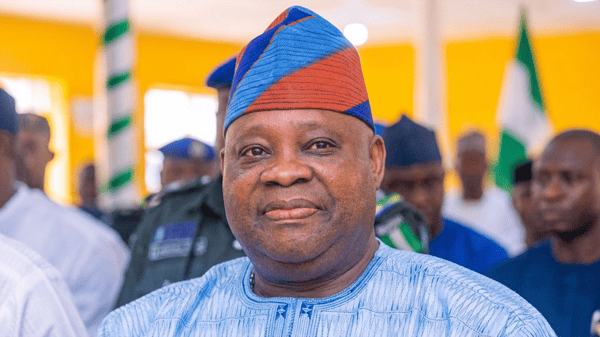
Governor Ademola Adeleke is seeking a second term in the August 2026 Osun governorship election on the platform of the relatively minor Accord Party, as the opposition All Progressives Congress (APC) prepares to deploy federal leverage to reclaim the state. With shifting alliances and emerging coalitions reshaping the contest, the race is fast becoming a test of grassroots appeal versus institutional federal power, SEYE OLUMIDE and OLUWOLE IGE report.
As Osun State inches toward the August 2026 governorship election, the battle for power has begun to reshape both governance and political alignments. Governor Ademola Adeleke is seeking a second term on the platform of the Accord Party after his dramatic exit from the Peoples Democratic Party (PDP), while the opposition APC appears poised to deploy federal influence to reclaim a state it lost in controversial circumstances.
Meanwhile, the ADC is positioning itself as a third force, banking on the enduring grassroots structure of former governor Rauf Aregbesola to challenge the dominance of the two major blocs. With political camps already mobilised and attention shifting from policy to permutations, the early jostling for advantage is increasingly paralysing governance in the state.
The scheduled election is shaping up to be a fiercely contested race, likely to unfold across four major political battlefronts.
The first front is Governor Adeleke, who is now positioning himself within the relatively less popular Accord Party. This move, coming less than 10 months to the election, raises serious questions about voter loyalty, party structure, and the governor’s ability to successfully transfer his personal popularity to a smaller and less entrenched political platform.
The second front involves the PDP itself, now weakened and politically unsettled by Adeleke’s exit. The party is expected to present a governorship candidate, but it enters the race as a deeply divided platform plagued by uncertainty and internal conflict. Ongoing litigation and factional disputes at the national level, particularly between camps aligned with the Minister of Federal Capital Territory (FCT) Abuja, Nyesom Wike and Governor Seyi Makinde, have left the party struggling to define a coherent strategy. These internal crises may significantly affect its organisational strength, campaign coordination, and overall electoral prospects in Osun State.
The third battlefront is occupied by the APC, the state’s major opposition party and a former ruling party in Osun.
Determined to reclaim the ‘State of the Living Spring’ the APC is banking heavily on federal backing and a consensus candidacy in the person of Munirudeen Bola Oyebamiji. With the advantage of incumbency at the federal level, the party hopes to leverage its national influence, resources, and renewed internal unity to dislodge the current administration and return to power in the state.
Finally, beyond these three dominant parties lies the growing grassroots force of the ADC. The party is currently led by its National Secretary, Rauf Aregbesola, a former two-term governor of the state (2010–2018).
Aregbesola’s political structure, deep grassroots connections, and enduring influence among a segment of the electorate make the ADC a formidable factor. Though often underestimated, the party’s coalition strength could significantly alter the dynamics of the race, especially in a contest already fragmented by defections and internal party crises.
Taken together, these four fronts suggest that the 2026 Osun governorship election will be less about a simple two-party contest and more about shifting alliances, personality politics, and the strategic mobilisation of grassroots support.
For Governor Adeleke, the path to securing a second term in office may be tortuous, considering his new political platform, the Accord Party.
Famed for his dancing skills and charisma, Adeleke’s path to retaining power next year promises to be a Herculean task compared to his electoral victory in the 2022 governorship election, when he defeated former Governor Gboyega Oyetola of the APC.
The governor, who then contested on the platform of the PDP, polled 403,371 votes to defeat Oyetola, who garnered 375,027 votes in a keenly contested election that ended the grip of the progressives on Osun’s polity.
However, one of the burning issues that continues to dominate public discourse is the strength of the Accord Party as a platform to deliver victory for Adeleke in the forthcoming crucial poll, which will ultimately determine his political future.
Adeleke, who resigned his membership of the PDP on November 4, clinched the governorship ticket of the Accord Party last Thursday in Osogbo, having polled 145 votes out of the 150 votes cast by delegates from the 30 local government areas of the state.
Findings indicate that the Accord Party, which is relatively unpopular in the state, managed to poll only 4,515 votes during the 2022 governorship election, thus raising concerns over its structure and potency as a platform for Adeleke’s second shot at power.
Retrospectively, it is quite obvious that some of the factors that aided the governor’s electoral victory in 2022 may not work out, taking into cognisance the present political realities.
Adeleke’s camp, during the build-up to the last gubernatorial poll, leveraged the leadership tussle within the APC, the party’s post-primary election mismanagement, controversies over the selection of traditional rulers, public anger against the then ruling party, and the Oyetola government’s inability to pay 30 months’ salary and pension arrears incurred during the administration of former Governor Aregbesola.
Besides, the collaboration between Adeleke’s camp and Aregbesola’s political group, the Omoluabi Progressives, significantly contributed to his victory in the 2022 poll. At present, however, there is no love lost between Adeleke and Aregbesola, as their relationship has since turned sour.
In July, shortly after Aregbesola emerged as the National Secretary of the ADC, Adeleke, in a statement, described the former governor’s regime in Osun as the worst in the history of the state.
The statement read in part: “Aregbesola’s wickedness against workers, public servants, and Osun people knows no bounds while he wielded state power. A man who introduced half salary, misapplied the contributory state pension fund, and misused the state cooperative deductions fund should be ashamed of his temerity to attack a governor who is now paying up the half-salary affliction, clearing unjustified debts, and rehabilitating brutalised Osun workers.”
Another hurdle before Adeleke’s quest to govern Osun State beyond 2026 is the emergence of Munirudeen Bola Oyebamiji, popularly known as AMBO, as the flag bearer of the APC. Given that the APC controls federal power in Nigeria’s political landscape, the party’s formidable structure in Osun and the galvanisation of its support base may pose a threat to Adeleke’s re-election.
Oyebamiji, the immediate past Managing Director of the National Inland Waterways Agency (NIWA), emerged as the APC’s flag bearer through consensus after eight other aspirants stepped down. Should the APC go into the poll with a united front devoid of internal implosion, Adeleke may face a tough challenge, now that he is contesting on the platform of the relatively weak Accord Party. He has also lost two senators and some critical lawmakers from his former PDP to the APC, while the Aregbesola factor is no longer on his side, leaving the incumbent governor’s flank apparently exposed.
However, Adeleke’s acceptability among the masses and civil servants, especially at the grassroots, coupled with his achievements in key sectors such as infrastructure—including road networks and flyovers—may work to his advantage ahead of and during the election.
What may also work in his favour is the expected crisis within the APC following the apparent endorsement of Oyebamiji’s candidacy by the President, against the interest of former Deputy Governor Iyiola Omisore, who had aspired to contest the 2026 governorship under the APC. This disagreement may, however, have been technically resolved.
Inside sources disclosed to The Guardian that Omisore is most likely going to be adequately compensated, hence his reluctance to challenge Oyebamiji’s endorsement in court.
The PDP, which has presented a candidate, may eventually support Adeleke, though not fully, as the faction loyal to Wike is poised to back the APC and its candidate.
Observers say Aregbesola is entering the poll with the ADC candidate, Najeem Salaam, a former Speaker of the Osun State House of Assembly, to protect his political ego and future relevance.
As it stands, Aregbesola is using the ADC to fight for political relevance at both the federal level and in Osun State. His candidate’s presence in the poll may serve as a spoiler to both Adeleke and the APC.
But while all the actors display their war chests, governance is already taking a back seat in the State of the Living Spring. Most affected is the local government sector, where activities have been paralysed and may not be resuscitated until an uncertain time.
Government policies have been shelved, while there is no ruling party structure in place since Adeleke exited the PDP.
Speaking on Adeleke’s chances, his Special Adviser on Media, Hezekiah Oladele Bamiji, expressed optimism that there is no threat to his principal’s re-election under the banner of the Accord Party.
He stated: “Adeleke’s chances are as bright as his character and personality. Before he joined the PDP in 2017 to contest the vacant Osun West Senatorial seat, the PDP was not as popular as it became after his entry. Governor Adeleke has always carried an aura of popularity wherever he goes, and this has been further bolstered by his performance in office over the last three years.
“What he did as a senator and now as governor is visible for all to see. The people of the state have been wired to stick with him. His performance has endeared him to the hearts of Osun people. Many who were neutral in the 2022 election or doubted his capacity have now become his automatic supporters.
“As of today, unless the opposition, with its federal might, wants to annihilate the entire electorate in Osun, there is no way any candidate can defeat Adeleke. His nature and character transcend party lines. The Accord Party has become a home, and people can see the soaring level of acceptability he enjoys,” Bamiji posited.
Also speaking on Adeleke’s chances on the Accord Party platform, former Deputy National Publicity Secretary of the PDP, Prince Diran Odeyemi, said it is not political parties but personalities that win elections.
According to him: “It is the electorate that determines who wins. When Adeleke joined politics, even as a political unknown, he won nine out of 10 local government areas to become a senator. He later defeated an incumbent governor.
“His performance has endeared him so much to the people of Osun State that they are clamouring for him to contest again. Being in the Accord Party is the best option for him.
“In Nigeria, it is not political parties that vote but the people you govern. With Adeleke’s record of performance, we have no doubt that he will emerge victorious irrespective of the APC, federal might, ADC, or any other party,” Odeyemi remarked.
However, an APC chieftain, Bosun Oyuntiloye, told The Guardian that his party is on the path to victory, saying: “It is just a matter of time. The APC is well positioned to retake Osun.”