
 Get Guardian on Google
By Ifeanyi Igwebike Mbanefo
How Ifeanyi Igwebike Mbanefo moved from employment controversy to education, planning, and the difficult work of giving Bonny a future it could own
Before dawn, the phone began to ring.Ifeanyi Igwebike Mbanefo had hardly slept.
The calls came one after another, carrying the same question in different voices. Why had he been sent to Community Relations?
The question sounded incredulous even to him. He was Nigeria LNG Limited’s Corporate Communication and Public Affairs Manager, and Community Relations was not where he had expected his career to go.
He had not requested the posting. He had not been briefed about it. Then the management reshuffle appeared on the company intranet.
Three hours later, Dr Babs Omotowa called. Mbanefo asked what offence he had committed. Omotowa gave him a different answer. He said Community Relations mattered deeply to him, and that he believed Mbanefo had the intellect, integrity, relationships, and courage the work required. But more than anything, Omotowa believed Mbanefo would not serve the rich and well-connected while abandoning the poor — that he would help build institutions capable of serving everyone.
Mbanefo asked permission to write down his own understanding of the assignment and the principles that would guide it.
Omotowa agreed.
The assignment became more than a posting. It became a test of whether Bonny could move from personal access to public capacity.
Mbanefo entered Community Relations at a moment when Bonny was debating representation in the LNG economy. The community believed that candidates of Bonny origin were being systematically excluded from company employment, and the allegation carried real weight, because employment had become the most visible route into the modern economy.
The plant stood on Bonny land. Workers arrived with specialised skills. Contractors entered with equipment and expertise.
The industrial complex grew. And many Bonny youths remained outside the gates.
To them, a job meant more than wages. It meant a share in the project, recognition of host status, compensation for land and disruption, a place in the future, and proof that the kingdom had not simply surrendered its land to outsiders.
Mbanefo’s first move was to seek a measurable response: he asked Omotowa to reserve 20 per cent of the ongoing operators’ recruitment for Bonny candidates as a floor, and Omotowa agreed.
Then the quota could not be filled. The empty places became a kind of evidence. The community had demanded access. Access had been offered. The qualified candidates were not available in sufficient numbers.
Mbanefo could have stopped there and let the dispute return to accusation. Instead, he asked a harder question: why was Bonny demanding entry into an industrial future without producing enough candidates prepared to enter it?
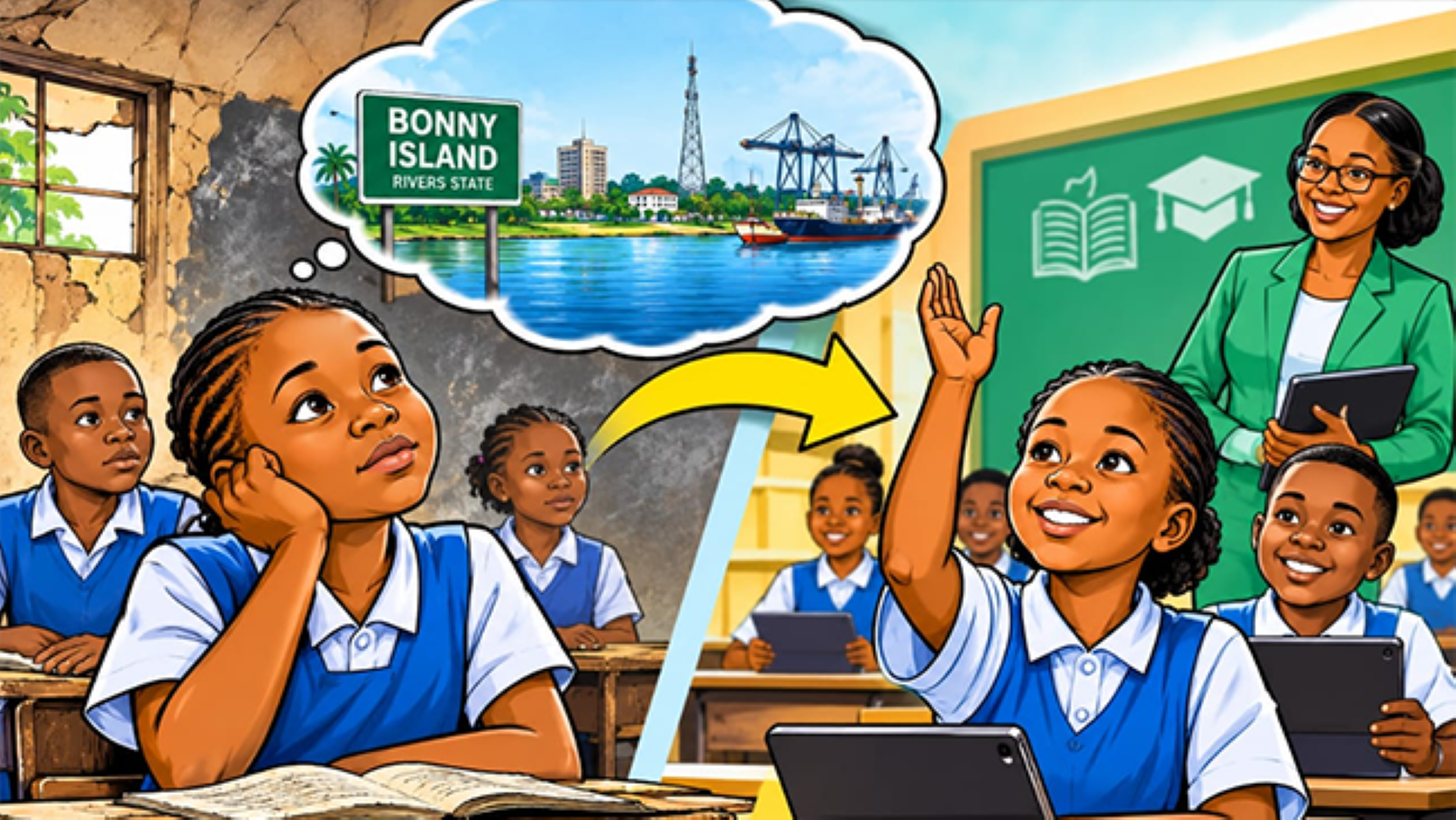
Mbanefo went to the West African Examinations Council. He purchased 10 years of school-certificate results from schools in Bonny and began to study them. There was no drama in the room where the figures were read — no angry youths, no Chiefs Council, no company gate. Only documents, percentages, subjects, credits, failures, and the quiet accumulation of evidence.
The results were stark. Roughly 70 per cent of the secondary-school results did not contain five credits, and among those who did obtain five, a substantial number had not passed Mathematics and English, the two subjects Nigeria requires for admission into tertiary education.
The figures did not prove that discrimination was absent. They showed that discrimination could not explain the whole of the problem. Even a perfectly fair recruitment process could not fill the quota if the educational system upstream produced too few qualified candidates.
This was the moment Mbanefo moved from allegation to diagnosis. He had gone looking for a locked door and found that Bonny also needed to build the road leading to it.
The discovery was painful because it demanded internal responsibility: the community had to examine its own schools, teachers, families, institutions, and priorities, and to ask why children growing up beside one of Nigeria’s most important energy projects were not being prepared to take part in its technical economy.
A school result can hide a life. Behind a failed Mathematics paper may sit a child who studied without electricity. Behind a missing credit may sit a classroom without adequate teachers. Behind a poor English result may sit a family without books or guidance. Behind a weak school may sit a community whose development spending was never connected to educational outcomes at all.
The statistics were not a verdict on Bonny’s children. They were a verdict on the systems around them.
A child who fails to obtain five credits is not incapable of learning; the result says only that the child has not yet received enough support to demonstrate the required knowledge under the examination system, and that distinction matters enormously.
Blame the child, and the system stays untouched. Measure the school, and the problem becomes addressable. Accept the evidence, and a community can begin to build better teacher support, better materials, better school leadership, career guidance, focused Mathematics and English programmes, technical and vocational routes, scholarships, mentorship, and industry-linked training. The future of Bonny was not waiting at the gate. It was sitting in a classroom, often without the tools to recognise itself.
Mbanefo presented the findings to the King, the chiefs, the youths, and to different sections of the community in turn. This was a dangerous kind of honesty. It would have been easier to flatter the kingdom, to blame the company entirely, to repeat the language of systematic discrimination, and to demand a larger quota. Instead, he told Bonny that it had to build a talent pipeline.
The message was not that the employment grievance was false. It was that the grievance could not be solved permanently by fighting over vacancies after the company had already begun recruiting. The work had to begin earlier — in primary school, in secondary school, at home, in teacher training, in career guidance, in the relationship between education and employment itself.
His argument to the community was direct: build a robust pipeline rather than keep fighting needless wars; the future of the children should concern everyone. The word “pipeline” was chosen carefully. It described a continuous system through which a child could move from school to skill, from skill to qualification, and from qualification to real employment or enterprise. Bonny had been demanding the final product, employment, without always possessing the machinery that produces it.
Mbanefo set out to build that machinery.
He reached out to the World Bank and to UNICEF, and both sent education experts to support the work — an act that widened the whole meaning of Community Relations. The problem could no longer be managed through NLNG, the palace, and the Chiefs Council alone. It needed development institutions with real experience in education, children, planning, measurement, and public systems. UNICEF brought its institutional focus on children; the World Bank brought experience in education reform, learning outcomes, data, school management, teacher performance, infrastructure, and monitoring.
He also reached out to Moronke “Ronke” Azeez, who had served as Special Adviser to the Lagos State Governor on the Eko Project, a World Bank-assisted programme that improved learning outcomes and infrastructure across hundreds of public junior and senior secondary schools, reaching more than half a million students through school development grants, teacher support, performance incentives, testing, and management reform.
Its relevance to Bonny was plain. Education could not be improved by building walls alone. It needed baseline data, measurable targets, teacher development, school leadership, student assessment, performance tracking, incentives, community engagement, and the willingness to change a programme when its results were poor.
Azeez shared the experience of a project that treated learning as an outcome to be measured, not school construction as an achievement to be photographed.
Mbanefo also reached out to Professor Akin Mabogunje. Mabogunje’s contribution should be described accurately: his major work on Lagos was academic and consultative rather than the drafting of a particular municipal blueprint, and his 1961 doctoral dissertation, Lagos: A Study in Urban Geography, remains a foundational study of the city’s spatial, demographic, economic, and social structure. His wider significance for Bonny was methodological — the conviction that a place must be understood before it can be planned.
Bonny was not an empty canvas. It had, as this history has shown, a deep historical memory, a riverine geography, a palace, chieftaincy houses, Finima, industrial enclaves, resettled communities, restless youths, a diaspora scattered across Lagos and other cities, a limited land base, a maritime identity, and a development future that could not be reduced to LNG alone.
A masterplan that ignored these realities would be just another external document imposed on the kingdom. A plan that understood them could become a framework for ownership.
Mbanefo was not looking for a foreign blueprint to lay over Bonny. He was looking for the knowledge that would help Bonny understand itself.
NLNG hired Accenture to develop the 25 year masterplan for Bonny Kingdom — a decision that marked the shift from scattered projects to strategic planning.
The plan had to study population, land, education, health, employment, infrastructure, tourism, industry, enterprise, fisheries, agriculture, environment, investment, governance, financing, and implementation all at once.
The kingdom’s future had to be mapped in more than ceremonial language. It had to be measured: how many children were in school, how many completed secondary education, how many passed Mathematics and English, how many could enter tertiary education or be trained for technical employment, how many local businesses could supply the companies, how many houses needed services, how much land could support new development, and what would happen to the community when the gas economy itself eventually changed. A masterplan could not answer every one of these questions on its own. But it could make them visible, and visibility is the beginning of accountability.
Mbanefo led sensitisation among the different constituencies of Bonny, including the Bonny people living in Lagos. The work required him to move through more than one Bonny at once: Bonny on the island, Bonny in Port Harcourt, Bonny in Lagos — the chiefs, the youths, the professionals, the business people, the elders, the women, the families, the students, the company workers, and the people who had left the island but still claimed it as home. A kingdom’s population may be physically scattered while its identity remains entirely concentrated.
The masterplan therefore had to engage the whole of that wider community, and Mbanefo’s consultations pressed for answers on what people wanted Bonny to become, what they feared, what had failed before, which projects mattered most, who should own the assets, how the Foundation should be governed, what role the King should play, how Finima should be represented, how the companies could remain partners, and what would make people trust the plan at all.
This was painstaking work. The community was not a blank audience waiting for a vision; it held its own visions, memories, disappointments, and competing expectations, and the task was to gather them into a shared direction.
Mbanefo was later accused of trying to divide Bonny, and of behaving as though he was “holier than thou.” The accusation deserves to be read as part of the political conflict surrounding the new method rather than as a verdict on the man. In a palace-centred system, the creation of multiple channels of consultation can look like a challenge to the one established channel. If the palace has traditionally interpreted the community to the company, a process that speaks directly with houses, youths, professionals, the Lagos diaspora, and development agencies can appear to bypass palace authority. If the chiefs have traditionally negotiated projects, a professional masterplan can appear to challenge their power to set priorities.
If a grievance has long unified people against an outside company, evidence of internal weakness can look, to some, like a betrayal of the community’s public story.
But Mbanefo’s method was not to weaken Bonny. It was to give Bonny more sources of strength. A kingdom is not divided because more of its people are invited to think about its future.
The accusation also revealed the real difficulty of reform: insist that public funds require rules, and those who benefit from informal arrangements may call you arrogant; insist that evidence matters, and those who rely on inherited narratives may call it disrespect; bring in outside partners, and those who control local access may call it interference. The conflict was never simply over personality. It was over who had the right to define Bonny’s future.
Mbanefo took the chiefs to the Bank of Industry — an image, in its way, of a kingdom meeting a different kind of power. The chiefs came from a world of houses, authority, history, land, and custom. The Bank of Industry spoke the language of finance, enterprise, investment, production, credit, business plans, repayment, capacity, and economic growth.
The meeting opened the possibility that Bonny could build its future through more than corporate social spending. It could seek genuine partnership.
The Bank of Industry agreed to work with Bonny alongside, UNIDO, UNICEF and the World Bank, each partner carrying a different part of the transformation: the Bank of Industry for productive capacity, UNICEF for children and education, UNIDO, the United Nations’ specialised agency for inclusive and sustainable industrial development, for the wider industrial picture, the World Bank for development expertise and systems, NLNG for corporate funding, infrastructure, and technical partnership, and Bonny itself for land, identity, participation, and ownership.
A partnership asks more than a donation ever does. A donation ends when the money is spent. A partnership requires institutions able to define priorities, prepare projects, manage funds, deliver results, report performance, sustain assets, and accept responsibility. Mbanefo was trying to teach Bonny to become a partner in its own development, not merely a claimant standing at the gate.
The twenty-five-year masterplan needed an institutional home. Without a Foundation, it risked becoming a document stored in offices while the old politics carried on outside, unchanged. The Foundation was meant to receive grants from oil companies, donor agencies, businesses operating in Bonny, and other development institutions, to own or manage assets, support projects, coordinate initiatives, and help Bonny take responsibility for its own development.
This model reflected Mbanefo’s long-standing belief: build around the traditional institution, but build institutions strong enough to serve the people directly.
The word “around” mattered. He did not propose building against the King. He proposed building around the King, so that the kingdom could hold both its traditional legitimacy and a modern administrative capacity at the same time — the palace preserving identity and continuity, the Foundation managing development, the houses articulating grievance and local priority, professional managers implementing projects, external partners providing finance and expertise, and the community holding the whole system accountable. This arrangement would not eliminate conflict. It would make conflict less destructive.
The Personal Cost of Standing Firm:
The work exposed Mbanefo to constant pressure. He had to move between the King, the chiefs, the youths, company management, Shell and ExxonMobil representatives, international partners, consultants, Bonny indigenes in Lagos, government institutions, schools, and development agencies. He faced accusations of arrogance and of division. He had to defend the masterplan against people who feared new institutions would weaken the old order. He had to explain to the community that the company’s employment process could not be transformed without also improving local qualifications. He had to persuade the company that community relations meant more than managing public anger.
This required him to say THAT difficult things in every direction at once. To the community: the company must treat you fairly, but you must also prepare your children and build your own capacity.
To the company: the community’s grievances are real, and the answer cannot be another short-term concession — NLNG is a successful company, and a rising tide must lift all boats. To the palace: traditional authority is essential, but public development cannot rest on personal control alone; monarchies that do not reform do not always survive — Greece abolished its own in 1974, when 64 per cent of its voters said they had had enough, and the lesson travels. To the chiefs: representation only means something when it produces institutions that serve beyond the representative himself. To the youths: protest may recover leverage today, but education and skill decide whether the next generation can stand on its own tomorrow. These messages did not always draw applause. They were not designed to. They were designed to build capacity.
What Mbanefo Saw
Mbanefo saw that Bonny’s deepest problem was never a lack of intelligence. The kingdom held capable elders, professionals, traders, engineers, businesspeople, teachers, administrators, and ambitious youths in abundance. What it lacked was the institutions connecting that intelligence to opportunity. The talent existed; the pipeline did not. The will existed; the structure did not. The money existed; the direction did not. The partnerships existed; the ownership did not.
That is why his work moved in several directions at once — employment, education, health, planning, finance, external partnership, community representation, institutional design — because isolated improvement would never be enough on its own. A better school without jobs waiting at the end of it would only frustrate its graduates. Jobs without schools behind them would remain out of reach. A road without enterprise would simply move people through Bonny a little faster.
A foundation without governance would become one more channel of patronage. A tourism project without transport would become a monument nobody could visit.
A development plan without ownership would become another file on another shelf. The strength of a system lies in the connections between its parts, not in any one of them alone.
The Bridge Between Two Shores
Mbanefo’s power came from connecting people and ideas that did not naturally meet: the company to the community, the palace to external institutions, employment to education, education to planning, planning to finance, Bonny on the island to Bonny in Lagos, immediate grievance to long-term capacity, traditional authority to modern governance.
This is a difficult form of leadership, because it produces few simple victories. The bridge-builder is blamed by both shores. The company may think him too sympathetic to the community. The community may think him too close to the company. The palace may think he is bypassing it. The youths may think he is asking them to wait. The international partners may ask whether local institutions are ready at all. Yet, without someone willing to stand between the shores, no shared future gets built. A bridge is criticised from both banks precisely because it belongs entirely to neither.
The Larger Meaning of His Work
Mbanefo’s work represented a new understanding of Community Relations — not publicity, crisis response, negotiation, concession, protocol, or palace liaison alone, but the design of a social and institutional environment in which company and community could coexist with greater fairness and less dependence on conflict. The work demanded evidence, listening, humility, persistence, strategic firmness, respect for tradition, the protection of public value, and a willingness to confront uncomfortable facts.
He did not treat Bonny as a problem to be managed. He treated it as a kingdom whose capacity had to be rebuilt. That is why he could speak honestly about weak school results without abandoning the employment grievance itself; why he could respect the King while resisting palace control; why he could engage the chiefs while also taking them to the Bank of Industry; why he could promote the masterplan while accepting that the process would draw accusations. Respect is not flattery. Sometimes the most respectful thing a person can do for a kingdom is to tell it the truth.
The Future in His Hands
Ifeanyi Igwebike Mbanefo entered Community Relations at a moment when Bonny demanded representation. He answered first with a quota. When the quota could not be filled, he answered with evidence. When the evidence revealed a weak talent pipeline, he answered with education. When education required expertise, he reached out to UNICEF, the World Bank, Ronke Azeez, and the planning intelligence associated with Akin Mabogunje. When planning required structure, NLNG engaged Accenture for a twenty-five-year masterplan. When the plan required ownership, he led sensitisation among the houses, the wider community, and Bonny people living in Lagos. When an external partnership became necessary, he took the chiefs to the Bank of Industry. When his method was accused of dividing Bonny, he continued, regardless, to build a broader definition of community.
His achievement was not only that he secured a conversation about jobs. It was that he moved the conversation to the conditions that make jobs sustainable. He saw that a quota without schools would remain empty; that projects without ownership would decay; that development without data would become guesswork; that a kingdom without institutions would remain vulnerable to whoever controlled the gate. He also saw something more hopeful: that Bonny possessed enough intelligence, history, talent, and commercial memory to rebuild itself, and needed only a structure capable of bringing those qualities together.
He did not merely carry a message from the company to Bonny. He carried the possibility of Bonny’s future from one generation to the next.
The road to independence began long before the road to the mainland. It began in the examination result, the classroom, the planning table, the development bank, the palace meeting, and the difficult conversation in which a kingdom was asked to look at itself without flinching. And somewhere in Bonny, beneath the sound of boats and waves, a child was still learning. The harbour could wait for ships. The future could not wait for the child.