 Follow Us on Google News
 Follow Us on Google Discover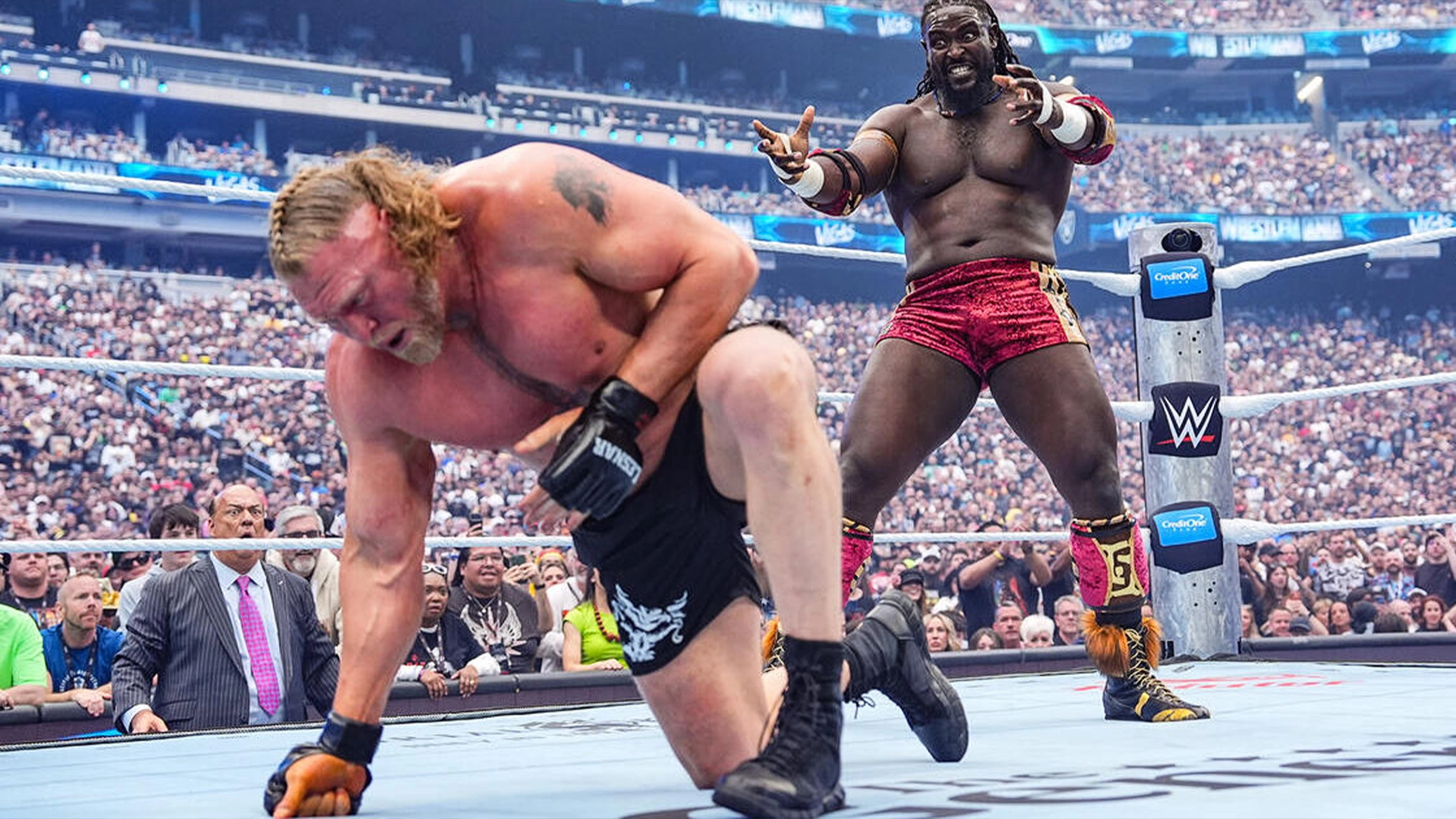
Nigerian wrestler, Oba Femi, recently made history when he defeated Brock Lesnar in his debut at WrestleMania Raw, signalling what some observers described as a new era in entertainment wrestling. Apart from inflicting an unexpected defeat on Lesnar, the loss forced the American to announce his retirement from the game. But to some Nigerians, Femi’s feat looks like the rekindling of interest in what many see as more of a staged performance than sport, CHRISTIAN OKPARA reports.
FOLLOWERS of the World Wrestling Entertainment (WWE) brand of professional wrestling, which usually draws millions of fans to the tube, were on April 19, 2026, treated to a spectacular display of grit, perseverance, and the triumph of dedicated pursuit of excellence.
It was a night when Nigeria’s Oba Femi announced his arrival on the scene with a stunning defeat of the world-renowned Brock Lesnar, who came into the fight with a scary reputation as one of the most dangerous fighters on earth.
But beyond the action in the ring, the event, tagged Wrestlemania 42, offered many possibilities, chief among them the ability to capture global attention with well-curated spectacles even when many do not take such activities seriously.
Many dismiss professional wrestling as more of a performative art than a sport, but Femi’s showdown against Lesnar drew billions of viewers to the Allegiant Stadium in Las Vegas, United States.
The fight, according to records, was part of a highly viewed event that set a new digital record for WWE, generating over 1.3 billion views across all social media platforms.
The high viewership is attributed to the combination of Oba Femi’s rising star status and Lesnar’s established star power. But beyond the statistics, the fight took the older generation of Nigerian wrestling fans back to the days when the likes of Power Mike, Mike Bamidele, Mighty Igor, Argentina Apollo and Dick the Bulldog Brawler ruled the roost.

In recent years, wrestling, which in the 1970s up to early 1990s commanded hefty followership among Nigerians, has been relegated to the back benches due to the perception that the wrestlers came on stage to perform already rehearsed actions.
Although the likes of the late Hulk Hogan, the Ultimate Warrior and the Undertaker still drew attention due to the entertainment they provided, they hardly commanded the type of interest the battle between Femi and Lesnar generated among Nigerians.
The reason is that Femi and Omos (Tolulope Omogbehin), alongside Uar Bernard, who was recently drafted into American football’s Philadelphia Eagles, represent a new generation of Nigerian superstars charting a new path for African youths.
Before now, Africa’s biggest export to the Stamford, Connecticut-based global wrestling company, WWE, was Ghanaian Kofi Kingston.
To make it big in WWE, according to followers of the game, a wrestler must be big, strong, athletic, believable (since the show is scripted), and be good with words to cut a promo.
That is where Oba Femi comes into the picture. For an athlete who joined the company in 2021 and, within five years, rose to be at the main event of Wrestlemania 42 is unprecedented and very remarkable.
Femi’s emergence, according to some WWE experts, allows old warhorse Lesnar to retire in peace, as he did while still on the canvas after his defeat.
But to some others, it shows how being deliberate in the pursuit of excellence can take even a rookie to the top. It has, in a way, rekindled interest in the game among young Nigerians, who now believe that if they also work hard, they can rise to the top of their game.
Olympic wrestling gold medallist, Daniel Igali, described Femi’s feat as a good thing for Nigeria, saying that it has brought positive attention to Nigeria.
Although he acknowledged that professional wrestling is make-believe, he said that for a person to be in the show, he must have some sort of athleticism.
He explained that some of these wrestlers go through a period of tutelage before they are thrust into the limelight.
“They’ve been using them as bodyguards, that’s how they introduce them in.
“Some of my friends, who did well in conventional wrestling and even won Olympic medals, have joined professional wrestling.
“They give you a role; you play different characters until finally they put you in the limelight. But it’s a good thing for Nigeria.”
The former president of the Nigeria Wrestling Federation added: “We have been getting a lot of inquiries about wrestling, but what they actually want to know is about professional wrestling because most of them don’t know the difference between Olympic style wrestling and this professional make-believe wrestling.
“So we have a lot of interest from young people, both men and women, who want to join wrestling, but when you explain to them what you do, they become very disappointed. But it’s a good thing for Nigeria, for the image of Nigeria anyway.”
From the marketing perspective, according to the Chief Operating Officer of Strategic Communications, Bamidele Johnson, whose outfit promotes the GOtv Boxing Night, a moment generating 1.3 billion views signals the dominance of virility over traditional promotion.
He said: “A shocking upset involving a global figure like Brock Lesnar would travel far beyond wrestling audiences, feeding social media cycles, memes and mainstream conversations.
“It becomes less about a match and more about a cultural event, expanding reach and pulling in new viewers who might not otherwise engage with wrestling.”
Johnson said that Femi’s victory also positions Africa as a serious growth market.
He explained: “With Femi at the centre of such attention, brands and promoters would see clear value in targeting Nigerian and wider African audiences through sponsorships, localised content and potential live events.
“At that scale, the victory becomes a marketing asset, reinforcing wrestling’s strength as character-driven entertainment with global appeal.
“Femi’s victory can rekindle interest among Nigerians, but not in the same way as before. The era of Power Mike and Mike Bamidele thrived on belief in wrestling as a real contest. Today’s audience is more sceptical, so the renewed interest would come less from perceived authenticity and more from nostalgia and emotional connection to a familiar form of entertainment.
“At the same time, national pride provides a powerful hook. A Nigerian succeeding on a global stage shifts attention from questioning the nature of wrestling to celebrating representation. Older fans may return out of curiosity and memory, while younger audiences engage more easily, seeing wrestling as spectacle rather than sport.”
Former UPE World Heavyweight Wrestling Champion, Osita Offor, better known as De Ultimate Commander, sees a job-creating opportunity in Femi’s triumph over Lesnar.
He said that the Federal Government could capitalise on the euphoria among Nigerians to draw the youths into wrestling and such other events that feed on natural power.
According to Offor: “The country is blessed with energetic young men and women, so energy can be channelled into such ventures as wrestling or even boxing.
“While not all the youths have the capacity to go beyond secondary school, it is also true that not everybody can play football, which seems to be the government’s main focus when it comes to youth development.
“A deliberate effort at scouting for young, strong men and women can help the country raise an army of talented wrestlers, whose strength could be useful to the WWE recruiters or those of the MMA.”
Drawing from his personal experience, Offor said that although he was based in Lagos as an active wrestler, “I had the opportunity of travelling to America, Europe and other countries to wrestle because I had a support system that exposed me to international supporters.
“But it was not easy getting to the height I reached in wrestling because in the early days I did my training and promotion with family resources until the Bauchi State government, then and former Abia State Governor, Theodore Orji, came in to help with my training and travelling to fight abroad. Not many youths of these days can go through that route to achieve the same success.”
With over 1.3 billion viewers across all social platforms, the MD/CEO of HenryJValeens, a PR, Brand and Communications, Marketing and Consulting outfit, Dr Ejike Ndiulo, said that the significance of Femi’s victory is massive.
“Given the integration of WWE with platforms like Netflix and YouTube and the fact that Oba Femi is seen as a bridge to the Gen Z and Millennial demographic, who consume WWE content via digital platforms, the significance in the Nigerian market is simply huge.
“What this means is that Nigerian brands now have a direct line to a global audience by associating with him early.
“Speaking from a marketing perspective, Oba Femi’s victory is not just another sporting achievement but a blank cheque for Nigerian brands. They need to milk the situation for product endorsement, merchandising, CSR and Talent pipelines.”
He advised brands to milk the euphoria immediately by embarking on a “180-day or even 365-day showcase campaign, as the case may be, a kind of docu-series of his journey from Lagos to the WrestleMania main stage. Billboards alone are not enough.”
According to Ndiulo, “given that Oba Femi is regarded as the ‘Ruler’ in WrestleMania, depicting royalty and strength, brands should situate this within Nigeria’s cultural context.
“Another strategic approach for brands would be in the form of CSR and Talent pipeline. Specifically, corporate brands should use his success to promote local wrestling or track-and-field clinics. This will position the brand as a ‘Builder of Future Rulers.’
If Nigeria desires to leverage on Femi’s feat to get the country’s youth into wrestling or any other sport, it must embark on an aggressive enlightenment campaign to show why the youths should embrace sports rather than crime.
According to a Canada-based sports analyst, Lucky Nana, people tend to lose interest in events quickly. He said: “As popular as ice hockey is here in Canada, they still embark on aggressive marketing everywhere you turn. Even during the tennis championship, people were watching the U.S. versus Canada ice hockey game.
“In 2014, I was part of the small group involved in the return of Stationery Stores FC. Our biggest match was against 3SC, and the gate fee was N1,000. The turnout was so strong that there were more people outside than inside. The owner of 1960Bet, who was the shirt sponsor at the time, even requested that the gates be opened before we had a full house.
“So the issue is not that Nigerians do not want to watch sports. The real problem has always been weak and inconsistent marketing. Stadium attendance is not only about the sport itself; it is also about how aggressively and creatively the event is promoted,” he said.

