 Follow Us on Google News
 Follow Us on Google Discover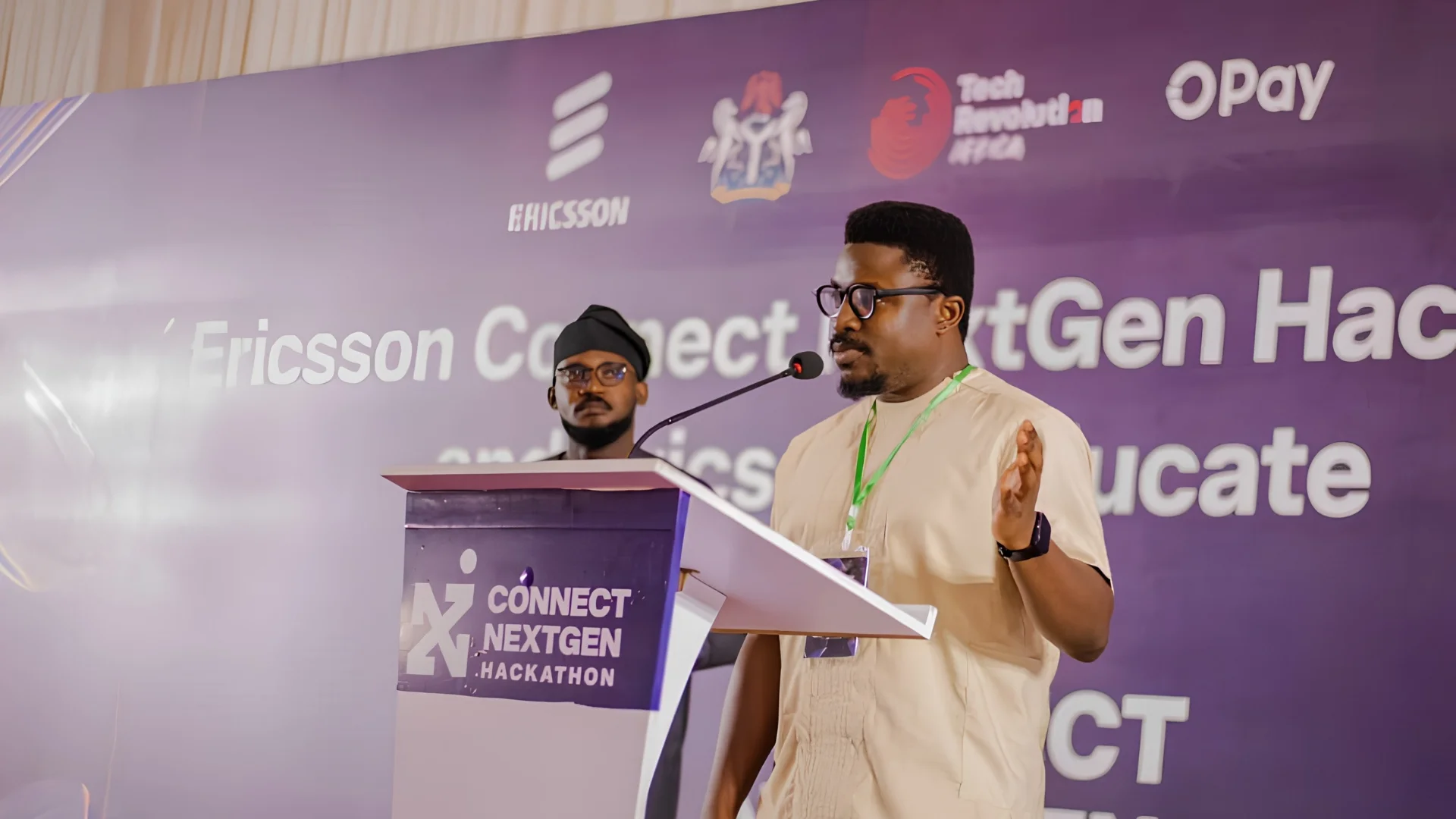
On February 11, 2026, Glory Olamigoke stood inside Nigeria’s Presidential Villa, speaking to members of the presidency, government officials, delegates and technology stakeholders about the country’s next generation of builders.
It was an unlikely setting for someone whose own journey into technology began several years earlier, not in a computer science classroom or a technology company, but with a degree in Human Anatomy and a decision to teach himself how to build websites.
This time, however, Glory was at the Villa as part of the team behind a national technology programme.
The occasion was the launch of the Connect NextGen Hackathon, a partnership involving the Federal Government through the Office of the Vice President, Ericsson, Tech Revolution Africa and OPay, created to identify and support young Nigerians building technology solutions around some of the country’s most important opportunities and challenges.
For Glory, Co-Founder of Tech Revolution Africa, the launch was the visible result of months of work that had happened largely away from the cameras.
He was involved in co-creating the Connect NextGen Hackathon from its earliest stages, from the programme’s name, to its curriculum, overall programme structure, schedule and implementation plan. Through the team at Tech Revolution Africa, he also drove the programme’s execution, working across partners and teams to move the initiative from idea to national initiative.

The Connect NextGen Program was designed to be more than a conventional hackathon. The familiar model is simple: bring young people together, give them a problem, allow them to build, judge the submissions and announce winners.
Connect NextGen took a broader view. More than 1,300 applications came in from across Nigeria, with 50 founders selected for the programme’s next stage. Participants were taken through structured mentorship and acceleration, refining already existing solutions and developing new solutions across areas including fintech, health, agritech, education, telecommunications, cloud, AI, IoT and sustainability.
The idea was to give young builders something that is often missing after a competition: a pathway to keep building.
For Glory, that thinking comes from experience.
His first encounter with technology was not part of a carefully planned career path. During his National Youth Service year in 2018, he began teaching himself web development. What started with learning how websites worked gradually turned into building digital products for startups and eventually founding Cleonify, where he worked with over 100 businesses and startups across Africa, US, Asia, Europe, and Canada to develop their ideas into technology products.
It was also the beginning of a pattern that would follow him into the wider African technology ecosystem.
Glory became increasingly interested not only in building products, but in mentoring, supporting and raising the people building them, essentially, developing Africa’s next generation of tech talents
This led him to create TekNexus Africa, a mentorship platform focused on developing and connecting African technology talent. The community has since supported more than 5,000 technology professionals across more than 10 countries.
His work later expanded into Tech Revolution Africa, which he co-founded with David Ogebe.
Tech Revolution Africa has grown into a platform connecting thousands of founders, technology companies, investors, policymakers and institutions. Its partnerships have included organisations such as MTN Nigeria, Huawei, PMI, Ligadata, Tech Mahindra, Coralpay, Bluechip, Infonomics, Vennote and more , while its programmes have increasingly focused on creating practical opportunities for startups and young builders.
All of these became particularly relevant when the opportunity to build Connect NextGen emerged.
The programme required more than a hackathon curriculum. It required coordinating different institutions, translating expectations between corporate and government partners, creating a structure that could work for young founders and ensuring that the programme could actually be delivered at scale.
It was the kind of work that sat somewhere between product management, programme design and ecosystem building.
Those different parts of Glory’s career have increasingly begun to overlap.
His corporate career has given him experience building and scaling financial technology products and infrastructure. At Moniepoint, he works in product leadership within a company serving tens of millions of businesses and consumers. Before that, at Kuda, he worked on core banking products and infrastructure serving several millions of customers as well.
Outside the corporate environment, the focus has been different but connected: building the people, programmes and partnerships that allow technology ideas to move further.
Connect NextGen brought all these sides together.
At the Presidential Villa, Glory was no longer simply the person who had taught himself how to build websites or the product leader working on financial infrastructure. He was speaking about the technology ecosystem to senior government officials and other stakeholders while representing a programme he had helped design.
For a young technology ecosystem that is often described in terms of its potential, the harder question is what happens when that potential meets institutions.
That is a question Glory has increasingly tried to address through the programmes he builds.
That bridge can be mentorship. It can be an enterprise partnership. It can be access to government. It can be a route to market. It can simply be the right person opening a door at the right time.
Building those bridges has become a significant part of Glory’s work.
It is also what makes his journey from Anatomy to technology less unusual than it first appears.
The degree did not determine the career. Neither did the absence of a traditional technology background prevent him from finding his way into the industry. What mattered was the ability to learn, build and then, increasingly, create opportunities for others to do the same.
That evolution is visible in the way his work has changed.
He started by learning how to build things himself.
Then he began helping startups build.
He moved into product leadership, working on technology serving millions of users.
He built communities and programmes for thousands of technology professionals.
And now he is increasingly working at the level of institutions, helping create programmes that bring government, global technology companies and local builders into the same ecosystem.
Connect NextGen sits at that intersection.
Its final event is scheduled for November, when the participating founders will have the opportunity to showcase what they have built.
For the founders, that stage will be about their products.
For the organisations behind the programme, it will be a measure of whether the connections created along the way can continue beyond the programme itself.
And perhaps that is the more important test.
A hackathon can produce a winning team in a matter of days. Building an ecosystem that gives talented people a genuine chance to succeed takes considerably longer.
For Glory, that work has already moved beyond a single programme.
From the Presidential Villa to startup communities, corporate boardrooms and technology programmes across Nigeria, his career is increasingly defined by the spaces in between: between talent and opportunity, between institutions and builders, and between an idea and the structures needed to make it real.
Connect NextGen is one chapter in that journey.
The next one may begin when the lights go down at the November finale and the young builders leave the stage.
What happens to their ideas after that may ultimately be the real measure of what the programme has built.

