 Follow Us on Google News


 Follow Us on Google Discover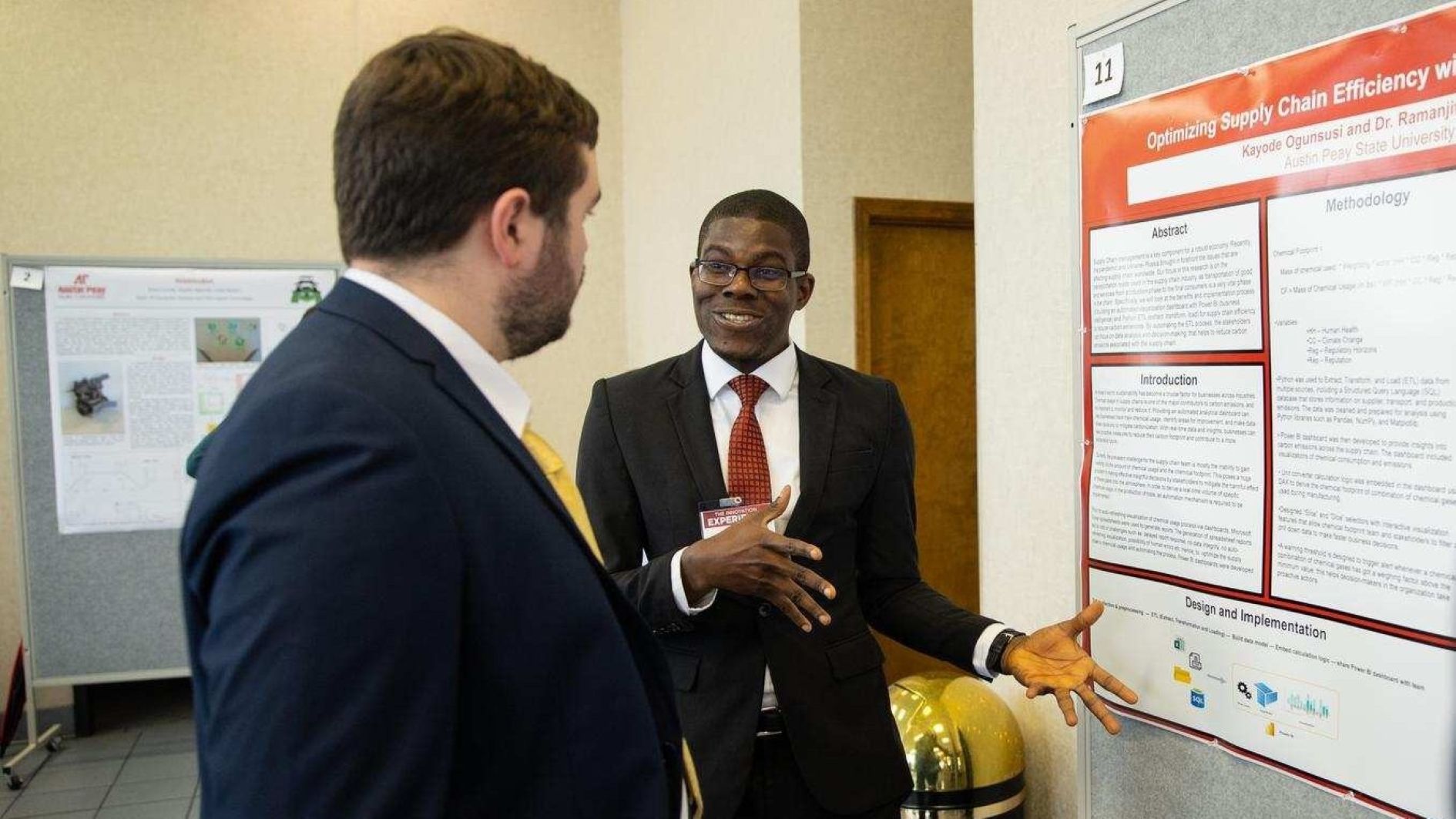
Amid the growing global demand for intelligent technologies that reduce carbon emissions and strengthen sustainable supply chains, Nigerian data analytics, artificial intelligence, and intelligent decision systems expert Kayode Ogunsusi has unveiled an innovative data-driven strategy that applies artificial intelligence (AI), predictive analytics, and advanced data visualization to improve supply chain efficiency while reducing environmental impact.
Ogunsusi, whose professional expertise spans enterprise data analytics, artificial intelligence, financial risk management, fraud prevention, predictive modeling, and intelligent decision systems, presented the research during the Austin Peay State University Innovation Experience in Clarksville, Tennessee.
His project, titled “Optimizing Supply Chain Efficiency with Data Visualization,” received the Second Place Innovation Award after demonstrating practical applications of AI and data analytics for addressing real-world operational and environmental challenges.
In a paper made available to newsmen during the event, Ogunsusi explained that organizations can no longer rely solely on traditional supply chain management approaches if they hope to remain competitive while meeting increasingly stringent environmental sustainability goals.
“Supply chain optimization is no longer just about improving operational efficiency. It has become a critical sustainability strategy. By leveraging artificial intelligence, predictive analytics, and interactive data visualization, organizations can identify hidden inefficiencies, reduce unnecessary fuel consumption, minimize waste, and significantly lower their carbon footprint while improving overall business performance,” Ogunsusi said.
He explained that businesses across the world are increasingly embracing intelligent technologies capable of transforming massive volumes of operational data into actionable insights, allowing decision-makers to respond faster to changing market conditions and optimize the movement of goods and resources across complex supply networks.

Ogunsusi disclosed that his research focused on developing analytics-driven decision support systems capable of identifying operational bottlenecks, streamlining logistics operations, optimizing transportation routes, improving resource allocation, and enhancing organizational sustainability through automation and intelligent data interpretation.
According to him, the research demonstrated that replacing manual analysis with AI-enabled, data-driven decision processes enables organizations to spend less time compiling reports and more time making strategic decisions that improve productivity while reducing environmental impact.
“The objective was to demonstrate that data should not merely be collected; it should be transformed into actionable intelligence that supports faster, smarter, and more sustainable decision-making. When organizations have access to real-time insights, they can optimize transportation routes, reduce excess inventory, eliminate avoidable delays, improve operational resilience, and significantly reduce greenhouse gas emissions,” he explained.
The practical significance of the research earned widespread recognition at the Austin Peay State University Innovation Experience, where Ogunsusi received the Second Place Innovation Award.
The annual innovation program brings together researchers, students, and leading industry representatives to showcase innovative STEM solutions capable of addressing complex real-world challenges.
Representatives from major organizations, including CDE Lightband, Electrolux, Trane Technologies, EnSafe, and Novelis, participated in evaluating projects and engaging innovators on practical industry applications.
Beyond optimizing logistics, Ogunsusi emphasized that artificial intelligence has become an indispensable tool for building resilient supply chains capable of anticipating disruptions before they occur.
He noted that predictive models can forecast demand fluctuations, identify supply shortages, optimize inventory levels, and improve resource allocation, enabling organizations to avoid costly interruptions while reducing unnecessary emissions associated with inefficient production and transportation.
“Artificial intelligence enables organizations to move from reactive decision-making to predictive planning. Instead of responding after problems occur, businesses can forecast disruptions, optimize inventory, improve demand planning, and make operational adjustments before inefficiencies escalate into significant financial and environmental costs,” he said.
Industry experts believe innovations such as these will become increasingly important as governments, manufacturers, and multinational corporations intensify efforts to achieve net-zero carbon emissions, strengthen supply chain resilience, and comply with emerging environmental regulations.
Beyond environmental sustainability, intelligent supply chain systems improve profitability by reducing operational waste, lowering transportation costs, improving customer satisfaction, strengthening business continuity, and enabling organizations to make more informed strategic decisions under rapidly changing market conditions.
Ogunsusi has built professional expertise across enterprise data analytics, artificial intelligence, financial risk management, fraud prevention, explainable AI, predictive analytics, and intelligent decision systems.
His work focuses on applying advanced analytics and trustworthy AI to strengthen operational resilience, improve financial decision-making, enhance cybersecurity, support data-driven governance, and enable secure, intelligent decision-making across critical industries.
He believes the convergence of artificial intelligence, automation, and advanced analytics will fundamentally reshape industries far beyond logistics by enabling organizations to transform data into strategic intelligence that drives operational excellence and long-term sustainability.
“The future belongs to organizations that can transform data into strategic intelligence. AI-powered analytics will continue to redefine how businesses operate, enabling them to achieve greater efficiency, reduce waste, strengthen resilience, improve decision-making, and contribute to a more sustainable global economy,” Ogunsusi stated.
Meanwhile, the Dean of the College of STEM at Austin Peay State University, Dr. Karen Meisch, described the Innovation Experience as an important platform for nurturing creativity and preparing students to solve real-world challenges.
“The Innovation Experience is a great opportunity for our students to showcase their creativity and innovative ideas while developing important skills such as collaboration, critical thinking, and communication. We are grateful for our industry partners who support and collaborate with our students, providing valuable real-world experience and helping prepare them for successful careers in STEM fields,” Meisch said.
With organizations increasingly seeking AI-driven solutions to environmental and operational challenges, experts believe innovations such as Ogunsusi’s demonstrate how advanced data analytics, artificial intelligence, and intelligent decision systems are becoming indispensable tools for reducing carbon emissions, improving supply chain efficiency, strengthening operational resilience, and supporting sustainable economic growth.
His work further illustrates the expanding role of data-driven innovation in addressing complex global challenges through practical, scalable, and intelligent technological solutions.

