 Follow Us on Google News


 Follow Us on Google Discover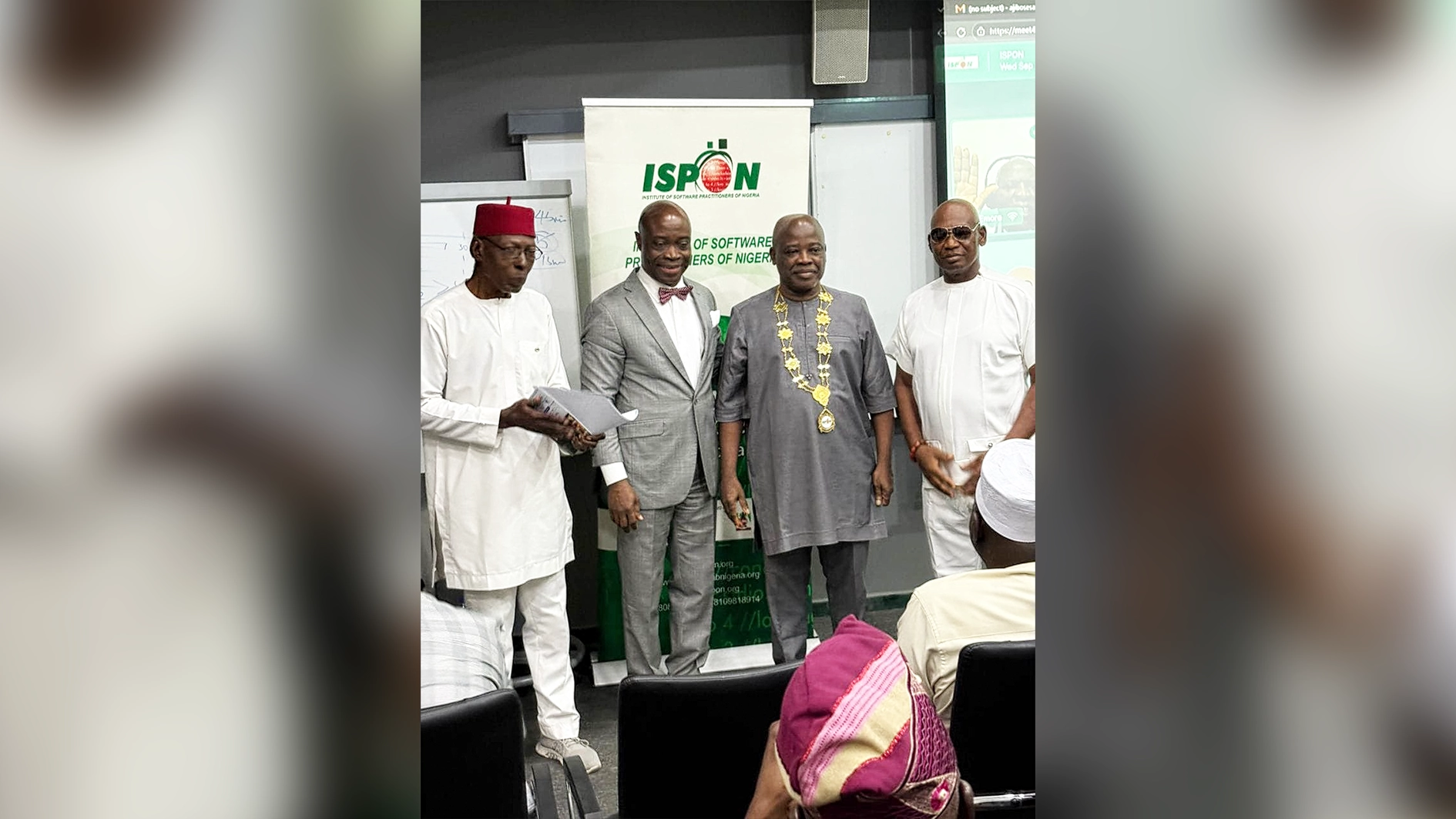
ISPON seeks government patronage, plans software industry registry
Software practitioners in Nigeria have expressed concern over the sub-sector’s 0.2 per cent contribution to the country’s gross domestic product (GDP) in the second quarter (Q2).
Under the aegis of the Institute of Software Practitioners of Nigeria (ISPON), the body lamented that the efforts of indigenous operators are being overshadowed by bureaucratic bottlenecks and low patronage, especially from ministries, departments and agencies (MDAs).
ISPON, through its new National Executive Council (NEC), inaugurated in Lagos, however, reaffirmed its commitment to closing the gap and establishing Nigeria as Africa’s dominant software powerhouse. It outlined key industry reforms, policy frameworks and market expansion strategies to achieve the objective.
The software practitioners, led by the Founder and Chief Executive Officer of Ziemozi Interactive Limited, James Agada, as the new president, noted that against the backdrop of rapid global technological evolution driven by artificial intelligence (AI), cloud computing and blockchain, Nigeria’s digital sovereignty rests firmly on its capacity to build, standardise and scale indigenous software solutions.
Agada, in his acceptance speech, said indigenous operators would begin addressing the discovery problem by launching a National Software Industry Registry within the next six months to document achievements and celebrate players in the industry.

“While our sector reportedly employs over one million people directly and indirectly, with more than 100,000 registered companies operating, the latest NBS reports indicate we contribute less than 0.2 per cent to the national GDP.
“Perhaps, this is an undercounting by the NBS. Or perhaps, the software consumed in Nigeria is simply contributing to the GDP of other nations. The licences, subscriptions, support fees and service fees we pay outward represent revenue that should be growing our own national GDP,” Agada stressed.
According to him, it is also telling that ISPON currently has fewer than 500 corporate members and 10,000 individual members.
“This is the multi-headed monster ISPON has battled since its inception; the growth of our software companies is capped by a lack of opportunity; that lack of opportunity is perpetuated by a lack of appreciation and patronage, and the cycle continues,” he said.
The new president, who submitted that other nations treat software as a highly strategic sector, stressed that they grow their local industries through deliberate government patronage, often acting as the initial testing grounds and providing the domain knowledge required to build world-class products.
He added that software companies in those countries had thrived because they possessed better business models, stronger organisational structures and a greater ability to attract and reward capital.
“We will tackle this monster head-on. We will ensure visibility through our Software Industry Registry. We will build robust partnerships and advocate fiercely across all economic sectors and within government,” Agada stressed.
Stakeholders and members at the event shared similar sentiments.
Representing the President of the Lagos Chamber of Commerce and Industry (LCCI), Aderonke Adeyegbe, said from agriculture to manufacturing, health to finance, trade to education, every sector depends on software to grow, compete and create jobs.
She said the digital economy was here and software was its foundation.
“For too long, Nigeria has relied heavily on imported software. This means we export capital, we export jobs, and we do not fully control the platforms that run our businesses and our government.
“This must change. And it will change through the work of ISPON and indigenous software development,” she stated.
Stressing the importance of indigenous software, Adeyegbe said: “First, it creates jobs and retains value. When Nigerian businesses use software built by Nigerians, the money circulates in our economy. It employs our developers, designers, and engineers.
“Second, it solves Nigerian problems. Indigenous software understands our markets, our regulations, our languages and our infrastructure. It is faster to deploy and easier to support.
“Third, it guarantees digital sovereignty and security. Our data, our institutions and our critical systems must be powered by technology that we own and control.”
According to her, LCCI is committed to the agenda. She said the chamber recently opened the LCCI Innovation Hub in Lagos, which would serve as a platform for co-creation, commercialisation and talent development.
“Through the hub and our 27 sectoral groups, LCCI will open market access for ISPON members. We will connect you to businesses that need solutions. We will advocate for the patronage of Made-in-Nigeria software in government and corporate procurement.
“ISPON, the opportunity before us is enormous. The National Digital Economy Policy, financial inclusion drive and government digitisation have created unprecedented demand for software.
“Let us seize this moment. Let us build the software here. Let us scale it from Nigeria to Africa and to the world,” she said.
From the perspective of the Association of Telecommunications Companies of Nigeria (ATCON), the inauguration of the new NEC came at a critical moment in Nigeria’s digital transformation journey.
Representing the leadership of ATCON, its Executive Secretary, Ajibola Olude, said software was no longer merely a component of the technology ecosystem, but increasingly the engine driving innovation, productivity, financial inclusion, digital services, artificial intelligence and the broader digital economy.
Olude said ISPON was a strategic and indispensable partner within the technology ecosystem.
He said telecommunications provided the connectivity infrastructure upon which the digital economy operated, while software provided many of the solutions, platforms and applications that transformed connectivity into meaningful economic and social value.
“Our organisations therefore share a common interest in building a stronger, more competitive and sustainable Nigerian digital ecosystem.
“There is a significant opportunity for ATCON and ISPON to deepen collaboration in areas including local content development, software innovation, cybersecurity, artificial intelligence, cloud services, digital skills development, technology standards, research and development, and the promotion of Nigerian technology companies,” he stated.
He said ATCON also believed that stronger collaboration between the two organisations could help accelerate the adoption of locally developed solutions across government and the private sector, reduce dependence on foreign technology, create jobs, and position Nigeria as a leading technology hub in Africa.
On his part, former ISPON President, Chris Uwaje, stressed the importance of dismantling mindset barriers and institutional bias.
He highlighted that several Nigerian software companies had attained international operational standards, including top-tier certifications across four separate International Organisation for Standardisation (ISO) benchmarks, with footprints spanning more than 25 African nations.
Despite these accomplishments, Uwaje criticised the tendency of public and private institutions to default to foreign enterprise resource planning (ERP) suites and other foreign software products, often driven by external market protectionism and a historical misperception of local capacity.
“The issue is not a lack of competence; it is a mindset problem. Foreign entities protect their own markets by convincing us that we lack capacity. That is a myth. We need strong regulatory frameworks and enshrined policies that actively support and protect local software development efforts,” Uwaje stressed.
On his part, President of the Nigeria Computer Society, Dr Muhammed Siraju Aminu, said the world was moving fast with AI, cloud computing and blockchain, describing them as the next wave of technologies that would not wait for Nigeria or any other country.
Aminu said the United States had just launched a one-million-mile rocket orbiting Earth, “that’s a statement that we must also put into context.”
According to him, available data also showed that Nigerians had never been short of knowledge, brilliance in software, tested software structures and standards to take on the market and scale.
“Today, more than ever before, the mission before us is to deliver the software promise to Nigeria, Africa and the world. No other nation in Africa can do it like Nigeria.
“And of course, we are pioneers. Today is not just a day to hand over or to make speeches; it is an instrument of leadership and office to govern the mission and aspiration of this body, but also to affirm our pioneering position and continuous renewal of the audacious promise to achieve the mission that Nigeria will lead, build and own the future of our digital sovereignty through software,” he stressed.

