 Follow Us on Google News


 Follow Us on Google Discover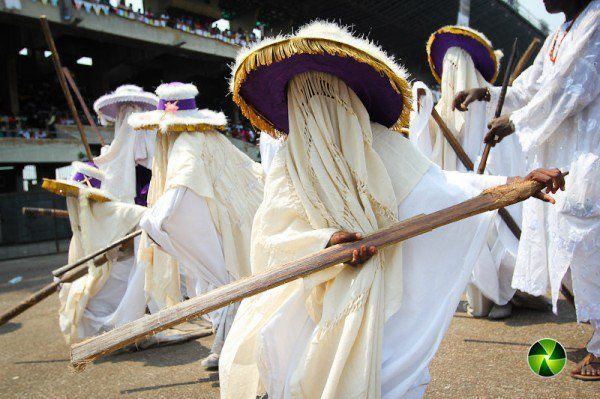
The radiant heat of the open sky, the wide gaze of a crowd within an amphitheater of shadows, an ancestral procession glides across the concrete floor. A sea of white-robed figures fills the frame, their forms cloaked entirely in flowing fabric white and cream, their faces hidden from the world veiled and capped in white furred purple hats.
The central figure, a young masquerader, commands attention with a forward lunge, gripping a long wooden staff whose grain catches the sunlight. Upon his head rests an elaborate hat, rimmed in deep purple and crowned with gold fringes, catching the light and movement like a halo caught mid-breath. The garb is voluminous, cascading in careful drapes, designed for anonymity. Around him, others in identical attire move in the likeness of a choreographed harmony, bringing life to their wind-blown cloth.
This image speaks of Eyo the famous Lagos elegant masquerade, an enactment of the visitation of the spirits of the dead checking on their earthly connections. What we see here is more than dance. It is a rite, a vessel of inherited power, a moving archive of lineage and reverence. The wooden staff, not merely a prop, is a symbolic extension of spiritual authority and mimicry of performance. Behind them, an amphitheatre with unseen faces, a modern world observing this tableau of heritage on tarred earth, bearing witness to a legacy that predates the roads beneath their feet. Every aspect the garments, the rhythm frozen mid-motion, the solemn coordination unlocks the code of cultural memory.
Chidozie’s visual appeal in this photograph thrives on contrast and texture. The dominant palette of soft ivory is gently offset by the deep plum and gold detailing on the hats, colors chosen not for mere aesthetic but for sacred resonance. The garments themselves, rich in pleats and flowing folds, absorb and reflect the ambient light, creating a dynamic play of shadow and luminosity adding to the depth to the composition. The raw wood of their staffs provides a textural counterpoint to the polished smoothness of fabric and floor.
Chidozie demonstrates a strong understanding of focus and framing. The primary subject is captured in sharp clarity, occupying the foreground with a deliberate sense of motion and poise. A relatively fast shutter speed freezes the precise moment the staff juts forward, while the aperture ensures a pleasing depth of field that keeps the background visible but not distracting. The natural daylight is handled with balance, neither overexposed in the whites nor lost in the shadows of the crowd. The image benefits from a mid-range ISO to retain detail and avoid grain, allowing texture and color to co-exist. The framing is low and angled, probably taken from a bending pose, slightly upward, adding importance to the figures and emphasizing their stately presence.
This photograph is a dialogue between tradition and modernity. It captures a moment that belongs to the sacred yet is staged within a space of public spectacle. The Eyo masqueraders, whose role is to mediate between ancestors and the living, here become performers before stadium lights and smartphone lenses. This dual existence mirrors the tension faced by many indigenous practices today how to remain rooted while visible in new ways. Chidozie with restraint and respect, does not intrude but rather observes, creating an image that is as much about reverence as it is about representation. It is a stillness that speaks, an image that holds time in its grip while allowing culture to move forward in its own footsteps.


