 Follow Us on Google News


 Follow Us on Google Discover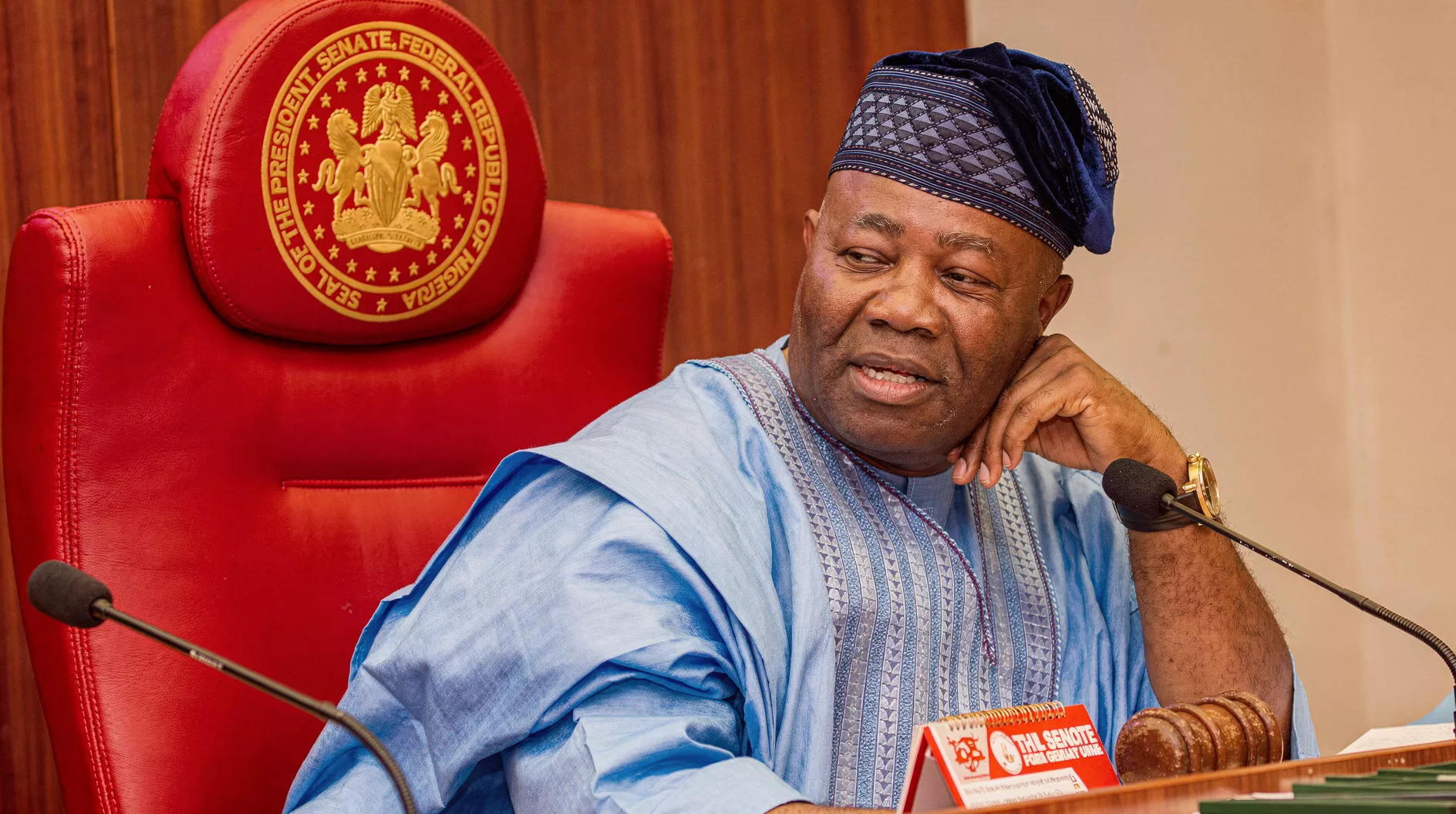
• Debate suspended as Senate mourns Rep Yaya Tongo
• NASS moves to place security funding in first-line charge
• State police may fail without addressing NPF’s challenges, ex-CP warns
President Bola Tinubu has transmitted a constitutional amendment bill seeking the establishment of state police to the Senate. The proposed legislation seeks to amend relevant provisions of the Constitution to provide the legal framework for the creation of state police in Nigeria.
The Senate President, Godswill Akpabio, disclosed this in a letter read during an emergency plenary session yesterday. Although the bill was transmitted with its various clauses, Akpabio did not disclose its details. He only stated that the relevant provisions were attached to the proposed legislation.
In the letter, Tinubu said his administration was committed to reorganising Nigeria’s security architecture to adequately protect the lives and property of citizens. He said the proposed legislation would complement the version of the state police bill earlier passed by the House of Representatives to address the country’s growing security challenges.
The House of Representatives had on June 11 passed the state police bill, while in the Senate, the bill scaled the second reading and was referred to its Committee on Constitution Review, mandating the Committee to determine whether a public hearing is required before the bill proceeds to further legislative stages. The Senate thereafter deferred decision on the substance of the proposal at this stage, pending the outcome of the Committee’s consideration.
Under Section 9 of the Constitution, a constitutional amendment bill must be passed by both chambers of the National Assembly, each by a two-thirds majority, in identical terms. Following passage by both chambers, the bill must be transmitted to the 36 State Houses of Assembly, where it requires the approval of at least 24 of them, before it is forwarded to the President for assent.

After reading the president’s letter yesterday, Akpabio referred the bill to the Senate Committee on Constitution Review for further legislative deliberation. He directed the committee to report back to the Senate on Wednesday for possible final consideration.
However, with the president’s transmission of the constitutional amendment bill, it remains unclear whether lawmakers will still conduct a public hearing in line with parliamentary practice before the final passage of the legislation.
Over the years, there have been calls from some state governments and civil society organisations for localised policing as incidents of armed robbery, communal clashes and other security challenges increased.
A National Conference was convened during the administration of former President Goodluck Jonathan in 2014, where the participants recommended the creation of state police as a strategy to reduce insecurity.
But the spiral cases of banditry, kidnapping, and other terrorist activities have led to the demand from governors and political leaders for the creation of state police lately.
In the absence of a formal state policing structure, some regions have established informal security outfits such as Amotekun in the South-west, Ebube Agu in the South-east, and Hisbah in the North-west.
DESPITE promising swift passage of the president’s amendment, plans by the Senate to commence deliberations on the proposed state police bill suffered an unexpected setback as lawmakers suspended all proceedings at an emergency plenary session in honour of late House of Representatives member, Yaya Tongo.
The upper legislative chamber had reconvened during its recess amid heightened anticipation that senators would begin consideration of the constitutional amendment bill seeking to establish state police formations across Nigeria. However, the atmosphere in the chamber turned solemn when the Senate President formally informed lawmakers of the passing of Tongo, who represented the Kwami/Funakaye Federal Constituency of Gombe State.
The lawmaker died on June 12 at Nizamiye Hospital in Abuja after a brief illness, bringing an abrupt end to a political career marked by grassroots engagement and public service.
Tongo was first elected into the House of Representatives under the Peoples Democratic Party (PDP) in 2019 before winning a second term in the 2023 general election. In March 2026, he defected to the African Democratic Congress (ADC), joining a growing list of lawmakers who switched political parties ahead of the next electoral cycle.
Announcing the decision to suspend legislative activities, Akpabio said the Senate would dedicate the day to mourning the deceased lawmaker and allow members to participate in funeral activities. Following the Senate President’s remarks, lawmakers stood in silence for one minute to honour the late legislator before the chamber adjourned.
The adjournment meant that consideration of several pending matters, including the state police bill transmitted by President Tinubu, was shelved till today.
MEANWHILE, the National Assembly is considering a constitutional amendment that would place security funding in the first-line charge of the Federation’s revenue as part of efforts to tackle the country’s growing security challenges.
The proposal is contained in Bill No. 8 among the measures recommended for passage by the House of Representatives Committee on Constitution Review. The amendment seeks to alter Section 81 of the Constitution to include the Armed Forces among institutions entitled to direct funding from the Consolidated Revenue Fund of the Federation.
Currently, agencies enjoying first-line charge funding under the Constitution include the Independent National Electoral Commission (INEC), the National Assembly and the Judiciary through the National Judicial Council (NJC). Speaking at the Chatham House Africa Programme Roundtable in London on Tuesday, Deputy Speaker of the House of Representatives, Benjamin Kalu, said security has remained the foremost priority of the 10th National Assembly since its inauguration in June 2023.
Addressing the theme, “Nigeria’s 2027 Elections: How to Ensure Electoral Integrity Amid a Deepening Security Crisis,” Kalu said the legislature has deployed its constitutional powers to confront insecurity through increased funding, enhanced oversight and ongoing efforts to establish state police.
He noted that allocations to the security and defence sector have risen from N2.98 trillion to N5.41 trillion in the 2026 budget, representing an 81 per cent increase over the past three years. According to him, committees of the House are working closely with the executive arm of government and security agencies to monitor expenditure and ensure effective implementation of security-related projects and programmes.
Kalu expressed confidence that sustained investment, stronger oversight mechanisms and institutional reforms would strengthen the country’s capacity to address insecurity and safeguard democratic processes ahead of future elections.
“Resources must translate into results and parliament’s role is to help ensure that they do that. Through its representative function, the House has considered over 1,500 substantive motions in its first three legislative years, between June 2023 and June 2026, with between 350 and 400 of them specifically focused on security matters.
“The majority addressed issues of urgent public importance, including banditry, kidnappings, attacks on farming communities, and the protection of vulnerable populations. These were not procedural gestures. They produced results.
“Resolutions led to the summoning of security chiefs before the House. They mandated the recruitment of forest guards. They secured commitments to protect schools in high-risk areas and to establish permanent security outposts in communities that had been left exposed.”
He disclosed that under its representative mandate, the House has considered over 1,500 substantive motions between June 2023 and June 2026, about 400 of which focused mainly on security, banditry, kidnappings, attacks on farming communities, and protection of vulnerable populations. According to him, the motions led to the concrete actions of summoning security chiefs, mandating recruitment of forest guards, securing commitments to protect schools in high-risk areas, and pushing for permanent security outposts in exposed communities.
The Deputy Speaker also said that the National Assembly has passed the revised Cybercrimes Act 2024 and the Control of Small Arms and Light Weapons Act 2024 while advancing the Joint Doctrine and Warfare Centre Bill for better coordination among armed forces.
BUT sounding a note of caution, a former Commissioner of Police and lecturer in the Department of Criminology and Security Studies, Lead City University, Ibadan, Dr Sybil Olufunmilayo Akinfenwa, has warned that the proposed creation of state police may not achieve its objectives unless the structural problems confronting the Nigeria Police Force (NPF) are first addressed. Akinfenwa gave the warning during Tea and Truth, a media programme organised by Ibadan 360 Production in Bodija, Ibadan, Oyo State.
The security expert said while calls for state police have continued to gain momentum as a solution to Nigeria’s worsening security challenges, policymakers must ensure that the weaknesses affecting the NPF are not replicated at the state level. “We must look at what makes the Nigeria Police Force fail. We should ensure that what affected the NPF does not affect state police so that the same issues do not come up again,” she said.
According to her, many of those advocating state police may not fully understand the operational realities and challenges confronting law enforcement agencies. “Those clamouring for state police are not insiders. If the people want state police, let us try it, but first let us examine the problems faced by the police,” she added.
Akinfenwa described the Nigeria Police Force as one of the most stressed institutions in the country, noting that officers are overstretched due to increasing security responsibilities. The police are the most stressed organisation. A lot of policemen are stressed out,” she said.
She urged Nigerians to become more involved in community security efforts, stressing that the fight against insecurity should not be left to security agencies alone.
“We must rise to deal with the situation. We should not sit and be complacent. It is not the time to rest. It is time to get up. While attention is often focused on terrorism, we must also address local crimes that affect our communities daily,” she said.
The former police commissioner also identified the absence of a harmonised national database as a major challenge hindering effective crime prevention and intelligence gathering. According to her, security agencies currently operate fragmented information systems, making collaboration and criminal tracking difficult.
“There is no harmonised database. Information is not harmonised; it is different across agencies. We need to harmonise the information. Let us bring it together and collaborate to track down criminals. We should start from the community level,” she said.
Also speaking during the programme, a national leader of the Oodua Peoples’ Congress (OPC), Mr Sina Akinpelu, called on political leaders to refrain from interfering in the operations of security institutions.
“Politicians must leave institutions alone and allow them to work. Let them stay away from security institutions and allow them to perform their duties effectively,” he said.
Akinpelu also appealed to the Aare Ona Kakanfo of Yorubaland and National Coordinator of the OPC, Otunba Gani Adams, to convene a meeting of all OPC groups across the South-West to strengthen collaboration in tackling insecurity.

