 Follow Us on Google News
 Follow Us on Google Discover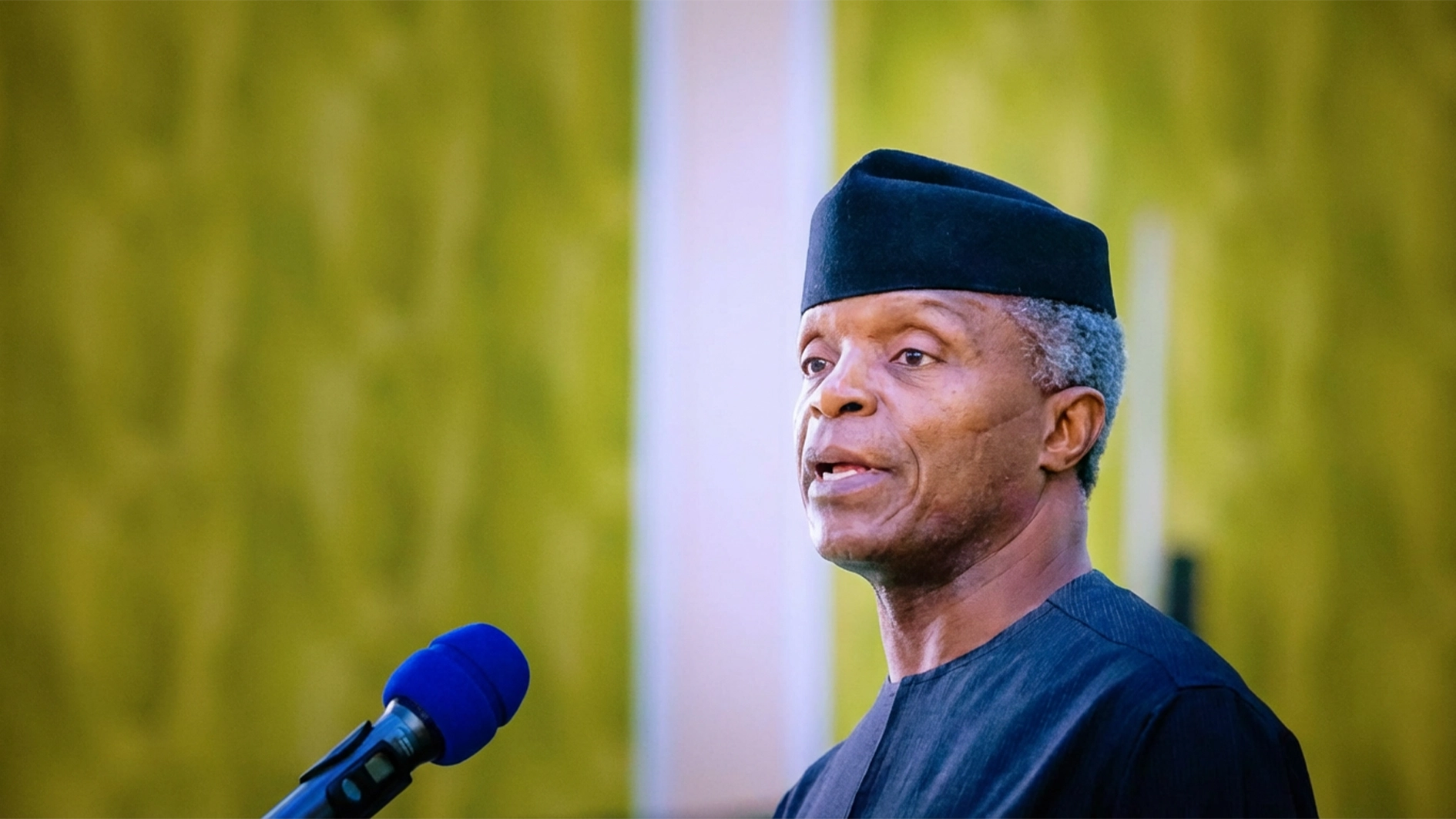
• Dictators like Weah shouldn’t be addressing lawyers, says Falana
• NBA backs tax ombud’s push for voluntary compliance
As the country prepares for the 2027 general elections, amid the crucial role the judiciary plays as the third arm of democratic rule, former Vice President, Prof. Yemi Osinbajo, has advocated a people-centred approach to justice reform, urging stakeholders to reposition the justice system around the actual needs and daily experiences of citizens.
Osinbajo spoke yesterday in Port Harcourt, Rivers State, during a panel session at the ongoing 66th Annual General Conference of the Nigerian Bar Association (NBA).
Represented by former Attorney-General and Commissioner for Justice of Lagos State, Mr Ade Ipaye, the former Vice President asserted that a citizen-focused justice system remains critical to strengthening governance and guaranteeing maximum protection for everyday Nigerians.
This was not without some flak for organisers of the NBA conference, as human rights lawyer and Senior Advocate of Nigeria, Femi Falana, criticised the NBA for inviting former Liberian President George Weah to speak at its annual conference.
Falana accused Weah’s administration of undermining judicial independence in Liberia and questioned the decision to give him a platform to address Nigerian lawyers on democracy and the rule of law.
The senior lawyer who spoke a day after Weah delivered the keynote address at the opening ceremony of the NBA’s 66th Annual General Conference in Port Harcourt, said the NBA should reconsider inviting African leaders whom he described as dictators to address its conferences.
He alleged that during Weah’s presidency between 2018 and 2024, Liberia’s judiciary was compromised to such an extent that citizens had to seek justice through the ECOWAS Court.
Falana cited the case involving the Mandingo people of Liberia, whose landed properties were allegedly confiscated during the country’s civil war. According to him, although the ECOWAS Court ruled in favour of the affected people, Weah’s administration failed to enforce the judgment.
BUT speaking yesterday on how the judiciary can effectively play its role in a democracy and highlighting the need for data-driven strategies, local ownership, and strategic prioritisation, Osinbajo, also a Senior Advocate of Nigeria (SAN), stated that reform efforts must start with rigorous data collection on justice needs and case outcomes.
“What is measured is what gets funded and fixed,” Osinbajo declared. He pressed the legal community to prioritise high-impact sectors, particularly pre-trial detention, small claims courts, first-response mechanisms, and legal assistance, adding that early successes in these areas would build support for more difficult reforms.
According to him, justice reform would be far more effective when domesticated and adopted by state governments, noting that it must be “embedded in institutions, rather than treated as a government-only initiative.”
Addressing members of the Bar, the law professor called on the NBA to take the lead in driving policy, professional development, and structural reforms that expand access to justice while maintaining quality and ethical standards.
He urged the association to champion continuous education in mediation, legal tech, legal aid, and community justice, while pushing for improved funding across the broader justice sector.
The former Vice President particularly singled out pro bono work as a game-changer, noting that a legal profession of the size of Nigeria’s, if it took its pro bono obligations seriously, “could provide a significant national legal aid mechanism for citizens who could not afford legal representation.”
He argued that the central issue is no longer whether Nigeria needs justice reform, but whether legal custodians are prepared to redesign the system from the standpoint of those who need it most. “The people-centred approach asks us to move from abstraction to reality, from system convenience to citizen need, from exclusive pathways to inclusive ones,” he stated.
Osinbajo further emphasised that justice should be viewed not merely as an institutional function, but as “a living public good.”
Recalling the historical role lawyers played in Nigeria’s struggle for independence and the fight against military rule, the former Vice President charged the current generation of legal practitioners to uphold that legacy. “It falls to our generation today to prove that law can give service to the people, all of the people,” he said.
Maintaining that a people-centred justice system would strengthen government, make the legal profession more transparent, and protect citizens, Osinbajo concluded: “That surely is in everyone’s interest.”
MEANWHILE, Nigerian lawyers have thrown their weight behind the Office of the Tax Ombud’s drive to increase voluntary tax compliance, describing taxation as critical to funding infrastructure and social services. At a panel session titled ‘Pay Now, Prosper Later’ during the NBA conference in Port Harcourt, participants said improving taxpayer trust is key to raising revenue without raising taxes.
The Tax Ombud, Dr John Nwabueze, said the Office was created to address grievances that discourage compliance and to make tax administration more transparent. “Since January, we have received 22 complaints and resolved 14 efficiently,” Nwabueze said.
“Our goal is to alleviate administrative burdens and strengthen confidence in the system so that more Nigerians pay their taxes willingly.”
He added that the Office, though non-judicial, provides early resolution of disputes and can ease the burden on courts.
Senior Advocate of Nigeria, Ahmed Raji, and other panellists agreed that a fair and accountable tax system is necessary to fund national development. The Office urged citizens with complaints against any tax authority to come forward as it expands its outreach nationwide.
Also, Senator Osita Izunaso has called for the effective implementation of Nigeria’s new tax reforms, stressing that increased taxation must be matched by improved public services, transparency and accountability.
Izunaso, speaking at the ongoing NBA conference on the theme, “Pay Now, Prosper Later: Making Nigeria’s New Tax Reforms Work in Practice,” said the success of the reforms would depend less on the passage of legislation and more on how effectively the new framework was implemented.
According to him, the objective of the reforms should not be viewed simply as an attempt by the government to collect more taxes, but as an effort to establish a tax system that is simpler, fairer, more transparent and easier to administer, while generating the revenue required for sustainable national development.
He said the reforms should harmonise Nigeria’s tax framework, broaden the tax base, reduce multiplicity and duplication, improve compliance, modernise tax administration and create a more predictable environment for businesses and investors.
Izunaso stressed that low-income Nigerians and small businesses must be protected, while individuals and businesses with greater economic capacity should make a fair contribution.
“The principle should be straightforward: everybody should contribute according to the law and according to their capacity, but nobody should be subjected to an arbitrary or unnecessarily burdensome tax system,” he said.
He called for a sustained national campaign to explain, in simple language, who is liable to pay tax, what income is protected, what businesses are required to do, how VAT operates, how taxpayers can obtain and use their Tax Identification Number, when returns are due, available deductions and exemptions, and taxpayers’ rights.

