 Follow Us on Google News
 Follow Us on Google Discover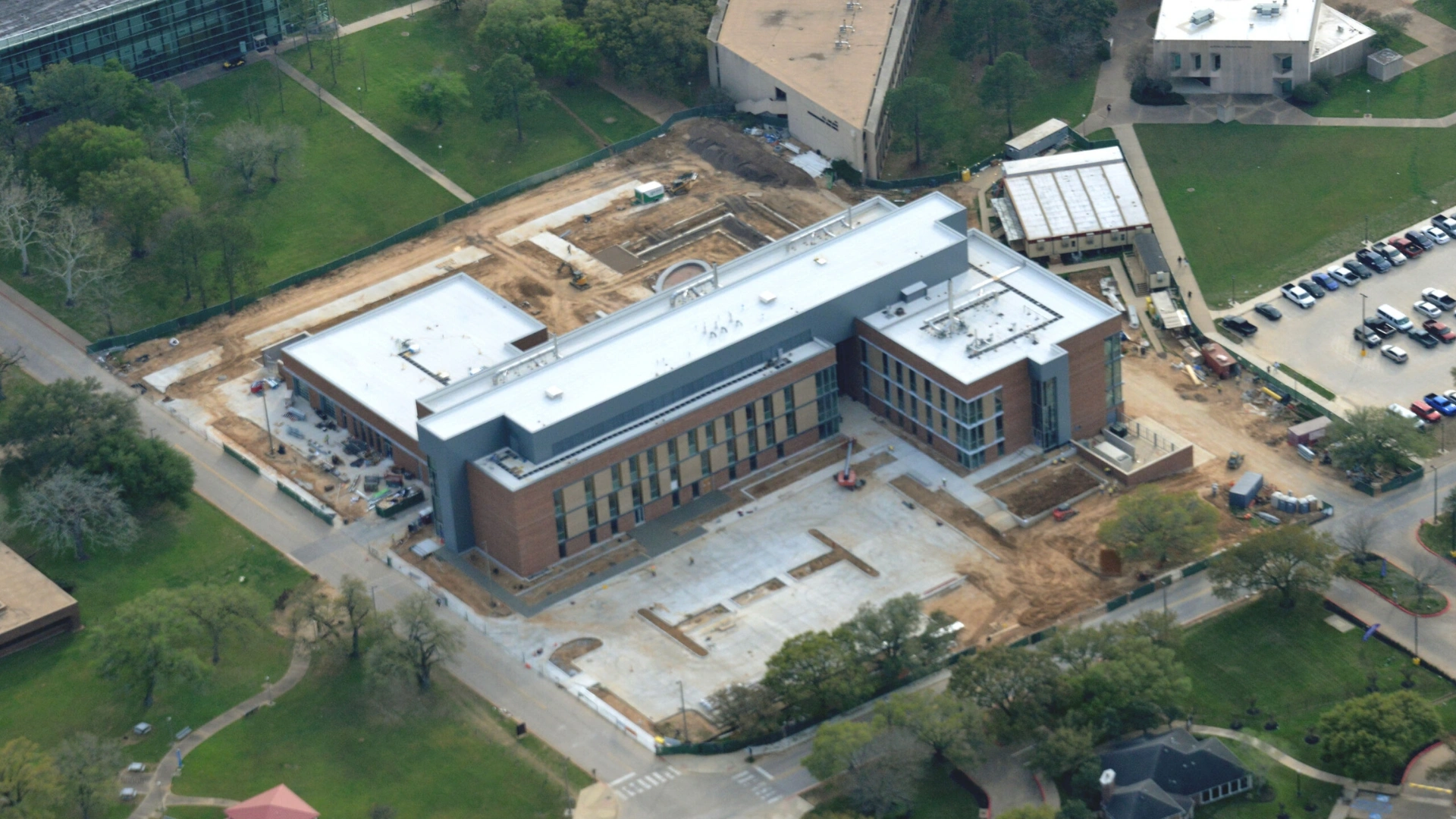
At Prairie View A&M University, computer scientist Sheriff Adepoju is exploring how data universities already have could help reduce one of their biggest energy costs.
Every weekday morning, hours before the first student swipes into the Roy G. Perry College of Engineering at Prairie View A&M University, the building goes to work.

Air handlers spin up. Chilled water moves through ceiling pipes. Vents push conditioned air into classrooms that will remain empty for hours, and in some cases, all day.
No one necessarily designed it that way. It is simply how many buildings operate.
Heating, ventilation and air conditioning (HVAC) is among the largest energy loads in commercial buildings, while conventional systems often rely on schedules created years earlier and adjusted only occasionally. The building cools or heats spaces on the assumption that someone might arrive.
Sheriff Adepoju, a researcher in the university’s Department of Computer Science, asked a different question: what if the building already knew who was coming?
The data was already there
His answer starts with the registrar’s office.
Every semester, a university produces a detailed map of expected human occupancy: the class schedule. It shows which room is being used, at what time and, in many cases, how many students are enrolled.
It is not merely a forecast. It is a timetable that thousands of people are expected to follow.
Much of the research into occupancy-aware HVAC control takes a different approach, relying on hardware such as carbon-dioxide sensors, motion detectors, Wi-Fi connection counts or cameras to estimate the number of people in a space.
Those technologies can be effective, but they require equipment, installation and maintenance and, in some cases, raise privacy concerns.
They also share a fundamental limitation: they detect occupancy after people arrive. By then, a room may already be too warm or too cold and the HVAC system has to respond.
A class schedule, by contrast, gives a building information before the door opens.
For institutions operating with constrained capital budgets, equipping every classroom with sensors can be a significant investment.
Adepoju’s framework, called AIRFLO – AI-powered Robust Framework for Learning to Optimise HVAC Energy Consumption – takes another route. It uses occupancy information from class schedules and applies machine learning to estimate appropriate temperature settings for a space.
The goal is to move from a static HVAC timetable towards automated, occupancy-informed control.
His test case is ENCARB, the Engineering Classroom and Research Building, a facility he encounters regularly.
Rather than modelling a generic office tower or relying solely on an old benchmark dataset, Adepoju modelled a building within his own university environment, using the schedule that governs its classroom activity.
How it works
The technical approach is deliberately conventional.
Adepoju trained the framework using supervised machine learning and an ensemble of multilayer neural networks, drawing on data from HVAC service periods in ENCARB. He then evaluated its performance against an independent validation set.
Ensemble methods may not attract the attention generated by newer artificial intelligence techniques, but they can be useful where datasets are limited or noisy – conditions common in real-world building environments.
The research also identifies possible directions for further development, including convolutional neural networks for richer representations and graph neural networks capable of capturing relationships within a building.
Rooms sit beside rooms. Zones share air handlers. Heat can move from a crowded lecture hall into an adjoining seminar room.
A building, in other words, is a network, and future versions of the framework could seek to model it as one.
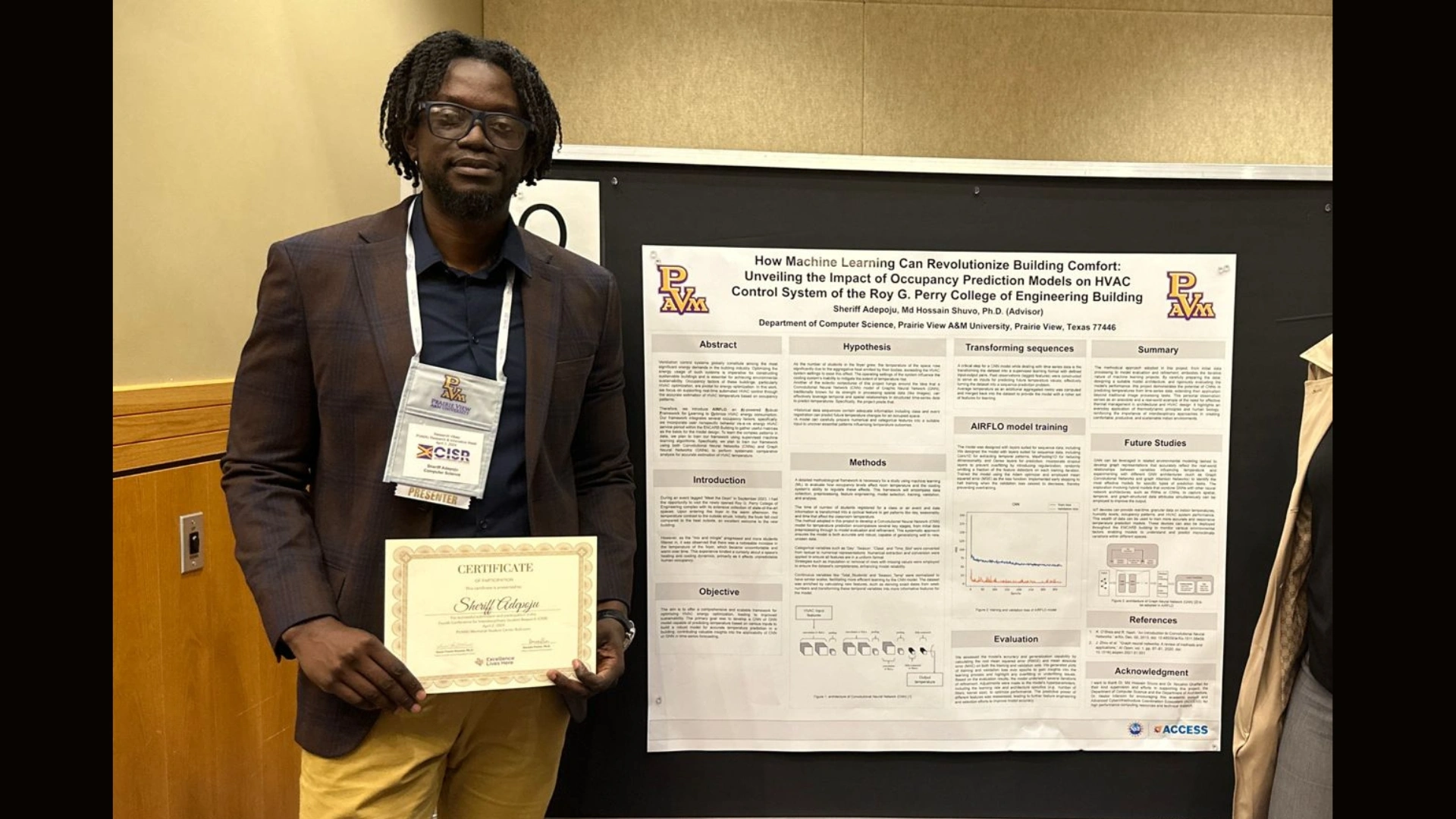
The research was published in 2025 in the World Journal of Advanced Research and Reviews under the title, “How machine learning can revolutionise building comfort: Accessing the impact of occupancy prediction models on HVAC control systems.” It appeared on pages 2315 to 2327 of volume 25.
Adepoju has also presented the work at a poster session, where he outlined the abstract, hypothesis, methodology, evaluation and areas for future study while responding to questions from attendees.
His academic adviser was present alongside him.
The funding acknowledgements on the poster also point to the role of research grants in supporting work of this kind at universities.
Why it matters beyond one campus
The challenge of reducing building energy consumption is no longer simply a question of whether efficient equipment exists.
Efficient HVAC equipment and advanced control systems are already available. A significant challenge is operational: buildings can continue to run according to defaults that are rarely revisited, conditioning spaces even when they are unoccupied.
Approaches such as AIRFLO are potentially attractive because they seek to make use of information institutions already collect.
A university interested in exploring schedule-driven HVAC control would not necessarily have to install a sensor in every room. It could begin with existing occupancy data and software capable of interpreting it.
That possibility could be relevant beyond universities.
School districts, hospitals and other large institutions operate facilities with substantial energy requirements and often maintain detailed schedules in digital systems.
However, the research itself is measured in its claims. It presents a framework, an initial training and validation exercise, and a roadmap for further comparative analysis. It does not establish that the problem of automated, energy-efficient HVAC control has been solved.
That distinction matters in a field where ambitious claims about artificial intelligence can sometimes run ahead of evidence.
For now, the Perry College of Engineering still begins its mornings in much the same way as many other buildings: conditioning rooms before all of their occupants arrive.
Adepoju’s research is exploring whether the building can be given enough information to make a better-informed decision first.

