 Follow Us on Google News
 Follow Us on Google Discover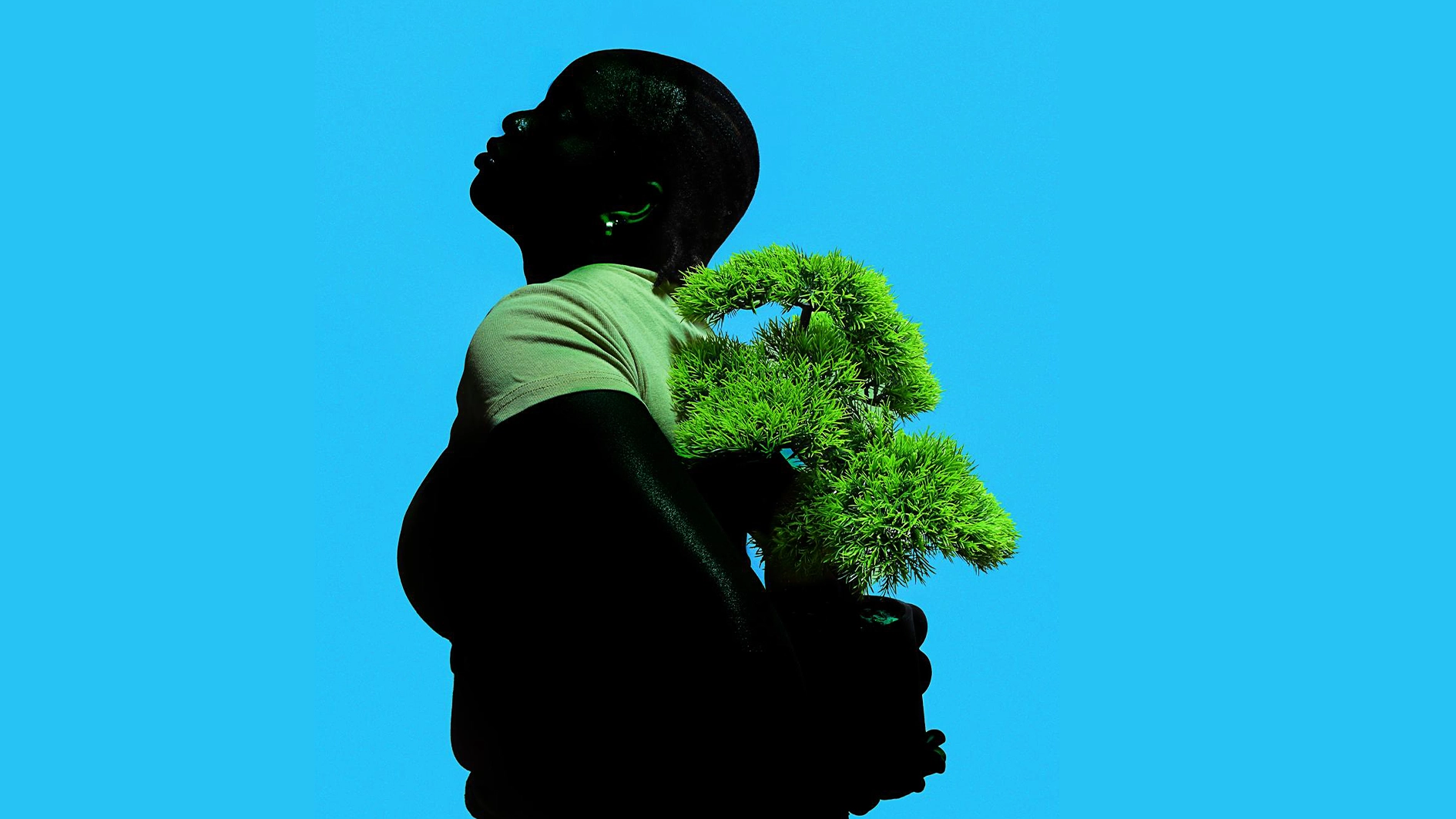
Abiola Badmus Moshood’s photograph, Bonsai, is a quintessential example of conceptual portraiture.
In the photograph, Moshood, working through his visual practice Mux Imagery, exalts Nubian skin while staging a subtle psychosocial commentary on the Black woman and, more broadly, on Blackness itself.
It is a portrait built around a relatively simple gesture: the subject holds a bonsai close to herself and looks upward. There is no elaborate physical action or crowded environment competing for attention. Moshood allows the body, the plant, colour and the direction of the sitter’s gaze to carry the photograph.
The placement of the bonsai beside such a strikingly dark-skinned figure becomes central to the image. Bonsai cultivation has long been associated with patience, care, tranquility and an intimate relationship with growth. Within Moshood’s composition, those associations can be extended towards ideas of purity, fertility and the generative possibilities that abound within the Black person.
Further, Bonsai packs a wider cultural resonance. Across the Black race, there have been revolutions, innovations, inventions and masterpieces that have defined the spirit of entire generations. The point here is not to compare Black achievement against that of other races. Moshood’s photograph feels more interested in extolling this pristine facet of Black existence on its own terms: its capacity to create, nurture, endure and continually produce new forms of beauty and thought.
The photograph is especially interesting because Moshood does not communicate these possibilities literally. There are no obvious historical references and no attempt to overload the frame with recognizable cultural symbols. Instead, he allows visual relationships to perform much of the intellectual work. The body and the bonsai exist together. The upward gaze introduces another suggestion of aspiration, contemplation or even transcendence. The stillness of the sitter gives the photograph an almost meditative quality.

It is here that Moshood’s photography begins to operate as a visual medium of communication rather than simply an exercise in capturing appearance. He uses colour as language, light and shadow as syntax, and composition as the structure that holds the sentence together.
The photograph can therefore be encountered at two levels. There is the immediate visual pleasure of the portrait itself, and then there is the collection of associations that begins to emerge once the viewer spends time with the objects, posture and tonal relationships inside the frame.
Also, light and shadow are particularly useful to this approach. Moshood does not appear interested in revealing every detail of the sitter. Darkness becomes part of her presence. Her skin is allowed to carry its own visual weight while selected areas of the composition emerge more forcefully around it. This restraint matters because the portrait concerns Blackness without turning Blackness into spectacle. The sitter is not presented as an anthropological subject or as someone whose identity requires explanation. Her presence is sufficient. Everything else in the composition expands what that presence might mean.
The bonsai strengthens that reading because it introduces another form of life without overwhelming the human figure. Its relationship to the sitter can accommodate several interpretations. It might suggest fertility and regeneration. Its careful cultivation can evoke discipline and patience. Its compact form can represent concentrated possibility: something capable of enormous complexity despite being contained within a relatively small physical space. Beside the Black woman, those qualities begin to echo differently.
There is also an interesting contradiction within the photograph. A bonsai exists because natural growth has been deliberately shaped. It is alive, yet carefully controlled. That tension introduces another possible psychosocial reading of the Black experience. Across history, Black people have repeatedly produced extraordinary cultural, intellectual and political movements while living within environments that attempted to restrict the scale of their possibilities. Moshood does not state this directly, and the photograph does not require such an interpretation to function. Still, conceptual portraiture becomes most compelling when an apparently simple arrangement can sustain these wider associations without collapsing into a single fixed explanation.
This is perhaps the strength of Bonsai. Moshood begins with the familiar vocabulary of portrait photography: a person, an object, a pose, and uses those elements to construct something more contemplative. The photograph is beautiful before it is explained. Its symbolism arrives afterwards.
This distinction is as important as the work itself. Conceptual photography can sometimes become dependent on lengthy artist statements to supply ideas that the image itself struggles to communicate. Bonsai avoids much of that problem. The sitter’s darkness, the living green presence of the bonsai, her upward gaze and the deliberate simplicity of the composition already establish an emotional and intellectual field for the viewer to enter. Moshood leaves enough uncertainty for interpretation while placing enough visual information inside the photograph to guide it.
Within Mux Imagery, Bonsai therefore demonstrates Moshood’s interest in using photography to think through Black identity, beauty, growth and cultural possibility. More importantly, it reveals the beginnings of a visual grammar in his practice. Colour speaks. Shadow withholds. Objects acquire symbolic lives. Composition decides how these individual elements converse.

