
 Get Guardian on Google
Buying reagents from abroad goes better when the lab treats the paperwork as part of what it’s paying for. That means a certificate of analysis for the actual batch, the HPLC and mass spectrometry data behind it, the name of the lab that did the testing, and labelling that makes clear the product is for research only. In Nigeria, there are two more jobs on top of that: getting the right NAFDAC import permit, and making a naira budget cover costs that are set in dollars or euros.
The currency part has become hard to ignore. When the Central Bank of Nigeria liberalised the foreign exchange market in mid-2023, the naira dropped sharply. Reagents whose prices abroad had hardly changed suddenly cost far more in naira. One study surveyed 413 academic staff at six Nigerian universities and found that research output fell as the naira lost value. Grant sizes don’t leave much room for mistakes either. In TETFund’s 2025 National Research Fund cycle, single awards ran from about ₦13.7 million to ₦50 million, and that money has to cover equipment, staff and fieldwork as well as reagents. If a batch turns out to be unusable, there is often nothing left to reorder with, and a replacement has to wait for the next tranche or another funding source. That can hold a project up for months.
What a supplier’s documents should actually prove
A certificate of analysis (COA) is the supplier’s own report on its own product, and an outside lab won’t always get the same result. One research group tested this directly. They ordered synthetic peptides that were supposed to be at least 95% pure and ran the analysis themselves. Only 44% passed. In one sample, the main compound wasn’t even the peptide they had ordered. Their advice to other researchers was simple: don’t rely on the supplier’s certificate alone, and check in-house where you can.
A peptide can also match its label and still cause trouble. Synthesis sometimes leaves behind versions of the sequence with an amino acid missing or added, and purification leaves counter-ions in the powder. One of the most common, trifluoroacetate (TFA), cut cell numbers in osteoblast and chondrocyte cultures at concentrations as low as 10⁻⁸ M. In cell experiments, that’s enough to hide a real effect, or to make a peptide look as though it’s slowing growth when the TFA is doing it.
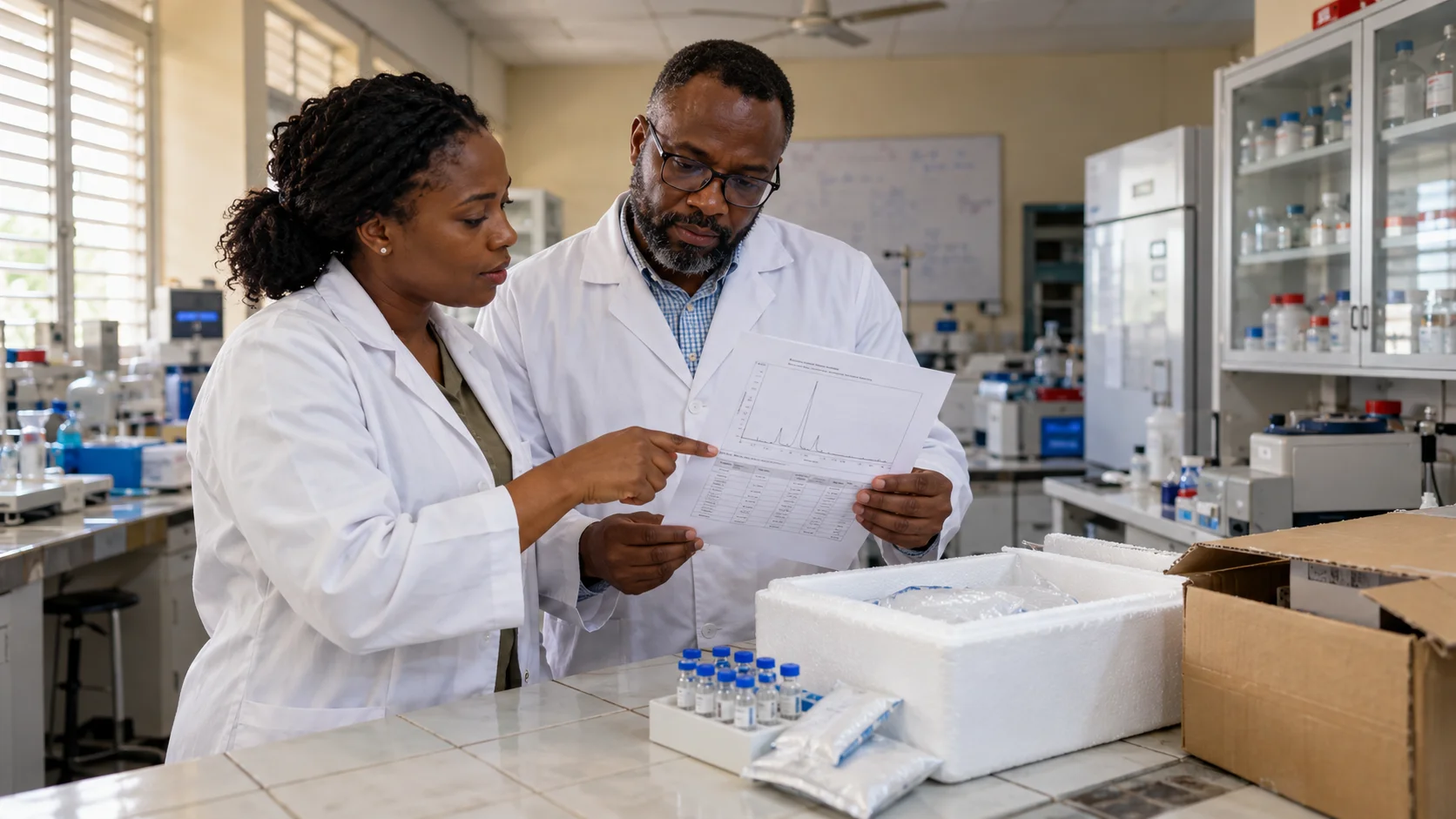
So before paying, it’s fair to ask the supplier for a few things. The COA should carry the same lot number that will be on the vial. A purity figure on its own isn’t much use; ask to see the HPLC chromatogram it came from, and the mass spectrometry result that shows the molecule weighs what it should. Net peptide content and the counter-ion are worth asking about as well, since a high purity number says nothing about how much of the powder is peptide. Then there’s the testing lab. A supplier should be able to name it, and say whether it holds ISO/IEC 17025 accreditation – the international standard labs use to show their testing is competent. And check what shipping and storage conditions the product was tested under.
The product page is worth reading closely too, and AOD-9604 shows why. It’s a synthetic fragment of human growth hormone, designed to study the hormone’s effect on fat metabolism separately from its effects on growth. In mouse studies it increased fat breakdown and fat oxidation, and labs still use it to explore how lipolysis is regulated. Its clinical history is well documented: it was tested in people as a potential obesity treatment, but that programme ended in 2007 and it has not been approved as a medicine, so today it is used as a research tool. For a lab working on lipid metabolism, a good listing for an AOD 9604 peptide for sale looks like any other well-documented reagent: lot-specific HPLC and MS data, stated peptide content, clear storage conditions and research-only labelling. A page that skips the data and talks about weight loss instead is telling you something different about the seller.

Comparing quotes: the price of usable peptide
A vial’s label weight and the amount of peptide inside it are two different numbers. According to Bachem, research peptides are usually more than 95% pure by HPLC, but the peptide itself may make up only 70-90% of the powder. The rest is counter-ions and leftover moisture.
Here’s how that plays out. Say two suppliers sell a 10 mg vial for the same price. One has 85% net peptide content, the other 70%. The first vial holds 8.5 mg of actual peptide and the second holds 7 mg – about 18% less for the same money. To run the same number of experiments with the second supplier, a lab would need to buy roughly a fifth more. And if a supplier won’t tell you the peptide content at all, you can’t make this comparison, which says something in itself.
Then there’s everything around the item price. Shipping, cold packs, permit fees and customs duty can add a lot. Look at who is paying the duty: on DDP (delivered duty paid) terms it’s the seller, on DAP (delivered at place) it’s you. It also helps to compare quotes in the currency the lab will actually pay in. The naira still moves around, and the cost on payment day may not match the cost on the day of the quote.
Permits and paperwork in Nigeria
You can’t just order laboratory chemicals and pick them up. Import permits for industrial and laboratory chemicals come from NAFDAC’s Chemical Evaluation and Research Directorate, and the application goes through the Single Trade Window portal. You list the chemicals, the quantities and what they’re for, and you need suitable storage. Importing chemicals without a valid permit is an offence. Renewals should start three months before the permit runs out, and anything not on the current permit needs extra approval.
Getting the goods through the port is a separate process. NAFDAC’s clearance guidelines allow a consignment to be held if lab analysis comes back unsatisfactory, which is why patchy or contradictory supplier documents can end up costing weeks.
One thing is worth sorting out early. It isn’t always clear whether a synthetic peptide counts as a laboratory chemical or falls into another category, such as pharmaceutical raw materials, and the published guidelines don’t answer that for every compound. It’s much easier to ask the directorate before placing the order than to find out at the port.
When the parcel arrives
None of this takes long. Check every vial’s lot number against the COA. Note the date the parcel turned up, how the packaging looked, and the temperature indicator reading if the box had one. If something doesn’t match, get in touch with the supplier the same day – the longer you wait, the harder the shipment is to trace.
Storage brings a problem that suppliers’ handling guides rarely mention: power cuts. Bachem’s advice is to keep freeze-dried peptides below −15 °C, and to let a cold vial come up to room temperature in a desiccator before you open it – peptides soak up moisture from the air quite readily. Lose power for a few hours and the freezer can’t do either job properly. Where possible, put reagent freezers on a voltage stabiliser and a backup supply, and keep a simple log of temperatures and interruptions. GenScript also suggests splitting freeze-dried peptide into portions matched to daily needs, so the same vial isn’t opened over and over.
Getting more from a tight budget
Most of the savings come from avoiding failed or delayed orders rather than from finding a cheaper vial. Ordering peptides dry, as a freeze-dried powder, helps: they generally handle transit better than solutions, which matters when clearance drags on. Departments that buy together can share one permit application, one shipment and one set of import costs. Permit and renewal dates should go into the project plan from the start, not be squeezed in before a grant deadline.
For any reagent a major experiment depends on, set some money aside for an independent check. In the study mentioned earlier, nobody would have caught the problems if the researchers hadn’t tested the peptides themselves. And keep the records. TETFund pays research grants out in stages, so lot numbers, COAs, permits and storage logs make the reporting side a lot less painful.
The 2026 National Research Fund cycle has ₦10 billion behind it, more than any cycle before. How much of that ends up as solid results will depend, in part, on what happens between a supplier’s website and a lab bench in Zaria, Ibadan or Nsukka.
Products discussed in this article are intended strictly for laboratory research. They are not for human or veterinary use.
Sources
- Verbeke F, Wynendaele E, Braet S, D’Hondt M, De Spiegeleer B. Quality evaluation of synthetic quorum sensing peptides used in R&D. Journal of Pharmaceutical Analysis.2015;5(3):169–181.
- D’Hondt M, Bracke N, Taevernier L, et al. Related impurities in peptide medicines. Journal of Pharmaceutical and Biomedical Analysis.2014;101:2–30.
- Cornish J, Callon KE, Lin CQ, et al. Trifluoroacetate, a contaminant in purified proteins, inhibits proliferation of osteoblasts and chondrocytes. American Journal of Physiology.1999;277(5):E779–E783.
- Heffernan M, Summers RJ, Thorburn A, et al. The effects of human GH and its lipolytic fragment (AOD9604) on lipid metabolism following chronic treatment in obese mice and β3-AR knock-out mice. 2001;142(12):5182–5189.
- Development of AOD-9604 in obesity terminated following phase IIb results. 2007.
- US FDA. Evaluation of AOD-9604-related bulk drug substances: briefing document for the Pharmacy Compounding Advisory Committee. 2024.
- Care and handling of peptides.
- Peptide storage and handling guidelines.
- ISO/IEC 17025 – Testing and calibration laboratories.
- Guidelines for obtaining permit to import industrial and laboratory chemicals (new applicants).
- Guidelines for renewal of permit to import industrial and laboratory chemicals.
- Guidelines for issuance of additional permit to import industrial and laboratory chemicals.
- Guidelines for clearance of imported general chemicals, agrochemicals and raw materials.
- Adeyanju J, Nwaodike CA, Aina AD. Currency devaluation-induced inflation, university academic staff research output and coping strategies. African Journal of Stability and Development.2025;17(1):484–520.
- Financial Nigeria. How exchange rate stability and local production can rebuild Nigerian science. 2026.
- Voice of Nigeria. Nigeria awards ₦7.5bn grants to 174 research teams nationwide. 2026.
- News Agency of Nigeria. TETFund awards ₦7.5bn research grants to 174 researchers. 2026.
- The Guardian Nigeria. FG approves ₦10 billion TETFund research grants. 2026.