 Get Guardian on Google
Northern Nigeria faces a defining dilemma ahead of the 2027 general election: whether its fear of a one-term presidency will overshadow the region’s urgent demand for good governance. The APC’s retention of a same-faith presidential ticket and the early manoeuvres of aspirants eyeing 2031 have further deepened the North’s political predicament, LEO SOBECHI reports.
Whether in the North or South, Nigeria’s march towards its eighth general election cycle is presenting politicians and voters with difficult choices. Some of the unresolved issues from the 2023 election are already shaping the political narratives ahead of the 2027 poll, with zoning, religious balancing and the performance of the incumbent government emerging as competing considerations.
While candidates from the South largely consider power rotation essential to national cohesion and political stability, former Vice President Atiku Abubakar, the leading presidential contender from the North, has moved away from his earlier embrace of zoning, insisting on every Nigerian’s constitutional right to contest for the presidency.
Although the Muslim-Muslim ticket adopted by the ruling All Progressives Congress (APC) has not attracted as much criticism as it did in 2023, its implications for the North’s political future are generating fresh concerns, particularly among some second-term governors looking beyond 2027 to the 2031 presidential contest.
Sources within the APC national leadership disclosed that President Bola Ahmed Tinubu’s reported understanding with Middle Belt leaders had unsettled sections of the North. The President was said to have assured the leaders that if they supported his re-election, his administration would back the emergence of a Christian from their zone as his successor in 2031.
The alleged understanding has reportedly prompted some core northern politicians to reconsider the implications of another four years of the Tinubu-Shettima administration for their political fortunes.
A source within the Northern Governors’ Forum told The Guardian that confirmation of the reported arrangement had contributed to the lukewarm attitude of some governors towards Tinubu’s re-election campaign.
He said the prospect of the North-Central securing the 2031 presidential ticket had raised questions about the political relevance of other northern blocs, particularly the North-West, which considers its voting strength a major bargaining advantage.
“Those of us from the North-West believe that our voting numbers should confer on us some level of respect when political deals are to be struck. The North-Central does not have the numbers and they are not a voting bloc.
“How can the President sell that idea to the Middle Belt? We see it as a grand plan to bury the North politically. I can tell you that the proposition has already divided the APC into three tendencies.
“Those from the North-East believe that the Vice President, Kashim Shettima, should be supported to succeed the President instead of throwing him under the bus, as President Muhammadu Buhari did to Prof. Yemi Osinbajo.
“There are many state governors warming to the Vice President in the emerging realities of the APC. The division among the states is too deep to dismiss, and the President does not want to involve himself because he has a crucial election ahead of him.
“Then you saw how the President bought into the Rainbow Coalition. Some of us close to the FCT Minister, Nyesom Wike, tried to persuade him to join the APC, but he had his calculations. It is possible that Wike has foreseen the likely implosion of the APC in the near future.”
Beyond the North-East’s preference for Shettima, several political actors from the North-West, including Senators Abdull’Aziz Yari and Aminu Waziri Tambuwal, as well as embattled former Kaduna State governor, Nasir el-Rufai, are believed to be positioning themselves for the 2031 contest.
el-Rufai’s recent directive to his supporters to vote for Atiku and other candidates of the African Democratic Congress (ADC) is seen by some observers as part of his political repositioning ahead of the next election cycle.
This contrasts with his role in the build-up to the 2023 election, when he mobilised northern APC governors behind the argument that power should shift to the South after Buhari’s eight years in office. He subsequently switched support from former Transport Minister Rotimi Amaechi to Tinubu, amid indications that he could be considered for the vice-presidential ticket.
The decision to back Tinubu also followed Atiku’s emergence as the Peoples Democratic Party (PDP) presidential candidate, prompting northern governors to rally behind a southern candidate rather than allow the presidency to return to the North.
Four years later, however, the governors face a more complicated political landscape. While they remain united by the immediate electoral calculations surrounding 2027, their ambitions for 2031 are pulling the region’s three geopolitical zones in different directions.
Against this background, Wike’s reported involvement in the Rainbow Coalition has also been linked to efforts to promote former Gombe State governor, Senator Ibrahim Hassan Dankwambo, as a possible northern presidential contender from the North-East.
In the run-up to the 2019 election, Dankwambo was among the politicians considered for the PDP presidential ticket alongside former Kano State governor Ibrahim Shekarau and former PDP national caretaker chairman Ahmed Makarfi before Atiku returned to the party.
Some political associates believe Wike’s interest in a North-East candidate could revive the possibility of a North-East-South-South presidential arrangement, similar to the proposed Dankwambo-Donald Duke pairing that failed to materialise following Atiku’s return to the PDP.
Associates of Vice President Shettima, however, believe the FCT minister’s political calculations for 2031 explain the Vice President’s reservations about the Rainbow Coalition.
During a recent address to APC supporters in Lafia, Nasarawa State, Shettima urged them to reject any voting arrangement that departed from the party’s official line-up.
Speaking in Hausa, he advocated kasa zuwa sama, sama zuwa kasa (bottom to top and top to bottom) voting for APC candidates, including Tinubu and the party’s candidates for governorship, National Assembly and State Assembly elections.
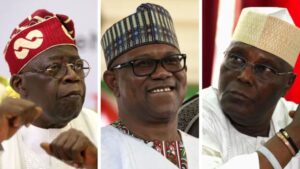
The emerging calculations have placed Shettima, Atiku and Rabiu Musa Kwankwaso at the centre of three different political strategies for securing northern support.
Shettima: Khalifa in waiting
Vice President Kashim Shettima has maintained a loyal public posture towards Tinubu, but his political interests remain closely tied to the future of the APC and the North’s place in the party’s succession arrangement.
His first major political battle in office was resisting attempts to remove him from the presidential ticket. His alliance with some influential members of the Progressive Governors’ Forum helped counter pressure on Tinubu to replace him with a candidate from the North West.
Now confirmed as Tinubu’s running mate for the 2027 election, Shettima is believed to be working towards consolidating his influence within the party ahead of 2031. His expectation is that a Tinubu second-term would strengthen his claim to the party’s presidential ticket.
The former Borno State governor’s political engagements and interventions during the current campaign also offer an opportunity to demonstrate his leadership capacity and test his influence among northern political stakeholders, particularly as he confronts the ambitions of other presidential contenders, including Atiku.
Atiku: Beleaguered veteran
For Atiku, the 2027 election represents another defining moment in his decades-long pursuit of the presidency. However, the changing political calculations in the North pose fresh challenges to his ambition.
Aware that most northern governors are not particularly enthusiastic about his candidacy, the former Vice President is relying on his political networks and the region’s voting strength to sustain his campaign.
Although he has resisted committing himself to a written undertaking to serve only one term, Atiku is reportedly working towards political and constitutional reforms that would provide for a single six-year presidential tenure.
That proposition, however, does not appear to appeal to some northern politicians, particularly those who believe the region should retain greater flexibility in determining its political succession.
Some APC governors who are uncomfortable with the reported Tinubu-Middle Belt understanding are said to favour a Christian from the South succeeding the President in 2031. They consider such an arrangement a more acceptable route to restoring religious balance while keeping the presidency outside the North for another term.
Atiku’s political experience and influence also make him a formidable contender, but these qualities have not necessarily translated into broad support among the northern governors.
Meanwhile, Makinde’s reported engagement with former Director-General of the Department of State Services (DSS), Lawal Daura, has been interpreted by some political observers as an attempt to attract former Buhari loyalists and strengthen his position in the emerging northern calculations.
Consequently, some northern governors appear inclined to maintain a neutral posture towards Tinubu’s re-election rather than openly oppose him, partly because of their reservations about the President’s reported political understanding with Wike.
The implications could become significant if Atiku is absent from the presidential ballot on January 16, 2027. In that eventuality, the North West’s substantial voting strength would become available to competing presidential candidates, including Tinubu, Makinde and Peter Obi, who is contesting on the Nigeria Democratic Congress (NDC) platform alongside Kwankwaso.
Kwankwaso: A gamble with history
Former Kano State governor Rabiu Musa Kwankwaso is taking a different political gamble, seeking to translate his strong grassroots following into a viable national political platform.
His supporters celebrate his leadership through a popular folksong that portrays him as a divinely favoured leader destined to overcome his political rivals. The song, which is widely associated with the Kwankwasiyya Movement, reflects the personal loyalty he commands among his supporters.
During the coalition negotiations preceding the 2027 election, Kwankwaso and El-Rufai were also involved in competing calculations over who could inherit Buhari’s political influence and substantial northern support.
Tinubu, who reportedly had reservations about El-Rufai, subsequently reached out to Kwankwaso in an attempt to secure a political understanding ahead of the next election.
As negotiations progressed, the President removed Kwankwaso’s former political associate, Abdullahi Umar Ganduje, as APC national chairman, in what was interpreted as an attempt to make the party more attractive to the former Kano governor.
But Kwankwaso reportedly rejected the prospect of joining the APC without assurances about his political future. Having served as governor and senator, he was said to have demanded a written commitment that the party’s structure would support his presidential ambition in 2031.
The former governor reportedly asked Tinubu what the party could offer him and his supporters in the Kwankwasiyya Movement, given his own political experience and ambitions.
What Tinubu could not secure, Peter Obi eventually achieved through negotiations.
Determined to contest the 2027 presidential election, the former Labour Party (LP) candidate reportedly offered to provide an affidavit committing to a single four-year presidential term if elected.
That understanding paved the way for a political alliance between Obi’s Obidient Movement and Kwankwaso’s Kwankwasiyya Movement, culminating in their pairing on the NDC presidential ticket.
Speaking at the party’s national convention in Abuja last May, Kwankwaso defended the alliance as an opportunity for national reconciliation and political cooperation.
He recalled previous political partnerships, including the alliance between the Northern Elements Progressive Union (NEPU), led by Aminu Kano, and the National Council of Nigeria Citizens (NCNC), led by Nnamdi Azikiwe, as well as the coalition between the NCNC and the Northern People’s Congress (NPC) ahead of independence.
He also cited the partnership between former President Shehu Shagari and Alex Ekwueme under the National Party of Nigeria (NPN) during the Second Republic.
Kwankwaso said such alliances had demonstrated the importance of political cooperation in overcoming national divisions.
He subsequently declared his support for zoning the NDC presidential ticket to the South, arguing that the arrangement would allow the region to complete its turn in producing national leadership.
The decision underscores the political bargain between Obi and Kwankwaso: Obi gets the presidential ticket, while Kwankwaso brings his northern political machinery and grassroots following into the alliance, with the reported one-term understanding offering a possible pathway to future political negotiations.
As the 2027 election approaches, the contest for northern votes is therefore about more than the immediate struggle between the ruling party and the opposition. It is also a battle over political succession, regional influence and the distribution of power beyond the next election.
Whether Shettima’s loyalty to Tinubu, Atiku’s enduring presidential ambition or Kwankwaso’s alliance with Obi will produce the greatest electoral dividends in the North remains to be seen.