 Get Guardian on Google
On Tuesday, at the World Public Relations Forum in Abuja, Nigeria’s Minister of Finance, Taiwo Oyedele, said something that should have landed like a thunderclap across every ministry, boardroom and newsroom in the country.
He said: “Trust is the one currency that sits beneath all the other currencies.” He went further: when trust is strong, citizens cooperate, capital flows, businesses invest, and reforms get a fair hearing. When trust is weak, even sound policies meet suspicion, and every explanation sounds like spin.
It was a rare and welcome moment of candour from a government official, and Oyedele deserves credit for it. I’ve heard him speak a number of times, and among the current crop of ministers, he stands out as one who speaks from a solutions perspective and treats communication as an instrument of governance. His framing of trust as the foundational currency of economic life was not political rhetoric. It was a diagnosis, and an accurate one.
Nigeria’s trust deficit is not a branding problem; it is a structural failure that costs the country real money, real talent and real time.
Sitting in that hall, I found myself less moved by the diagnosis than by the question it begs, the one the speech, for all its clarity, left largely unanswered: if trust is infrastructure, who is building it, and how?
The Price of Arriving Late
Oyedele himself offered the proof. Nigeria’s recent tax reforms, designed to protect small businesses and exempt low-income earners, were met with fierce public opposition. The irony is worth pausing on: the people the reforms were built to protect became the people who fought them hardest, because misinformation filled the vacuum that government left open. As Oyedele put it, “Facts do not defend themselves.” That is true. But the deeper truth is that facts should never have been left undefended in the first place.
The cycle has its own rhythm in Nigerian governance where policy is designed in closed rooms and then announced with fanfare. When the backlash arrives, as it always does in an information environment where outrage travels faster than explanation, government scrambles into crisis mode. Ministers appear on morning shows, press statements are released and fact sheets are circulated. In practice, all of it costs more, in money, in political capital, and in public patience, than carrying people along from the beginning would have cost.
The inflation numbers tell a similar story. Nigeria’s October rate of 14.06 per cent is the lowest in six years, which is real progress. But as the Minister acknowledged, bread and milk are still expensive, and many Nigerians rightly feel that the numbers do not match their reality. The gap between the statistic and the lived experience is not a failure of economics, it is a failure of communication. Falling inflation means prices are rising more slowly, not falling.
That distinction, which could be explained in a sixty-second voice note in Yoruba or Pidgin or Hausa, was instead left to the public to decode, and when the public could not decode it, frustration deepened, traders raised prices in anticipation of worse to come, and the government found itself in yet another cycle of defensive explanation.
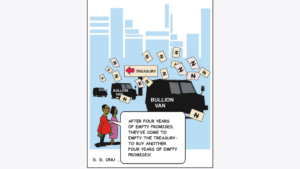
The cost of that cycle is measured in investors who delay decisions because the narrative around Nigeria is too noisy to parse. It is measured in professionals who relocate because they have heard, over and over, that “Nigeria is finished.” It is measured in the credibility tax that every new policy announcement has to pay because the last five were poorly explained.
Building What Oyedele Described
If we accept Oyedele’s premise, and we should, then trust is not something government earns through better speeches. It is something government builds through better systems.
The most urgent shift is to bring communicators into the room before the policy is written, not after the backlash begins. The tax reform debacle was not a failure of messaging. It was a failure of process. If strategic communicators and community stakeholders had been part of the design conversation, the policy’s language would have reflected the concerns of ordinary Nigerians, and the need for post-launch damage control would have been dramatically reduced. Prevention, in communications as in medicine, is cheaper than cure.
Every major policy rollout also needs its own translation layer. Oyedele had to stand at a global PR forum and explain what “falling inflation” means. That explanation should have been embedded in the rollout from day one, in Pidgin, in Yoruba, in Hausa, in Igbo, in formats that meet people where they already are: WhatsApp forwards, market radio, community voice notes, short video explainers from faces people recognise. Government can afford to do this. What it cannot afford is the alternative: a Finance Minister spending his time at an international conference doing remedial statistics.
Third, build feedback architecture, not for show, but for signal. Oyedele said something else that deserves amplification: “Experiencing is knowing.” That is a profound concession from a sitting minister, an acknowledgement that no amount of data will convince a woman at Mile 12 market that the economy is improving if her daily reality says otherwise.
But that concession only becomes useful if government creates structured channels for lived experience to feed back into policy adjustment. Town halls where officials talk and citizens listen are theatre, but feedback loops where citizen experience shapes the next iteration of policy, those are infrastructure.
Finally, own the narrative continuously and not episodically. Government should not appear in the public conversation only when numbers look good or when a crisis forces a response. The story of reform is long, with setbacks and gains, and the public deserves to hear it honestly and regularly, not in bursts of triumphalism followed by silence. If outrage pays and correction does not, as Oyedele rightly observed, then the answer is not to shout louder than the outrage. The answer is to be present before the outrage begins, to build enough trust that when the difficult news comes, a foundation of credibility can absorb it.
The Growth That Works
At the 32nd Nigerian Economic Summit last month, the theme was “Growth That Works: Delivering Jobs, Productivity and Shared Prosperity.” It is a good theme, and a necessary aspiration. But growth does not work in a vacuum of trust. Every road built, every reform passed, every billion naira allocated sits inside a narrative, and if that narrative is contested, confused, or absent, the growth itself is diminished, because the people it is meant to serve cannot see it, cannot feel it, and therefore cannot participate in sustaining it.
Oyedele told the WPRF audience that government must match words with performance and he is right. But the corollary is equally true: performance without words is invisible, and invisible performance earns no goodwill, attracts no investment, and builds no consensus. Nigeria does not need a propaganda machine: Nigeria needs communication infrastructure, the systems, the people, the feedback loops, and the sustained institutional commitment to making governance legible to the governed.
Trust, as the Minister said, is the currency beneath all currencies. It is time we started investing in it like we mean it.
Edward Israel-Ayide is the CEO of Carpe Diem Solutions, a strategic communications agency. He writes from the World Public Relations Forum holding in Abuja.