
 Get Guardian on Google
Nigeria on Saturday, begun deploying an artificial intelligence-powered agricultural intelligence system designed to provide real-time data on farmland use, crop development and agricultural productivity, with Jigawa State serving as the pilot location.
The National Agro-Productivity System (NAPS) deployment comes four months after Nigeria signed a Memorandum of Understanding with Morocco to develop its agricultural intelligence capacity, bringing satellite technology, data analytics and artificial intelligence into farmland monitoring.
Reacting to the development in a statement, Director-General of the Jigawa State Agricultural Transformation Agency (JATA), Dr Saifullahi Umar Basirka, said the system would help the state better understand its agricultural potential and improve support for farmers.
Basirka said: “NAPS gives Jigawa a clear picture of our farmland and what is happening on it, season by season. That lets us support our farmers where they need it, plan our land and water with confidence, and show investors and lenders the real strength of agriculture in Jigawa.
“We bring to Nigerian agriculture the satellite, data and artificial intelligence tools that are reshaping farming worldwide, and it does so through Nigerian institutions. Artificial intelligence reads satellite images of Jigawa, and extension agents confirm what it sees against observations on the ground.
“Together they show, plot by plot, which land is cultivated and which lies fallow, what is planted and how crops are progressing, in a picture that refreshes every five days.
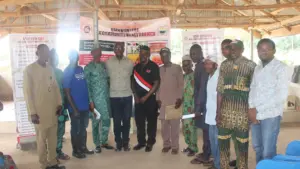
“In this first phase, which runs through the dry season to April 2027, extension agents trained in Dutse on 18 November are gathering field observations on rice, wheat and maize in 59 communities across 11 Local Government Areas, with coaching from OCP Africa agronomists.
“Land is the foundation of Nigeria’s agricultural wealth, and knowing how it is used changes what is possible. Knowing where land lies guides land-use planning and investment. Knowing what is cultivated, and where, helps State Governments plan irrigation and target inputs, and helps extension services reach the farmers who need them.
“At the federal level, timely and reliable data strengthens food supply planning, gives earlier warning of shortfalls, and informs trade and research policy. For farmers, the benefit can be direct: verified records of what they have planted give banks the confidence to lend and insurers the evidence to provide cover.”
Also speaking, the Executive Secretary of the Presidential Food Systems Coordinating Unit, Marion Moon, said the system would address longstanding challenges associated with delayed agricultural data and decision-making.
Moon said: “For too long, decisions about Nigerian agriculture have been made after the season, on figures that arrive too late to act on. NAPS changes that. It gives every tier of government the same timely picture of our farmland, and it is built and owned by Nigerian institutions.
“All tiers of government are building NAPS together. The Steering Committee is chaired by the Presidential Food Systems Coordinating Unit (PFSCU) and reports to the PFSCU Steering Committee, chaired by Vice President Kashim Shettima.
“The members are the Federal Ministry of Agriculture and Food Security, the Federal Ministry of Water Resources and Sanitation, the National Space Research and Development Agency and the Nigeria Governors’ Forum, alongside six States, one from each geopolitical zone: Jigawa, Borno, Ebonyi, Plateau, Cross River and Ekiti.
“OCP Africa and Ground Truth Analytics, established by Mohammed VI Polytechnic University, support the work as technical partners. At its inaugural meeting on 16 November, the Committee adopted its Terms of Reference and the Phase One implementation plan, selected two further States for high-level land mapping, and agreed to reconvene after every key milestone. The next milestone is 31 January 2027.
“Built through Nigeria’s partnership with Morocco and run by Nigerian institutions, NAP is laying the foundation for a fully Nigerian-owned agricultural intelligence capability. What is learned in Jigawa will shape how it reaches every State of the Federation.”