 Follow Us on Google News
 Follow Us on Google Discover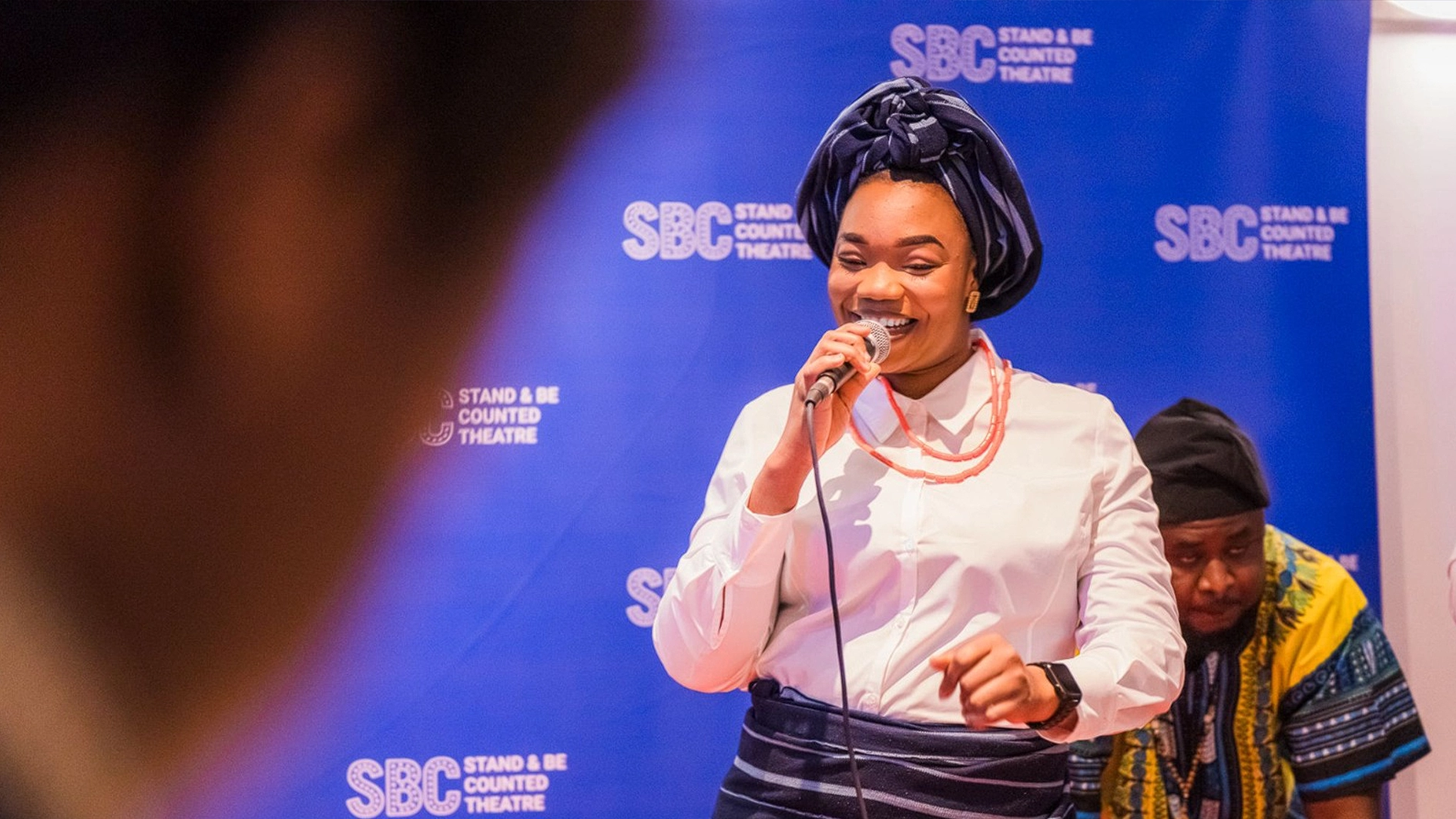
By Michael Kolawole
A woman whose womb carried the village is despised by her own people. Despite that, she still loves them. Her story of unconditional love and forgiveness is what Adebola Akinola carried into the Showroom Cinema in Sheffield at a recent soap box spotlight event.
Rightly titled “The Woman Whose Womb Carried The Village,” the story bears a soft, moral tone typical of theological stories, but it is a tale of virtue and valour, typical of Yoruba folklore. “Love gives life, love gives life, love gives life,” Adebola repeatedly sings in the pre-chorus, setting up the mood for the reflective story.
The song tells the story of Morẹnikẹ, a kind, beautiful but barren woman who lives in a small Yoruba village, where the “Moon listens at night”. She loves and cares for everyone in the village but is despised for her barrenness. The people whisper about her unproductive womb and compare her to an arid land whenever she walks through the village.
“Oh, she is fruitless, she has no womb, she has no blessing,” Adebola solemnly sings, recounting Morẹnikẹ’s ordeal in the village. It is in moments like this that her delivery earns its intensity. The solemnity she brings to the line is more considered; it depicts the voice of a narrator who understands what it costs to carry a touching and reflective story without sensationalising it.
In spite of all the insults from the very people she loves and cares for, Morẹnikẹ is never angry. Instead, she cherishes them more. Trying to establish the story, Adebola does not overreach but lets the contradiction stand, allowing it to strike up emotion in the audience.

Later that night, Morẹnikẹ got on her knees and cried to Eledumare (God), asking questions about why her womb remains infertile. But nothing changes. It seems as though God has forsaken her. This is the performance’s most underexplored moment. The scene gestures toward something genuinely complex, faith tested by silence, devotion without answer, but neither the song nor the performance lingers there long enough. A singer willing to sit inside that silence, to let the audience feel the full burden of unanswered prayer before the story moves on, would have made a braver artistic choice. Adebola moves through it too quickly, and the opportunity is lost.
A year later, the rain ceased and plants and animals died. The villagers came together to find out the reason for the drought. Unsurprisingly but ungratefully, Morẹnikẹ was blamed. They attached her barrenness to the scarcity and the death of plants and animals, claiming she had offended the gods and the spirit of the village. She was banned from the village. The maltreatment and banishment did not stop her from being kind to people.
It was evening when Morẹnikẹ crossed paths with a frail old woman on a narrow path in the woods. Her pot of water was almost empty, but she offered what remained for the woman to drink. The woman then looked at her and asked the question the village never thought to ask: Why does someone who is hated keep choosing love? Morẹnikẹ smiled before answering. Bitterness, she said, brings no child. But love heals. That response is the song’s finest line, and Adebola delivers it with the restraint it deserves. The smile before the answer is everything.
The woman was satisfied with Morẹnikẹ’s response, she placed a blessing on her pot and told her to return to the village. Heavy rain broke the drought that had held the village, putting an end to the scarcity, as Morẹnikẹ stepped on its soil. Uncomplicated but true to the Yoruba folklore that inspired the song, but it would raise a question amongst the Western audience unfamiliar with the Yoruba folkloric tradition.
Whether the rain arrived too early would be the fair question in any Western audience’s mind. But the story, like much Yoruba folklore, believes in its own moral logic. What it asks less of, however, is the community that caused the harm. It’s expedient that the community is interrogated, to ascertain its moral disabilities. Adebola never did that, she instead leaves it for the audience to judge.
When happiness and surpluses returned to the village, it was then that they realised the importance and impact of Morẹnikẹ. The village’s chiefs came together and admitted they had wrongly treated and judged her, so they asked for her forgiveness. With no hesitation, she forgave them. The repentance is swift and the forgiveness swifter. The chiefs apologise and are absolved in the same breath, which undercuts the story’s own moral ambition. Forgiveness is Morẹnikẹ’s to give but accountability is the village’s to earn, and here, they do not quite earn it. That’s one place where the performance’s emotional generosity works against its critical honesty.
The chiefs acknowledged Morẹnikẹ’s benevolence and declared that not every woman could give birth to a child, but a woman could give birth to a village. Though the line earns its place in the song, it doesn’t resolve the questions the story raises so much as reframe them. Morẹnikẹ’s barrenness, the thing that marked her as cursed, becomes the very condition that made her the village’s most essential person. That inversion is where the Yoruba folklore tradition lives in the idea that the person a community discards is often the one carrying what the community most needs.
Adebola did not deliver a perfect performance, nor did she tell a perfect story. But she told a necessary one about what it costs to love without guarantee, and what a community loses when it mistakes productivity for worth.

