
 Get Guardian on Google
For several years, offshore operations were little more than cost centres. But the 2026 nine-month financial statement of Access Holdings Plc suggests that Nigerian banks are reaping significant value from their outposts, ABIGAIL IKHAGHU reports.
Access Holdings Plc is drawing a growing share of its banking profits from outside Nigeria, as stronger earnings from its African and international operations helped lift group performance and complement contributions from its domestic business.
The shift, alongside a sharp reduction in credit-loss charges and improved income from banking services, is reshaping the group’s earnings profile and providing a stronger base for its recovery.
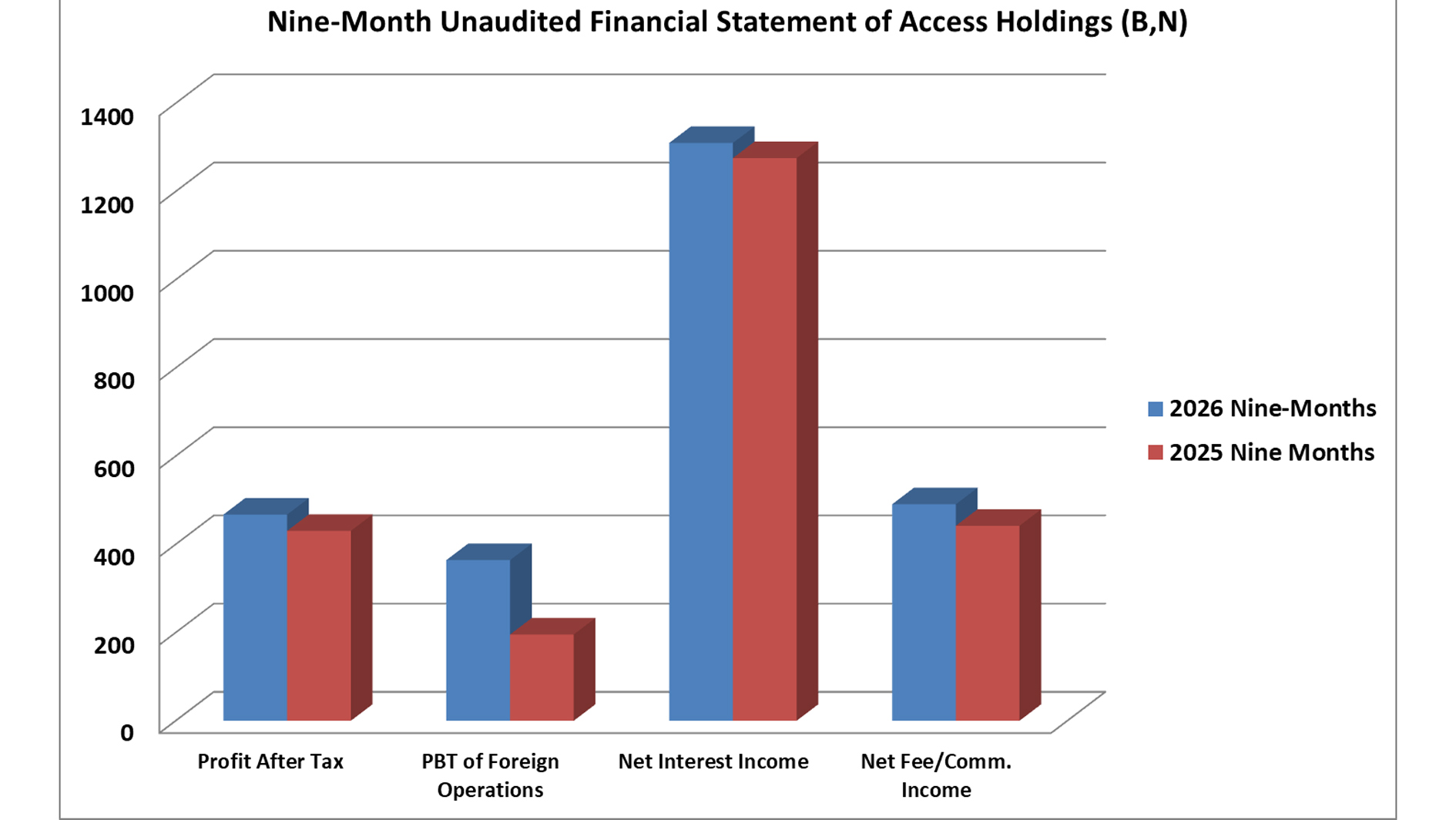
The group’s nine-month financial statements to September 2026 show that profit before tax rose by 8.3 per cent to N667.36 billion, from N616.25 billion in the corresponding period of 2025, while profit after tax (PAT) increased by 5.9 per cent to N474.17 billion.
A closer look at the results, alongside the half-year report released on the same day, shows that the group made considerable progress in the third quarter. Lower charges against bad loans, higher interest income and contributions from its international businesses helped lift quarterly profit following a less impressive performance in the first half of the year.
There were, however, changes in the geographical sources of earnings, the cost of managing credit risks and the contributions of different banking activities. The developments provide a clearer picture of how the group is improving its financial position and where its next phase of growth is coming from.
Perhaps the most striking feature of Access Holdings‘ nine-month performance is the growing contribution of its offshore businesses. The geographical breakdown of its financial statements shows that profit before tax from international operations increased from N195.58 billion in the first nine months of 2025 to N364.19 billion in the corresponding period of 2026, representing an expansion of about 86.2 per cent.
Rest of Africa operations also recorded an improvement, with profit before tax rising by 32 per cent from N242.50 billion to N320.01 billion.
Nigeria, however, moved in the opposite direction. PAT from the domestic segment fell from N260.78 billion to N131.81 billion. The half-year figures explain how the shift developed during the year. As of June, profit before tax from Nigeria stood at N121.43 billion, while Rest of Africa and international operations recorded N218.9 billion and N244.72 billion, respectively.
By September, Nigeria had added N10.38 billion to its half-year contribution. Rest of Africa added N101.11 billion, while international operations contributed another N119.47 billion.
This means that most of the additional profit recorded across these geographical segments between June and September came from outside Nigeria. It also explains why the group’s international businesses have become increasingly important to its overall performance.
The nine-month results show that operations outside Nigeria accounted for 82.2 per cent of the Banking Group’s profit before tax, compared with 79.8 per cent at the half-year. International banking subsidiaries contributed 43.7 per cent, Rest of Africa 38.5 per cent and Nigeria 17.8 per cent.
This growing international contribution provides another source of earnings for the group and reduces the extent to which its overall performance depends on its domestic banking operations.
It also reflects the financial importance of the network Access Holdings has built across different African markets and other international locations. Its activities in trade finance, transaction banking, payments and treasury services provide opportunities to earn income across different markets.
The development is particularly significant because the group’s international operations are no longer simply supporting its expansion strategy. Their contribution to profits has become central to its overall financial performance.
Lower credit costs change earnings picture
Another major improvement in the results is the reduction in impairment charges, which fell by 73.5 per cent to N92.91 billion from N349.99 billion in the first nine months of 2025.
Banks set aside impairment provisions to cover loans and other financial assets that may not be fully recovered. These charges reduce the income available for profit, making their movement an important part of assessing a bank’s performance.
For Access Holdings, the sharp decline meant that less income was taken up by provisions for possible loan losses. Net interest income after impairment consequently increased by 32.1 per cent to N1.20 trillion from N907.95 billion a year earlier.
The half-year report had already shown a significant reduction in impairment charges, which fell to about N69 billion. By September, the cumulative charge had risen to N92.91 billion, meaning the group recorded N23.90 billion in the third quarter.
This was considerably lower than the N119.92 billion recorded in the corresponding quarter of 2025.
The improvement in credit costs coincided with a strong rise in quarterly profit. Profit before tax increased by 52.3 per cent to N253.23 billion in the third quarter, from N166.32 billion a year earlier.
Profit after tax also rose to N207.45 billion from N102.28 billion.
The reduction in impairment charges has therefore played a major role in the group’s improved profitability. However, the longer-term test will be whether it can maintain the improvement through stronger loan recovery and careful lending, rather than relying mainly on lower provisions to support earnings.
Fee income broadens revenue base
Beyond interest from lending, Access Holdings also recorded growth in income from banking services.
Net fee and commission income rose by 12.4 per cent to N534.94 billion from N475.92 billion in the corresponding period of 2025. Fee and commission income increased by 8.4 per cent to N650.87 billion, while the expenses associated with these services declined by 6.9 per cent to N115.93 billion.
This growth is important because banks earn fees from services such as payments, transfers and other customer transactions. Such income provides another source of revenue beyond interest charged on loans.
The group’s net interest income and net fee and commission income, which together provide a useful measure of income from its main banking activities, rose by 5.4 per cent to N1.83 trillion.
Interest income increased by 6.9 per cent to N3.10 trillion. However, interest expenses grew faster, rising by 10.1 per cent to N1.81 trillion. This limited the growth in net interest income to 2.7 per cent, at N1.29 trillion.
The figures show why fee income is becoming an important part of the group’s earnings. With the cost of mobilising funds rising faster than interest income, stronger contributions from banking services help support revenue.
There was, however, a slowdown in the third quarter. Net fee and commission income fell by 26.2 per cent to N175.80 billion from N238.20 billion in the corresponding period of 2025. This suggests that the
strong nine-month performance in fees was driven more by the first half of the year.
Uptrend in deposits and lending
The improvement in earnings was accompanied by growth in customer deposits and loans, although the group’s total assets moderated from their June level.
Total assets stood at N52.60 trillion at the end of September, 1.7 per cent higher than the restated N51.71 trillion recorded at the end of December 2025.
Customer deposits increased by 6.6 per cent to N36.85 trillion, while loans and advances to customers grew by 7.4 per cent to N14.33 trillion. Shareholders’ funds stood at N4.49 trillion.
The increase in deposits provides the group with a larger pool of customer funds to support its lending activities. The growth in loans also shows that the expansion in deposits was accompanied by increased
credit to customers.
This comes at a time when the banking industry is adjusting to the post-recapitalisation environment.
Banks have strengthened their capital positions, but translating that capacity into productive lending remains an important part of the industry’s next phase.
However, between June and September, total assets declined by 4.78 per cent from N55.24 trillion, while customer deposits fell by 1.23 per cent. Loans and advances, on the other hand, increased by 1.42 per cent.
The quarterly movement does not erase the growth recorded since December, but it shows that the group’s balance sheet did not expand evenly throughout the period.
While the reduction in impairment charges and growth in fee income supported profitability, the cost of running the business continued to rise.
Operating expenses increased by 11.8 per cent to N1.30 trillion, while total other operating income fell by 40.8 per cent to N234.53 billion. Total operating income consequently declined by 3.2 per cent to N2.06 trillion.
The group’s cost-to-income ratio improved from 65.2 per cent at the half-year to 63.13 per cent in the nine months. However, it remained above the 54.64 per cent recorded in the corresponding nine-month period of 2025.
This shows that although the group has made progress in bringing down its cost ratio since June, expenses are still taking a larger share of income than they did a year earlier.
There was also an improvement in returns to shareholders. Annualised post-tax return on average equity rose from 11.8 per cent at the half-year to 14.10 per cent for the nine months, although it remained below the 18.4 per cent recorded for the 2025 financial year.
The group is also working to meet the investment limit under Section 19(8)(c) of the Banks and Other Financial Institutions Act (BOFIA), which restricts a bank’s investment in subsidiaries to 10 per cent of shareholders’ funds.
Access Holdings said it had identified capital recalls from six banking subsidiaries to address the requirement. One has been completed, while shareholder approvals have been obtained for four of the remaining five.
The group expects to complete the exercise within the timeline set by the Central Bank of Nigeria (CBN). Completion is expected to remove the regulatory restriction on dividend distributions, although any payment will still require the necessary approvals.
Overall, Access Holdings’ nine-month performance shows an improvement in profitability, supported by lower impairment charges, higher fee income and stronger contributions from its international businesses.
The third-quarter results also show that the group made a stronger contribution to earnings as the year progressed.
Its overseas operations have become an important source of profit, while growth in deposits and lending points to continued activity in its core banking business. The challenge now is to sustain these gains, control operating expenses and ensure that stronger earnings translate into better returns for shareholders.
For a group with operations across several markets, the latest results show that its international business is doing more than supporting its expansion. It is increasingly carrying a significant part of its profit.