 Follow Us on Google News
 Follow Us on Google Discover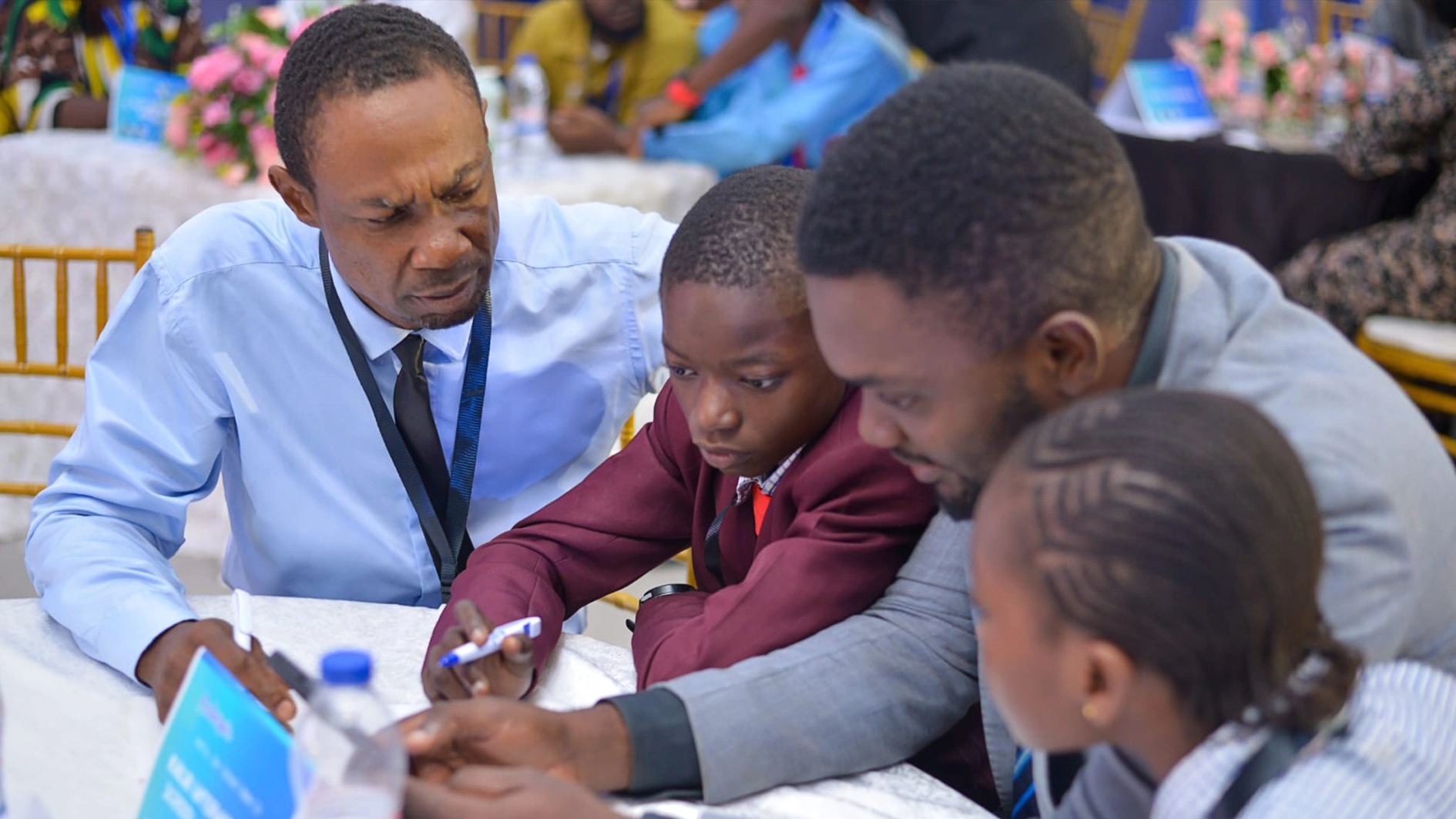
A Nigerian education technology company, EDATECH, has launched its artificial intelligence-powered learning platform, ẸDÁ, across sub-Saharan Africa, promising to help schools deliver personalised learning to students even in classrooms with 60 or more pupils.
The platform, whose name is derived from the Yoruba word ẹ̀dá, meaning a person or living being, was developed around the idea of putting individual learners at the centre of the education process.
Its production launch follows a January test involving more than 60 secondary schools in Benin City, Edo State, in a competition organised in collaboration with the Edo State Ministry of Education and the Association of Private School Owners of Nigeria.
According to EDATECH, the platform is designed to address one of the major challenges confronting teachers in overcrowded classrooms: the inability to give individual attention to every learner.
The company’s Education Operations Lead, Davidson Ohiafi, said the platform would enable teachers to identify individual learning needs despite the size of their classes.
“In our schools one teacher may be facing sixty or more students, and no teacher can give each of them individual attention by willpower alone.

“Going live means every one of those children can now get support shaped around them,” Ohiafi said.
Unlike conventional school management applications that often operate independently, EDATECH said ẸDÁ brings learning, assessment, tutoring, games, projects and school management information into a single system.
Founder of the company, Sylvester Juwe, a Cambridge-educated mathematician and qualified teacher, said the platform was created to eliminate the fragmentation associated with multiple education applications.
Juwe said, “Schools do not need another app, most are already carrying several, each knowing a fragment of a child and none of them talking to the others.
“We built one system that learns each child continuously, so the teacher, the parent and the school leader are all working from the same understanding.”
The platform tracks students’ interactions with its AI tutor, Eddey, learning games, competitions and projects, using the difficulty of questions to assess performance rather than simply recording correct and incorrect answers.
EDATECH said this enables the system to build an evolving profile of each learner and recommend what the child should practise next.
The information is then presented differently to students, teachers, parents and school leaders.
While students can monitor their learning paths, league standings and areas requiring improvement, teachers receive class-level information, including learning-outcome heat maps, lesson plans and reports.
Parents are provided with information about their children’s performance in plain language, while school heads can query school-wide data using ordinary language.
The company said the system can also identify changes in a learner’s engagement, including declining effort or withdrawal, potentially allowing teachers to intervene before the problem becomes more serious.
The platform currently contains content covering 22 subjects and more than 120,000 questions based on the Nigerian curriculum, including examination-oriented materials aligned with the expectations of the West African Examinations Council, National Examinations Council and Joint Admissions and Matriculation Board.
EDATECH said curricula from other countries can also be incorporated within days, allowing the platform to expand across Africa without imposing Nigeria’s curriculum on other education systems.
The January trial in Benin City provided an early test of the technology under difficult conditions.
More than 60 secondary schools participated in the competition, with teams comprising two students, a teacher and a parent competing as a “Human Fusion Unit”.
Their performance was compared with answers generated by artificial intelligence on the same material, testing whether human collaboration with AI could produce better results than AI operating alone.
Despite power and network failures during the event, participating schools continued with the competition, with Imaguero Secondary School emerging as the winner.
The school’s Principal, Nosa-Idiaru O. Y., said the experience demonstrated the importance of building education technology that can function within Nigeria’s infrastructure realities.
“The power went off, the network failed, and my students still competed on the same terms as everyone else in that hall and finished first,” the principal said.
“Knowing this is now open to any school that wants it is the most encouraging thing I have heard in education in a long time.”
EDATECH’s technology co-founder, Nnaemeka Akabogu, said ensuring that the platform could remain dependable despite unreliable electricity and connectivity had been a major part of the development process.
“Taking EDATECH into production meant a lot of hard work behind the scenes, much of it the kind nobody sees,” Akabogu said.
“But it matters, because schools need something they can count on.”
For Edo State, which supported the January event, the expansion of the platform is expected to widen access to digital learning support beyond a limited pilot.
The state’s Chief Inspector of Education, Mercy Imasuen-Isibor, said the focus should remain on ensuring that students in public schools can access quality learning support.
“Our interest is straightforward: that a child in a public school in Edo has the same access to good teaching support as a child anywhere else,” she said.
“Seeing this opened to every school, and not confined to a pilot, is a step towards that.”
Media entrepreneur and Creative-in-Residence at the London School of Economics, Chude Jideonwo, who advises EDATECH on communications, said the real test of the technology would be its ability to work in ordinary schools rather than only at high-profile demonstrations.
“The test of anything built for African children is not whether it shines in a showcase, but whether it reaches an ordinary school on an ordinary morning,” Jideonwo said.

