 Get Guardian on Google
Across the country, an expanding pool of young graduates is trapped on an expensive upskilling treadmill, piling new certifications onto university degrees in the hope of securing a first job, yet still struggling to gain employment. Meanwhile, companies complain of difficulties finding candidates with the practical competencies to deliver on the job. Experts and business leaders agree that aligning tertiary curricula with evolving labour-market demands, embedding practical internships and mentorship by seasoned professionals into students’ learning experiences, and shifting employers away from rigid credential-based recruitment towards hiring for potential could help bridge the divide. VICTORIA NWACHUKWU reports on the cost of the disconnect between academic qualifications and workplace readiness.
Joy Okowa’s graduation was supposed to mark the beginning of another phase of life – working life. It did not. Instead, it became the beginning of another search.
After completing her degree in mass communication and subsequently undertaking the mandatory National Youth Service Corps (NYSC) programme, she entered the labour market with the qualification she had spent years earning and the expectation that, eventually, an opportunity would come. It did not. So, she went back to school, this time not for another degree, but to acquire a skill she believed could make her more useful to an employer.
She trained in product management, learning another discipline in the expanding technology space. It was a deliberate attempt to respond to what the labour market appeared to be demanding. If a degree was not enough, perhaps another practical skill would make the difference.
But when the training ended, the applications continued, even after her certificates and résumé had received a makeover. What, however, did not change was the difficulty of getting an employer to give her an opportunity to demonstrate what she could actually do.
In at least one recruitment process, she made it beyond the application stage and sat for an assessment. It was a moment that seemed to suggest that the door might finally be opening, but it did not. She fell short of the required score and did not get the position.
That experience exposed Okowa to an uncomfortable truth about the modern job search: there is a point at which collecting qualifications and learning new skills cease to be the problem. The harder task is finding an employer willing to let a candidate turn those qualifications into demonstrated ability. Her story would be easier to explain if employers were simply refusing to hire, but that is not what the evidence shows.
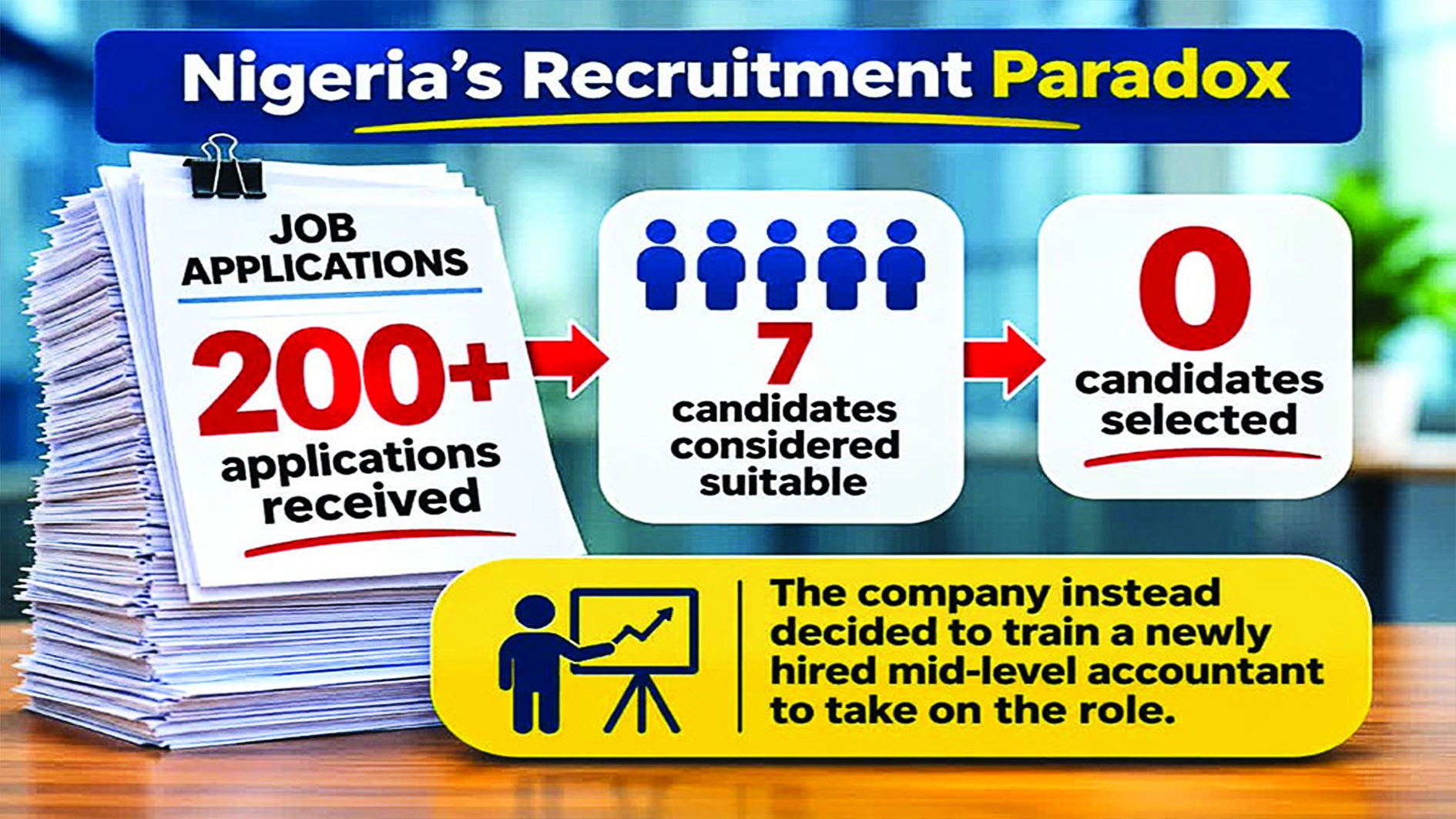
In one recruitment exercise for a joint-venture accountant, more than 200 applications were received, but only seven candidates were considered suitable. None was eventually selected. Instead, the company decided to train a newly hired mid-level accountant to take on the role.
On paper, the two sides of the labour market appear to be moving in opposite directions. There are graduates looking for opportunities and companies looking for workers. Yet somewhere between the application form and the workplace, something is being lost.
As Head of Talent Resourcing at FirstBank of Nigeria Ltd., Osasuyi Erhunmwunsee, put it: “One of the biggest misconceptions about recruitment is that qualification equals capability. It does not.”
That distinction is at the centre of a growing employment dilemma in Nigeria. A degree can prove that someone has completed a course of study, just as a certificate can show that someone has undergone training. But neither, by itself, tells an employer how that person will perform when faced with a difficult client, an unfamiliar problem, a demanding deadline, a team conflict or a task that was never taught in the classroom. And for the young person seeking that first opportunity, there is a cruel circularity to the demand: employers want experience, while experience comes from working. Yet, to work, the candidate first has to convince someone to provide the opportunity.
Helen Ugochi knows what it means to wait for an opportunity. After her NYSC programme, the communication graduate spent more than a year searching for work in the areas she had trained and wanted to pursue: public relations, writing and advertising.
She applied, waited and applied again. But as the search dragged on, the distance between what she had studied and what the market was willing to offer became increasingly apparent.
After months of searching for roles in the communication industry, she secured a position as a sales executive and investment adviser. It was not her dream role, but it gave her a foothold in the workplace.
Her employer trained her in product knowledge and taught her how to engage customers. The experience helped her begin acquiring the practical knowledge that employers often expect candidates to possess even before they are hired.
Faustina Chinekezie, a 2023 economics graduate of the University of Nigeria (UNN), Nsukka, decided to take a different route by choosing not to build her career around the subject printed on her degree. Instead, she pursued a skill she had begun developing before graduation: graphic design.
During her NYSC year, she took on design work for clients and organisations. What began as an additional skill gradually became the work through which she learnt the practical habits that employers and clients value, but which are difficult to acquire through certificates alone.
She learnt to interpret client briefs, work towards deadlines, communicate professionally, receive feedback and design with a business objective in mind.
Through projects, tutorials and practice, the skill developed into a career. Today, she works primarily as a brand identity and graphic designer.
Her journey illustrates another feature of the changing labour market: a degree is increasingly only one part of a person’s employability story.
Skills realignment needed for survival as job seekers outpace available opportunities
DAILY, key issues such as the alignment between education, skills, career aspirations, employer expectations and the actual direction of the economy continue to generate contradictions across the polity.
For a country whose education system places an immense premium on passing examinations and accumulating certificates, often at the expense of critical thinking, basic problem-solving skills and the development of practical, functional competencies, among others, the recent lamentation by the Chief Executive Officer of Moniepoint, Tosin Eniolorunda, that Nigeria lacks the skilled talent needed to meet the company’s global standards strikes at the heart of a national malaise.
In his remarks at an earlier edition of The Platform Nigeria in Lagos, Eniolorunda claimed that most Nigerians applying for positions at the fintech outfit failed to meet its global standards, despite the company’s commitment to hiring more Nigerians. He attributed the company’s inability to fill 500 vacancies with world-class professionals since 2025 to this shortfall.
“In 2024, we made a decision that we will no longer hire from any other place except Nigeria. And we chopped the cane in 2025. If you go to the Moniepoint career website now, we have 500 vacancies on our website, and we are struggling to see people fill those roles.
“Not only could we not find people in the quantity and the quality we needed, but the people we found also were not up to the global standards of quality that we needed. And we are competing globally, not only with local players, you know, where our biggest competition comes from, China.
“I have world-class people working in the organisation, and here I am, looking for Nigerians that cannot meet the requirements to build world-class products,” the Moniepoint boss stated, adding: “I blame our education system. I used to think Nigerians are really bright, but I am beginning to feel we need to do something for the general IQ of this country, not to go lower. I am really worried.
“I used to think intelligence is equally distributed around the world, but I am realising that the environment shapes a lot of things that we consume on social media. I am realising the value shaping our system now; what hook-up culture, yahoo-yahoo culture, is a problem,” he stated.
For Erhunmwunsee, one of the most difficult aspects of entering the labour market as a young graduate is being told that a job requires experience when, without that first job, such experience remains beyond the candidate’s reach.
This explains why he insists that while employers assess candidates with a view to finding the best fit for a position, many job seekers approach the labour market from the perspective of, “What job can I get with my qualification?”
According to him, some sectors of the economy are generating employment opportunities faster than the traditional talent pipeline can respond, while large numbers of graduates continue to pursue career paths where the supply of candidates significantly exceeds the available opportunities.
A talent management specialist at Lekoil Nigeria Limited, Chijioke Amaechi, noted that the pressures facing employers account for why many organisations are increasingly searching for “ready-made talents”.
Amaechi explained that companies have targets to meet and revenue to generate, while training an inexperienced worker takes time, requires supervision and comes at a cost. For businesses already operating under financial pressure, training budgets can be difficult to sustain, resulting in a preference for candidates who can hit the ground running and contribute immediately.
A Senior Human Resources Business Partner at Jobberman Nigeria, Oreoluwa Aboderin, said difficult-to-fill positions frequently expose gaps in behavioural skills and practical experience, even among applicants who meet the educational requirements.
“Employers are looking for candidates who can contribute, collaborate effectively, and adapt quickly to changing business needs,” she said.
Search for fresh graduates with capacity to handle specialised roles as wild goose chase
AN economist, policy analyst and Chief Executive Officer of the Centre for the Promotion of Private Enterprise (CPPE), Dr Muda Yusuf, said it was unrealistic to expect every fresh graduate to enter the workplace fully prepared for a specialised role without further training.
According to the immediate past Director-General of the Lagos Chamber of Commerce and Industry, while universities are saddled with the responsibility of providing foundational knowledge and intellectual capacity, employers must be willing to provide the organisation-specific, sector-specific and occupational training needed to strengthen their operations.
Yusuf, however, cautioned against reducing universities to vocational training centres. Higher education, he said, “should continue developing critical thinking, analytical ability, communication, self-confidence and problem-solving skills while strengthening its connection to workplace needs. Those transferable competencies remain important precisely because the workplace itself keeps changing.”
He added that the discipline studied was therefore not always the most accurate predictor of workplace performance.
For the Head of Career Service and Alumni Relations at Rome Business School Nigeria, Sarah Ugwu, many graduates leave school with knowledge but without sufficient exposure to the environments in which that knowledge must eventually be applied.
Internships, consulting projects, case competitions, mentoring and company engagements, she added, should therefore form part of the student experience rather than remain optional additions.
For Okowa, Ugochi and countless others navigating the same labour market, such exposure is more than another item to add to a CV; it can make the difference between being told they lack sufficient experience and being given the opportunity to acquire it. That is why the experience trap is so difficult to escape.
With the disconnect between academia and industry representing a “very huge gap”, the Founder of Zion Tech Hub, Godsent Ndoma, said the call for educational institutions and industry players to work together to understand current demands and re-engineer curricula accordingly was timely.
The problem, he argued, also extends to how learners choose what to study, with some selecting courses based on trends or celebrity endorsements rather than first examining the skills employers actually need.
The Director of Career Development Services at the Federal Polytechnic Nekede, Dr Ijeoma Emeagi, also acknowledged that keeping curricula relevant requires continuous feedback from employers, professional bodies, industry partners, alumni and organisations that receive students for industrial training, including through the Students Industrial Work Experience Scheme (SIWES) and internships.
She noted that the pace of change in artificial intelligence, data analytics, cybersecurity, automation and digital services also calls for more frequent curriculum reviews.
An online poll of more than 800 students at the Federal Polytechnic Nekede, conducted ahead of a career-readiness programme, showed that many students, including those in their third and final years, wanted guidance on CV preparation, interview confidence, professional communication, digital visibility and understanding workplace expectations.
Amassing new skills to maximise opportunities, become employable costs a fortune
WHEN the first qualification fails to open doors, many Nigerians respond in the most logical way they know: they learn something else. The Founder of Axia Africa, Olawale Samuel, confirmed this trend, noting that demand had increased for practical technology skills, including data analytics, product design, software development, cybersecurity, AI automation and product management. Increasingly, he said, learners were asking, “What can I learn that will make me useful in the workplace?”
Interestingly, those enrolling for these programmes are not necessarily school leavers. Visits by The Guardian to skills-training centres revealed a mix of undergraduates, unemployed graduates, career changers and working professionals. While some were seeking their first jobs, others wanted to change careers, earn through freelance work or remain relevant in their existing fields.
At one data analytics programme visited by The Guardian, learners worked with Excel, SQL, Python and Power BI. Their training also involved assignments, practical exercises, group projects, dashboard development and presentations.
For a young person already struggling to find employment, however, the cost of becoming “employable” can become another financial burden. A single course can cost as much as $100 or $200, representing a significant commitment for young Africans earning in local currencies, particularly those without any source of income.
At Adavi Digital Institute, a 12-week data analytics programme costs N190,000, while its cybersecurity and full-stack software engineering programmes were listed at N280,000 and N270,000, respectively.
At Wild Fusion Digital Centre, programmes reviewed by The Guardian were priced between N200,000 and N350,000, with durations ranging from eight days to 10 weeks.
Other advanced technology boot camps and masterclasses cost between N500,000 and N1 million. However, free and subsidised alternatives are also available.

Yet, completing training does not guarantee placement. Some learners finish their programmes and continue searching for jobs, while others enrol for additional courses, move into different fields, take up freelance work or attempt to build their own businesses.
Certificates without a runway
DAVID Itodo, a psychology graduate who moved into technology-related work after developing programming skills during his NYSC year, later enrolled in another six-month programme to deepen his technical knowledge.
He was not learning because his initial skill had become obsolete, but because workplace demands had evolved. He said he was able to apply what he learnt to his work.
For some people, therefore, upskilling is no longer a bridge used once to cross into employment. It has become a road they must keep travelling.
A strategic communications adviser, Nosike Nwigene, described the danger as an “endless cycle” in which people continue acquiring new skills without getting opportunities to demonstrate them.
That is the uncomfortable question at the heart of Nigeria’s skills economy. If people are willing to learn, training programmes are expanding, graduates are adding technology skills to their university degrees, and employers continue to report talent shortages, why are the two sides still struggling to meet?
Jobberman’s Young Nigeria Works evaluation found that 63 per cent of participants had tertiary qualifications, even as the programme continued to identify a mismatch between available skills and job requirements.
Its assessments also recorded improvements in soft skills, from an average baseline of 46 per cent among more than 116,000 assessed jobseekers to about 85 per cent of 1,024,843 learners classified as proficient at the endline.
Training, therefore, can improve measured capabilities, but it cannot, on its own, create employers or vacancies, nor can it guarantee the work experience employers say they need. This is where the story moves beyond the individual job seeker.
The cost of waiting for the ‘right’ worker
EVERY vacant position has consequences. At MoreMonee MFB, HR professional Shittu Zainab said unfilled roles could redistribute workloads across teams, placing additional pressure on existing employees and affecting productivity, morale and staff retention.
At The Goodland Exclusive Company, a design, real estate and lifestyle investment firm, the Head of Human Resources, Sharon Adegbe, said prolonged vacancies could slow decision-making and execution, ultimately affecting revenue, customer experience and business growth.
Product leader Kelechi Ndieze added that experienced product managers, senior software engineers, AI and data specialists, cybersecurity professionals and technology leaders were among the hardest roles to fill. He noted that vacancies in these specialised positions could slow delivery and innovation, increase pressure on existing teams and push companies towards consultants or outsourcing. Delayed product launches and slower innovation, he added, could also affect revenue and competitiveness.
The World Economic Forum’s employer data reinforces these concerns, with 65 per cent of employers operating in Nigeria identifying skills gaps as a barrier to business transformation, while 50 per cent cited difficulties attracting talent to their industries as another barrier.
Brain drain from within
INDUSTRIES do not build expertise overnight. They develop it over years through mistakes, mentoring, field exposure, challenging assignments and the accumulated knowledge of people who have spent decades learning how things work.
Amaechi said this problem was increasingly evident in the oil and gas sector, where older professionals had benefited from extensive training and mentoring by international oil companies, while younger workers had received less exposure. As experienced professionals retire or leave the industry, less-experienced workers may inherit their responsibilities without having received the same depth of training.
The Nigerian Association of Petroleum Explorationists’ (NAPE) proposed Academy is, in part, a response to this concern. It builds on the former Shell Intensive Training Programme (SITP), which NAPE said produced generations of petroleum professionals before it was discontinued due to funding constraints.
At a NAPE event, its President, Olajumoke Ajayi, recalled how an internship transformed what she had learnt as an applied geophysics student into practical understanding. Before the internship, she said, many of the concepts she encountered at university remained abstract.
At Mobil Producing Nigeria Unlimited, experienced professionals exposed her to seismic interpretation and demonstrated how geology, geophysics and engineering came together to solve field problems. The lesson stayed with her.
Ajayi has since urged senior professionals and retirees to ensure that the knowledge accumulated over decades does not leave the industry with them, but is passed on through teaching and mentoring younger professionals.
The point extends beyond the oil and gas industry. The workforce cannot be built solely by sending people into classrooms; someone must also show them how knowledge translates into practice when confronted with the complex and unpredictable demands of real work.
That is the thinking behind NAPE’s proposed Academy. The programme aims to provide graduates with practical industry training and exposure before they enter the workforce, while NAPE is also calling for university curricula to incorporate more practical, industry-relevant learning.
Counting trainees, missing jobs
THE Federal Government’s NYSC Skill Acquisition and Entrepreneurship Development (SAED) programme already provides a formal post-graduation skills pathway.
The NYSC says the programme encompasses training and mentoring, identification of training organisations, monitoring and supervision, and efforts to facilitate access to funding.
In its 2023 yearly report, the NYSC said 325,892 corps members underwent SAED in-camp sensitisation that year. The report also recorded quarterly monitoring and evaluation of post-camp activities, entrepreneurship-support initiatives, and the development of a Jobs Portal and CV Bank intended to connect former corps members with prospective employers.
But there is a crucial piece of information missing: the 2023 report reviewed for this investigation does not provide a national post-training employment rate for SAED participants.
This makes it difficult to determine, from the published figures, how effectively the training translates into employment. The report also identified inadequate skills-training centres to accommodate the number of corps members participating in post-camp training as a challenge.
Among its stated prospects were plans to expand training centres and strengthen online tracking, monitoring and supervision.
The question, therefore, is not simply how many people Nigeria trains, but what happens to them afterwards. Do they find jobs? Do they remain in those jobs? Do employers find their skills useful? Do the workers acquire experience? Do their wages and working conditions allow them to build sustainable careers? And, perhaps most importantly, does the system create the next generation of experienced workers capable of training those coming behind them?
Way out goes beyond certificates alone
FROM all standpoints, the available facts, data and evidence point to a problem that cannot be solved by asking only one side to change. Education and training institutions need to align their curricula with actual labour-market demands, update programmes more frequently, strengthen practical learning and internships, and assess what students can do rather than simply what they have completed.
For Dr Yusuf, there is a need for periodic industry placements for lecturers to enable them to update their knowledge of emerging technologies and workplace practices. He also advocates greater involvement of industry practitioners as mentors and curriculum advisers.
Employers also have a role to play. They need to hire for potential where necessary, provide structured graduate development programmes, offer internships and apprenticeships, mentor workers, reskill existing staff and build internal capabilities.
Jobberman’s evaluation argues that employers should be treated as intervention targets rather than merely placement partners, and recommends a greater shift towards competency-based hiring.
The measure of success, however, cannot stop at the number of people trained. The National Employment Policy’s monitoring framework includes indicators such as the quality and sustainability of jobs, the supply of required skills, employer satisfaction, hard-to-fill vacancies and whether employers can find people with the competencies they need.
The Guardian review of 49 graduate and fresh-graduate vacancies advertised on HotNigerianJobs showed that the entry-level market is not uniformly closed to inexperienced candidates. Seven of the vacancies explicitly required prior experience, while others accepted fresh graduates or candidates with limited experience. Requirements also varied according to academic discipline and background, technical skills, years of experience, certifications, NYSC status, age and location. Some graduate trainee programmes, however, offered structured training for new entrants.