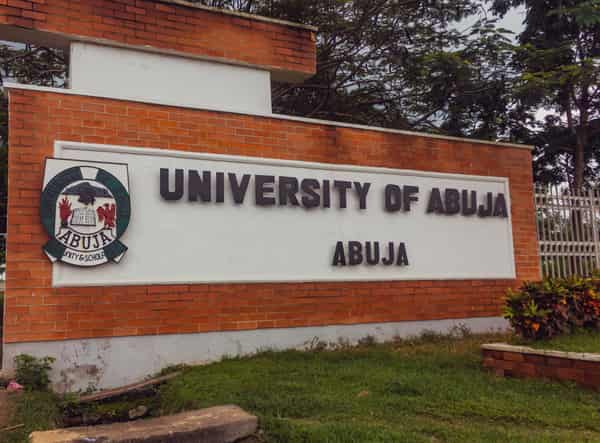
Some professors at the University of Abuja have voiced strong objections to the appointment of Professor Hakeem Fawehinmi as the institution’s new substantive Vice-Chancellor.
Operating under the banner of the Concerned Academic Stakeholders, the professors claimed that the appointment violates the published eligibility criteria, particularly the requirement that candidates must hold a Ph.D.
They therefore urged the Governing Council to uphold the advertised standards for the VC position, insisting that the role should be filled by a candidate with a Ph.D. rather than an individual whose qualification is based solely on a fellowship.
Specifically, they called on the Governing Council to “correct the present anomaly through elevation of the fully qualified, non-controversial candidate from the existing shortlist.”
The Governing Council had, last month, announced Professor Fawehinmi as the substantive Vice-Chancellor of UniAbuja, with his five-year tenure scheduled to commence on February 10, 2026.
In a report titled ‘An Academic Analysis of the Substantive Vice-Chancellor Appointment at the University of Abuja: Legal Compliance, Institutional Precedent, and Governance Implications’, the group drew a clear distinction between academic doctorates and professional fellowships, stressing that Nigerian courts have consistently held that a medical or professional fellowship does not substitute for a Ph.D. in academic leadership roles.
The report argued that while fellowships reflect advanced professional competence, they do not certify the research expertise, scholarly contribution, or cross-disciplinary leadership capacity expected of a Vice-Chancellor.
It warned that substituting one for the other amounts to both an academic misclassification and a breach of established regulatory standards.
The academics who signed the report include: Prof. Oluwaseun Livingstone Fayose (Faculty of Law); Prof. Fatima Ribadu (Faculty of Social Science); Prof. Folake Agnes Ige (Faculty of Arts); Prof. Khalid Ibrahim Musa (Faculty of Sciences); Prof. Ibinabo Hart (Faculty of Management Sciences); and Prof. Sambo Ishaq (Faculty of Education).
According to them, university leadership appointments in Nigeria are regulated by a strict framework that includes the Universities (Miscellaneous Provisions) Act, National Universities Commission (NUC) guidelines, and each institution’s internal governance policies.
The report noted that the advertised possession of a Doctor of Philosophy (Ph.D.) degree is not a discretionary preference but a mandatory baseline aligned with existing laws and national academic norms.
The paper reads in part: “A rigorous academic and legal evaluation of the substantive Vice-Chancellor appointment at the University of Abuja, viewed strictly through the lens of Point 2 (advertised requirement compliance) and institutional precedent, leads to one clear inference: failure to meet a mandatory Ph.D. requirement constitutes a fundamental disqualification. Such non-compliance invalidates the appointment in both law and governance ethics.
“Furthermore, the long-standing tradition of the University in selecting the least controversial and most legally defensible candidate reinforces the argument that the Governing Council is institutionally obligated to correct the present anomaly through elevation of the fully qualified, non-controversial candidate from the existing shortlist.”
To preserve institutional integrity, regulatory coherence, and public trust, the professors called for the immediate enforcement of strict advertised requirements; withdrawal of any appointment made in violation of mandatory academic qualifications; adoption of the highest-ranked fully compliant candidate to restore procedural legitimacy; and a formal reaffirmation of the University of Abuja’s historical governance tradition rooted in legality and risk avoidance.