• Refining capacity plummets, petrol imports soar to 1.8 mMT, highest in 12 months
• Stakeholders list expectations for new heads of NMDPRA, NUPRC
Importation of petroleum products and crude oil into Nigeria will persist in the short term despite the resumption of new regulators and the appointment of a new board in the nation’s oil and gas industry.
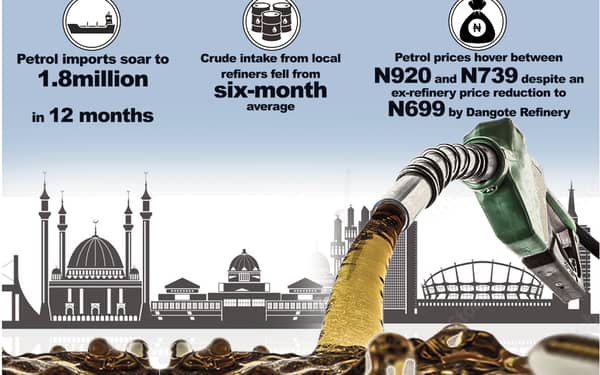
Coming amid rising tension among local refiners, marketers and the government, concerns over delay in issuance of new importation permits by the Nigerian Midstream Downstream Petroleum Regulatory Authority (NMDPRA), there are indications that Nigeria and other West African countries imported over 1.8 million metric tonnes of Premium Motor Spirit in November and December last year, the highest since 2024.
With imported fuel accounting for 73 per cent of Nigeria’s premium motor spirit consumption in November, lingering local production challenges, as indicated by data from local regulators and international sources, show that rather than abating, the so-called “petrol war” will remain.
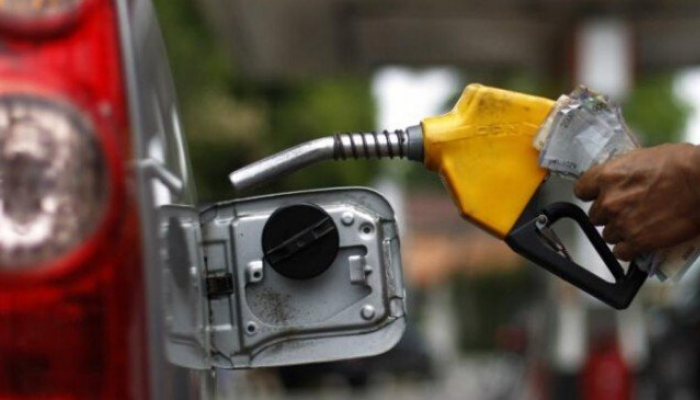
This comes as petrol prices remained above N800 per litre across fuel stations in the country, with major retailers yesterday in Abuja dispensing at N920 and N739 despite the ex-refinery price reduction to N699 by Dangote Refinery.
In a departure from previous practice where single suppliers have been crashing prices, most marketers, including members of the Major Energy Marketers Association of Nigeria (MEMAN), Depot and Petroleum Marketers Association of Nigeria (DAPMAN) and Independent Petroleum Marketers Association of Nigeria (IPMAN) appeared defiant on the price adjustment, sticking rather to higher bands.
While MRS dispenses at N739 per litre with long queues, TotalEnergies, directly opposite NNPC headquarters in Abuja, sold at N920 per litre, which is N181 difference. AY Shafa, NIPCO and NNPC Retail across the city were selling at N840 per litre. This is about N101 difference per litre.
Data from S&P Global Commodities at Sea show that about 1.8 million metric tonnes of gasoline arrived in West Africa in November and December, largely sourced from Northwest Europe. This marked the highest volume recorded on the route over two months since November–December 2024, underscoring the scale of supply entering the region.
Gasoline prices across West Africa have fallen to multi-month lows, driven by a combination of ample imported supply, price reductions at the international market and recent price cuts by the Dangote refinery, and restrictions on Nigerian import permits, according to market sources and data from Platts, part of S&P Global Energy.
Following the crisis with the Dangote Refinery, which led to the removal of heads of the two regulatory agencies in the sector, President Bola Tinubu had appointed new heads for the Nigerian Midstream and Downstream Petroleum Regulatory Authority (NMDPRA) and the Nigerian Upstream Petroleum Regulatory Commission (NUPRC) who quietly resumed while bringing in boards appointments, which has been elusive since passage of Petroleum Industry Act.
Sources at the Presidency, who pleaded anonymity, told The Guardian that the removal of the regulators was more political and that the allegations against the regulators only fast-tracked a planned decision.
The two sources, speaking separately on Farouk, said the inaction of the regulator, especially the long history of silence and the inability to provide accurate data and engage the public, was viewed as sabotaging the efforts of the president.
Meanwhile, industry players, analysts and community leaders told The Guardian that while the appointment of new regulators offers an opportunity for reform, the underlying structural weaknesses in Nigeria’s petroleum value chain remain unresolved. These weaknesses, they argue, will continue to force the country to rely on imports to meet domestic fuel demand in the medium term.
Documents obtained from the NMDPRA, CITAC and S&P Global revealed the scale of Nigeria’s continued dependence on imported petroleum products.
Between November 2 and November 30 alone, no fewer than 179 vessels were cleared to discharge petroleum products into the country.
The clearance records, which include vessel names, importing companies, submission and approval dates, show that virtually all major downstream players were active importers during the period.
Dangote featured on the list through vessels such as MT Plata North and MT Initiator. NNPC Trading Limited imported products via MT Mosunmola, MT Kriti Ruby and MT High Fidelity, while Pinnacle Oil and Gas utilised MT Sabaek.
Other marketers and traders listed include Ardova, Nipco, Asharami, A.A. Rano, TotalEnergies and more than 50 additional firms. The imports covered a range of petroleum products, including premium motor spirit (PMS), automotive gas oil (diesel), aviation fuel and liquefied petroleum gas (LPG).
The data showed the persistence of large-scale imports that enabled a seamless supply during the festive period at a time when Nigeria was expected to rely increasingly on domestic refining following the commencement of operations at the 650,000 barrels-per-day Dangote Refinery.
Regulatory data further highlight why imports remain unavoidable, as figures released by the NMDPRA indicate that Nigeria’s average petrol consumption stood at about 52.9 million litres per day in November 2025, exceeding the long-standing benchmark of 50 million litres per day.
Contrastingly, domestic supply remains both inadequate and unstable. The Dangote Refinery, currently Nigeria’s only operational large-scale source of locally refined PMS, supplied an estimated 18 to 23.5 million litres per day between October and November—well below its stated target of 35 million litres per day, and far short of national demand.
Production gaps from local refineries
Nigeria’s four state-owned refineries, despite having a combined nameplate capacity of over 400,000 barrels per day, produced no petrol during the period, further widening the supply gap.
CITAC reported operational fragility at the Dangote Refinery has compounded the situation, as its market intelligence reports indicate that the refinery experienced reduced crude processing rates in early December after its Residue Fluid Catalytic Cracker (RFCC) was taken offline for maintenance on December 5.
Crude distillation unit (CDU) throughput reportedly fell from about 450,000 barrels per day to 330,000 barrels per day before being ramped back up to 450,000 barrels per day by December 15.
However, the RFCC itself, the research body said, has continued to operate below optimal levels, adding that since returning from a six-week maintenance programme on October 12, the RFCC has been running at only 60–70 per cent utilisation, as underlying issues linked to catalyst loss remain unresolved.
These problems are expected to be addressed during a 49-day downtime that began on December 6 after several revisions to the maintenance schedule, CITAC said.
S & P, citing the Vice President of Dangote Refinery, Devakumar Edwin, had stated that the asset had begun a planned turnaround maintenance that would pause its main gasoline unit, the residue fluid catalytic cracker, and briefly halt all crude processing in early 2026.
Edwin had told the market analysts that maintenance on RFCC began in early December and will end in late January.
The upgrade, according to the body, may raise capacity from 450,000 barrels per day to 700,000 barrels per day. The start date for this work has not been confirmed.
Crude intake data point to softer refinery operations as well. The Dangote Refinery received about 11.5 million barrels of crude in November, below its six-month average of 13.8 million barrels per month. Most of the feedstock consisted of Nigerian grades, led by Bonny Light, which accounted for 41 per cent of deliveries, and Amenam at 17 per cent.
Other grades included Forcados, Usan, Qua Iboe and Ghana’s Sankofa. Notably, no U.S. crude was imported during the month, the first such occurrence in nine months.
Pending a successful upgrade that may see the asset operate at full capacity, market data suggest that imports may remain the system’s primary balancing mechanism.
Dangote, while reacting to reports of the refinery being shut down, explained that while work may be carried out on units such as the Crude Distillation Unit (CDU) and the Residual Fluid Catalytic Cracking (RFCC), other critical processing units remain operational.
The refinery listed the Naphtha Hydrotreater, Continuous Catalyst Regeneration (CCR) Reformer, and Hydrocracker as units currently running, producing PMS, Automotive Gas Oil (Diesel), and Jet A-1.
According to industry reports, gasoline imports surged by more than 50 per cent month-on-month in October following pump price adjustments that restored import parity.
Partner at professional services firm, Kreston Pedabo, Olufemi Idowu, insisted that expectations that fuel imports will abruptly end under new regulatory leadership are unrealistic.
“I don’t believe fuel importation in Nigeria will suddenly come to an end simply because new regulators have been appointed at NUPRC and NMDPRA,” he said.
“Nigeria still relies heavily on imported refined products, spending trillions of naira annually on imports, according to recent trade data.
“Until local refineries, such as the Dangote Refinery and the government-owned plants, can operate consistently at full capacity, the challenge of petroleum product importation will remain.”
However, Idowu noted that the new leadership could make a difference over time by focusing on transparency, infrastructure development and fair competition.
“If these areas are prioritised, Nigeria can gradually reduce this costly dependence on imports and move closer to energy independence,” he added.
Downstream operator, Jide Pratt, echoed the need for balance rather than outright elimination of imports.
“Importation should not stop. The mix of local refining and imports should be properly regulated so we don’t have a single source. Professionalism, corporate governance and ethics must guide the actions of the new heads, with minimal interference,” he said.
Stakeholders list expectations for new heads of NMDPRA, NUPRC
Energy economist and scholar, Professor Wunmi Iledare, framed expectations for the new regulators around institutional reform rather than personalities.
“My expectations for Saidu Mohammed of NMDPRA and Oritsemeyiwa Eyesan of NUPRC are anchored not on personalities, but on leadership mindset and institutional fidelity to the Petroleum Industry Act,” he said.
According to Iledare, Nigeria needs transformational regulatory leadership that strengthens institutions and restores credibility. He outlined his expectations using the QUAD-E framework—efficiency, effectiveness, equity and ethics.
“Regulators must reduce discretion-driven delays, eliminate regulatory frictions and ensure predictable, time-bound approvals. Regulation should translate into measurable outcomes such as investment confidence, infrastructure development and energy security, not just compliance statistics.
“Competitive neutrality is critical, and credibility will ultimately rest on transparency and strict adherence to the spirit and letter of the PIA,” he said.
The chairman of the Board of Trustees of the Community Development Committees of the Niger Delta Oil and Gas Producing Areas, Joseph Ambakederimo, warned against concentrating energy supply in the hands of a single operator.
“It is dangerous to leave a product as critical as energy for over 240 million people in the hands of one entity. The oil sector should operate based on a free market, with a mix of local production and imports to address supply shortfalls caused by glitches in the system,” Ambakederimo said.
Ambakederimo argued that while imports should not dominate as they have in recent years, regulators must actively encourage local production to stimulate jobs and economic growth.
On crude oil production, he challenged the new NUPRC leadership to be ambitious, stressing that “Nigeria needs to target four to five million barrels per day. Anything short of this cannot drive the economic needs of the country.
“This level of production will provide enough crude for local refining and enough exports to earn foreign exchange and support the naira. But this will only be possible if the cost of producing a barrel of crude is brought down to globally competitive levels.”
The Executive Secretary of the Major Energy Marketers Association of Nigeria (MEMAN), Clement Isong, expressed confidence in the evolving governance framework of Nigeria’s petroleum sector, noting that the establishment of a governing board, the first of its kind after the Petroleum Industry Act (PIA), has strengthened strategic oversight and direction.
“There is now a governing board providing strategic direction, a structure that has not been in place since the enactment of the PIA. With this guidance and protection, the regulators are well positioned to perform their roles effectively, if not better than before,” he said.
According to Isong, the existence of the board provides clear institutional guidance, positioning it to deliver improved performance compared to the past. He also highlighted the depth of experience of the incoming Authority Chief Executive (ACE), describing the difficulties encountered in 2024 and 2025 as a necessary learning curve that has ultimately reinforced institutional capacity and operational understanding.
Isong said, “The incoming ACE and CCE are also highly experienced. The challenges of 2024 and 2025 represented a learning curve, one that has strengthened institutional capacity and deepened operational insight. It is important to acknowledge the foundations laid by previous regulators and their teams, upon which current and future progress will be built. I am sure this development will serve the upstream and downstream better for the good of the consumers.”