 Follow Us on Google News
 Follow Us on Google Discover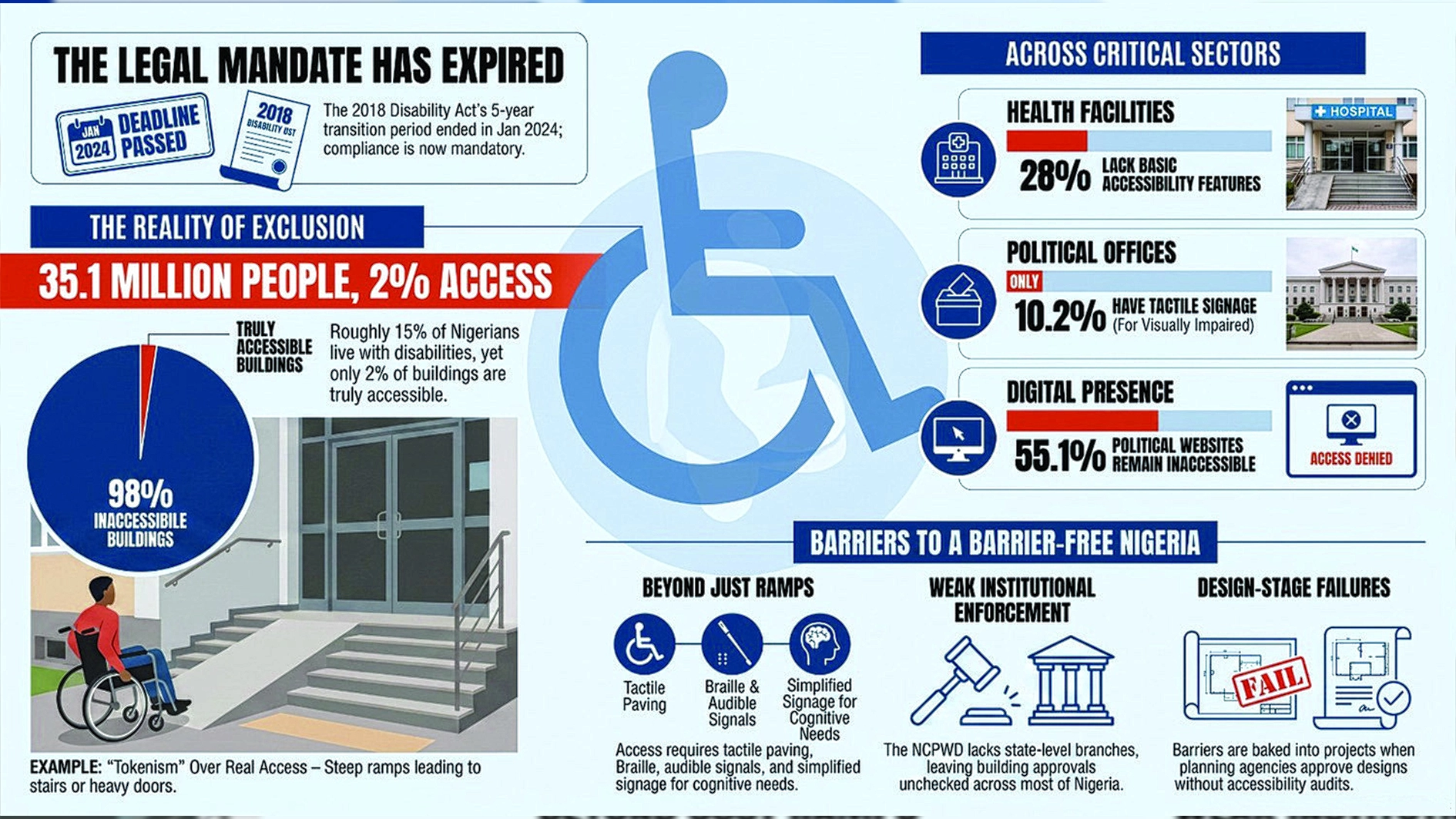
• Only about 2% of buildings are accessible to people with disabilities
• 28% of health facilities lack basic accessibility features
• Operators seek penalties, sealing of non-compliant facilities
Despite increasing investment in roads, housing, commercial buildings and public infrastructure, persons with disabilities (PWDs) continue to face significant barriers accessing Nigeria’s built environment, with many new developments failing to provide basic accessibility features.
Government offices, hospitals, schools, shopping complexes, transport terminals and residential estates now often lack facilities that enable PWDs to move independently and participate fully in society.
The problem persists despite the Discrimination Against Persons with Disabilities (Prohibition) Act 2018, which requires that public buildings, roads, sidewalks, pedestrian crossings, and other public facilities be accessible to persons with disabilities.
The five-year transition period provided by the law for existing public structures to comply with accessibility requirements expired in January 2024, but accessibility remains an afterthought in many public and private developments.
According to figures cited by the National Commission for Persons with Disabilities (NCPWD) and disability-rights groups, about 35.1 million Nigerians, or roughly 15 per cent of the population, are estimated to be living with disabilities. Reports have also suggested that only about two per cent of buildings in Nigeria are accessible to PWDs.

The NCPWD announced National Accessibility Compliance Certificates in September last year and has been developing minimum accessibility standards to strengthen compliance and enforcement. However, many professionals and developers remain unfamiliar with the certification requirements.
A 2025 Enhancing Enforcement of the Disability Act in Nigeria’s Political Spaces (EDANPS) accessibility audit of 49 political-party offices across Nigeria found that only 22.4 per cent had accessible ramps, while just 10.2 per cent had tactile signage for persons with visual impairments. It also found that 55.1 per cent of political-party websites and social-media platforms examined were inaccessible to PWDs, showing that exclusion extends beyond physical infrastructure into digital public life.
Similarly, the 2024 State of Disability Inclusion Report found that 28 per cent of health facilities in Nigeria lacked basic accessibility features, affecting access to clinics, maternity services, treatment and emergency care.
Although the Disability Act provides a legal framework for inclusive infrastructure, experts and recent studies have criticised the accessibility provisions of the National Building Code as vague and lacking detailed, measurable standards for universal design. The Persons with Disabilities (Accessibility) Regulations, 2023, were introduced to address some of these gaps.
For wheelchair users, common barriers include buildings without ramps or lifts, steep or poorly designed ramps, narrow doorways, inaccessible toilets and uneven walkways. Persons with visual impairments face additional difficulties where facilities lack tactile paving, Braille signage, audible signals and clearly defined pathways.
The problem extends to the wider transport and urban environment. Pedestrian bridges are frequently constructed with stairs but without lifts or alternative accessible routes. Sidewalks are often obstructed by traders, parked vehicles and open drains, while pedestrian crossings may lack dropped kerbs and other features required for wheelchair access.
Professionals in the built environment said accessibility should be incorporated at the design stage and enforced through planning approval, construction supervision and completion certification, rather than treated as an optional feature.
The Guardian gathered that building-control agencies sometimes approve plans without adequate checks for accessible entrances, lifts where required, toilets, tactile signage, appropriate parking spaces, wide circulation routes and emergency evacuation provisions. As a result, barriers that could have been eliminated during design are reproduced in completed buildings.
The former President of the Nigerian Institute of Town Planners, Mr Nathaniel Atebije, expressed concern over the continued construction of buildings without adequate consideration for PWDs.
Atebije attributed the situation to poor awareness of the rights and capacities of persons with disabilities, inadequate knowledge of statutory requirements and weak enforcement of accessibility standards.
He told The Guardian that many architects, developers, builders and approving authorities were insufficiently familiar with the provisions of the Discrimination Against Persons with Disabilities (Prohibition) Act, 2018, and the National Building Code.
He said limited institutional capacity, inadequate professional training, economic considerations and negative societal attitudes had further compounded the problem.
According to him, responsibility for inaccessible buildings should be shared across the development chain, from architects and other design professionals to developers, builders and planning authorities. However, he identified the design stage as a major point of failure, arguing that many buildings were conceived without adequate consideration for universal design principles.
Atebije, who is also the Founding Director of the Nathaniel Atebije Foundation for Planning Advocacy, called for a comprehensive strategy that combines stronger legislation, effective enforcement, economic incentives, professional capacity building, and public awareness.
He urged governments to make accessibility compliance mandatory for planning approvals, development permits, construction inspections, occupancy certification and periodic building recertification. He also recommended mandatory accessibility checklists for planning applications and site inspections.
Atebije said inclusive design should be viewed not merely as a technical requirement but as an investment in human dignity, social justice and sustainable development.
The President of the Spina Bifida and Hydrocephalus Association of Nigeria, Alhassan Funmilayo, told The Guardian that more than 90 per cent of public, government and commercial infrastructure in Nigeria failed to meet basic accessibility standards for PWDs.
Funmilayo, an architect, said accessibility audits had exposed widespread barriers, including inadequate ramps, poorly designed pedestrian routes, inaccessible toilets, absent or non-functional lifts and inadequate signage for people with hearing and visual impairments.
“Most infrastructural barriers are experienced with a lack of ramps for wheelchair users, poor roads and paved areas dedicated for PWDs, inaccessible toilet spaces and non-availability of elevators for multi-storey buildings or non-functional, dilapidated lifts in most public and government buildings,” he said.
He also cited inadequate tactile and Braille signage, appropriate symbols for people with hearing impairments, and properly designed circulation spaces in schools, hospitals and government offices.
While government agencies had made efforts to incorporate accessibility requirements into building-plan approvals, Funmilayo said enforcement remained weak after construction.
“Post-occupancy evaluation after completion of physical infrastructure, such as buildings, road pavements, walkways and sidewalks, still shows that a lot has to be done in terms of implementation and enforcement of accessibility,” he said.
Funmilayo said the Disability Act provides a strong legal framework for inclusive infrastructure but expressed concern about the NCPWD’s limited capacity to enforce its provisions nationwide.
He noted that the commission is expected to issue accessibility compliance certificates for completed buildings before occupation but questioned how effective nationwide enforcement could be without a stronger presence across the states.
“At the moment, the commission does not have the capacity to enforce it. There is only one branch of NCPWD in Abuja. How do they want to monitor across the country without support branches in each state and collaborative awareness with the relevant monitoring building and construction agencies?” he asked.
He called for stronger collaboration between the NCPWD and agencies responsible for planning, building approvals, construction and infrastructure monitoring.
Funmilayo also urged built-environment professionals to understand that accessibility goes beyond ramps, stressing the need for tactile signage, accessible toilets, lifts, adequate circulation spaces, pedestrian walkways and appropriate road crossings.
He advocated a shift from the traditional charity-based approach to disability to a rights-based model in which accessibility is treated as a legal obligation and an essential part of development.
The President/Chief Executive Officer of the Down Syndrome Foundation Nigeria, Mrs Rose Mordi, called for a broader approach to accessibility, saying attention must extend beyond physical barriers to the cognitive and sensory needs of PWDs.
Mordi told The Guardian that while steps, stairs and the absence of ramps remain major barriers, persons with intellectual and developmental disabilities face less visible obstacles that limit their ability to navigate public spaces independently.
“When we talk about infrastructure barriers in Nigeria, society often defaults to physical obstacles like steps and stairs. While those are severe, accessibility goes far beyond physical mobility,” she said.
She identified schools, hospitals, public transport, workplaces and government offices as areas where accessibility remains poor. Many facilities, she said, lack simplified signage, pictograms and colour-coded pathways to assist people with intellectual disabilities and those with lower literacy.
Public transport also remains challenging, with chaotic boarding arrangements at motor parks and inadequate visual and auditory announcements. Mordi said the expiration of the five-year transition period in January 2024 should have marked a shift from accessibility being optional to becoming a legal requirement.
Although she acknowledged regulatory steps by the NCPWD, including National Accessibility Compliance Certificates and enforcement guidelines, she said non-compliance remained widespread.
She criticised “tokenism”, where developers install poorly designed ramps without addressing other accessibility requirements. “A ramp that leads directly into a heavy manual door or a flight of stairs” does not constitute genuine accessibility, she said.
Mordi also warned that compliance assessments often focus almost exclusively on wheelchair access while ignoring cognitive and sensory needs.
She faulted building-control and urban-planning authorities for approving some public and commercial projects without adequate accessibility features, calling for stricter checks before building permits and occupancy certificates are issued.
“The grace period has ended,” she said, calling for prosecution, civil penalties and the sealing of non-compliant public and commercial facilities.
Mordi urged governments to incorporate universal design into national and state building regulations, including step-free entrances, standardised ramp gradients, wide doorways, tactile indicators, accessible toilets and appropriate emergency systems.
She called for mandatory accessibility audits before building permits are issued and urged state building-control agencies, including the Lagos State Building Control Agency, to enforce the Disability Act. “No building permit should be issued without a verified Accessibility Compliance Audit signed off by certified accessibility consultants,” she said.
She further proposed withholding occupancy permits and certificates of completion from buildings that fail accessibility checks, while requiring public institutions and companies providing public services to obtain valid National Accessibility Compliance Certificates from the NCPWD.
Mordi said enforcement should include meaningful penalties for developers who violate accessibility requirements and a simple complaint mechanism for PWDs to report breaches.
She maintained that accessibility must be treated as a fundamental component of infrastructure development rather than an afterthought or special concession, stressing that Nigeria’s built environment should be designed to serve all citizens.
However, a civil engineer and Deputy Chairman of the Nigerian Institution of Highway and Transportation, Dr Mudashiru Bola, disagreed that new building designs have generally failed to incorporate accessibility for PWDs.
According to him, no registered engineer would design a commercial building without considering the needs of PWDs.

