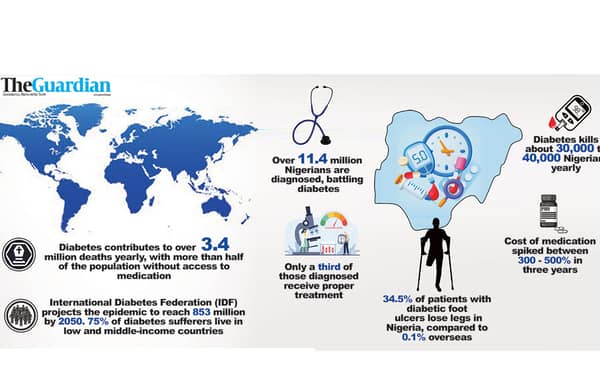
With 30,000 to 40,000 yearly diabetes-induced deaths occasioned by over 300 per cent increment in medication cost, unhealthy religious and cultural beliefs, and inadequate care facilities, diabetes has become worse than a silent epidemic. Belonging to the top 10 killer diseases in Nigeria and afflicting over 11.4 million citizens, the ailment, many say, is receiving little attention from the Federal Government, with attendant policy gaps, poor funding, and shrinking access to care. Stakeholders warn that with patients fast rationing medicines and abandoning clinics to ‘get by’ cost-wise, rising cases of stroke, kidney failures, and amputations could push up the morbidity figures, NKECHI ONYEDIKA-UGOEZE and IJEOMA NWANOSIKE report.
Mrs Leticia Nnabuike, a resident of Aleta, a community along the Airport Road, Abuja, has been diabetic for the past eight years. She took her medications religiously until 2024, when the cost of prescribed drugs rose sharply.
“Managing diabetes drains you both financially and otherwise. Apart from the drugs, your diet also costs quite some money if you want to follow your meal plan because certain foods must be avoided,” she explained.
Nnabuike continued: “Before now, I used to spend between N35,000 and N40,000 monthly on medication and other medical expenses, but today, the same regimen costs me over N120,000 monthly. So, what I do nowadays is to ration the medication; I skip my medications some days. In fact, the way I feel determines the number of times I take my drugs. It is no longer (financially) sustainable to adhere strictly to doctors’ prescriptions.”
While Nnabuike has resorted to drug rationing, a 59-year-old plumber, Lukman Hassan, who lives in Dakibiyu Village, an urban slum in Jabi District of Abuja, has abandoned orthodox medicine altogether and resorted to herbal treatment.
“I took ill in 2019, and they rushed me to the hospital. After the lab tests, the results showed that I had diabetes. When I started taking the drugs, some of them cost N500, and some others N800 per card, but now, I can no longer afford my medications because the prices have skyrocketed. The last time I took my medications was in December 2003 because of the unbearably high cost. So, I had to search for herbal alternatives. What I do now is combine bay leaf, Moringa, and ginger to manage my condition.”
Another diabetic, who simply identified himself as Odafe, said: “I was first diagnosed with diabetes in 2015, and one of the first things that the doctor told me to encourage me to take my drugs was that if I want to see my grandchildren, I must take my drugs religiously, and only stop using them on the doctor’s advice.
“But with the increasing cost of diabetic drugs, you must have the required finance to stock your drugs as they are due because many are dying because they can’t sustain the medications. Before now, I could get all my routine drugs for one month for less than 4,000, but now, I spend up to N14,000, and my type of drugs are those cheap ones.”
Prevalence, disease burden rising in poor countries
INTERNATIONALLY, the global agenda on diabetes, spearheaded by the World Health Organisation (WHO), aims to reduce diabetes risk and improve treatment for the 589 million adults (aged 20-79) diagnosed with diabetes.
In Nigeria, many people suffering from diabetes struggle to cope with several socio-economic factors that expose them to short and long-term consequences, but which the government appears to pay scant attention to.
According to the International Diabetes Federation (IDF), this number is projected to reach 853 million by 2050, even as 75 per cent of people with diabetes live in low and middle-income countries.
With over 90 per cent of people with diabetes suffering from Type 2 diabetes, the WHO in 2024 revealed that the number of people living with diabetes rose from 200 million in 1990 to 830 million in 2022, while the prevalence has been rising more rapidly in low and middle-income countries.
Further startling revelations from the organisation indicated that diabetes contributes to over 3.4 million deaths annually, and more than half of the people living with diabetes did not take their medication in 2022.
Still in 2022, an estimated 8.02 million Nigerian adults were living with diabetes, most of whom had Type 2 diabetes, and the latest figures released by the Diabetes Association showed that over 11.4 million Nigerians are battling the worsening diabetes crisis.
Diabetes, despite being one of the top 10 killer diseases in Nigeria, receives scant attention from the Federal Government.
A recent expert’s opinion indicated that only 11 million out of 22 million persons diagnosed with diabetes in Nigeria were aware that they had the disease, with the potential that this figure could double by 2045 if the trend is not checked.
 The heavy burden of cost, treatment plan
NIGERIA has the highest number of diabetic cases in Africa and ranks among countries with the highest mortality rates arising from the disease globally. To date, many cases remain undiagnosed, while only a fraction of patients receive adequate care.
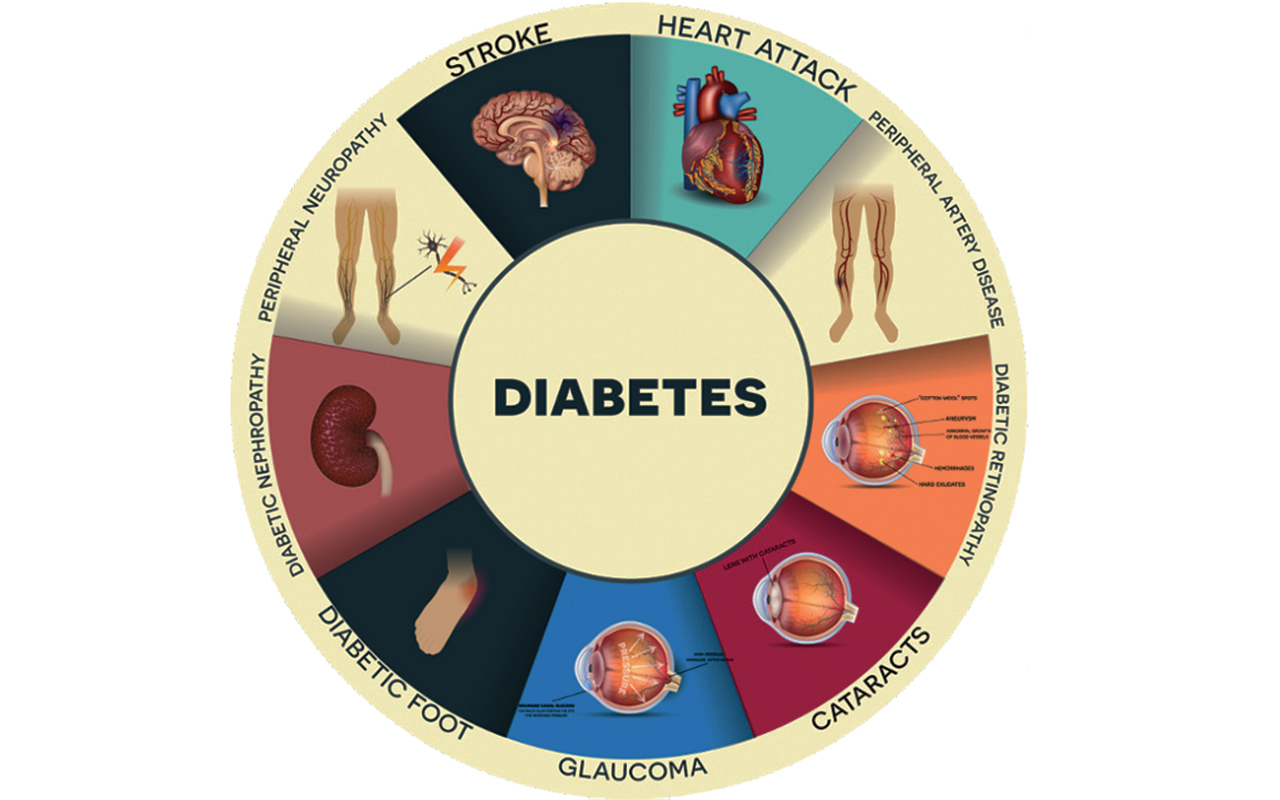
While shortage of healthcare specialists has left millions vulnerable to preventable complications such as heart attack, stroke, kidney failure and blindness, the cost of medication, which has tripled in the last couple of years, is forcing patients to either ration drugs, abandon treatment or turn to unproven herbal remedies, which ultimately results in dire consequences.
It was this pathetic scenario that forced the Diabetes Association of Nigeria (DAN) to, in November last year, call on the Federal Government to declare a state of emergency on diabetes care. It also warned that failure to do so could result in an alarming rise in diabetes-induced deaths.
Worryingly, the association further disclosed that despite the rising numbers of diabetics, only a third of those diagnosed were receiving appropriate treatment, and only about a third of those on treatment achieve good control of blood sugar.
According to the National President of DAN, Prof. Ejiofor Ugwu, even the figure of diabetics in the country represents just a tip of the iceberg, as two-thirds of diabetes cases in Nigeria are still undiagnosed due to a lack of routine screening.
The DAN president emphasised that factors like poor awareness about diabetes, grinding poverty, unhealthy religious and cultural beliefs, and inadequate diabetes care facilities are some of the challenges facing the management of diabetes, which has led to the death of approximately 30,000 to 40,000 Nigerians annually.
In addition to these, other factors that engender increased diabetes burden include rapid urbanisation, which promotes a more sedentary lifestyle, poor diet exacerbated by the increased consumption of processed foods, sugary drinks, and high-calorie meals among Nigerians.
While the issue is further worsened by the transition from traditional diets high in fruits, vegetables, and whole grains to more Westernised diets low in nutrients, the continuous rise in medication costs has forced many patients to abandon medical care in favour of prayer or alternative remedies.
Investigations by The Guardian showed that despite the government’s zero tariff on pharmaceutical products, the cost of diabetic drugs has continued to gallop.
For instance, Galvus Met 50 mg/1000 mg, which cost N3,000 in January 2025, now sells for N9,700 per sachet. Glucophage (metformin) 1000 mg, previously priced at N1,500 to N2,000, now costs N5,000. Amaryl 4 mg, which was N500 in January, now costs N11,000 per sachet. Co-Mepiryl Forte, sold for N1,500 in January, now sells for N2,500.
Ugwu, who is an endocrinologist/consultant physician, decried the current state of diabetes and diabetes care in the country, saying: “Now, you have a disease that is killing more than 30,000 Nigerians every year; you have a disease in the country that is one of the leading causes of stroke, heart disease, kidney disease, and blindness.
“Diabetes is not supposed to kill anybody if it is well-controlled, but it is killing because most patients are not on treatment because they cannot afford the 300 to 500 per cent increase in the cost of diabetes medications. Sadly, this 500 per cent increase in the cost of diabetic drugs has ensured that one-third of diabetics who were on treatment are no longer on treatment. Added to this, many of those who are on treatment are not receiving proper diabetes care.
“We did a Multicentre Evaluation of Diabetic Foot Ulcer in Nigeria, which is a study on amputation. As the lead investigator, we found a prevalence rate of 34.5 per cent of Nigerians who go to the hospital with diabetic foot ulcer and lose their legs. To put it simply, it means that the number of people whose legs are cut off as a result of diabetes is almost four out of every 10 patients. If you go to the U.S., Australia, the prevalence is less than 0.1 per cent, but ours is 34.5 per cent.
“So, are we going to wait until we have corpses littered everywhere before we declare a state of emergency? That is why we are calling on the government to please declare a state of emergency on this epidemic so that we can bring in all the necessary power and machinery to tackle it before it is too late,” he added.
Ugwu said that the government’s intervention has been quite insignificant and has not caused any reasonable change.
He noted that, though the government last year gave a tax waiver on pharmaceutical reagents to reduce the cost of locally produced pharmaceuticals.
“But the question is, what percentage of anti-diabetic medications are manufactured in this country? It’s less than five per cent. Over 95 per cent of anti-diabetic medications are imported. So, reducing the tax waiver on pharmaceuticals instead of the tax waiver on imported anti-diabetic medications is just like a drop in the ocean.”
Also bearing her mind on the issue, a consultant endocrinologist at the National Hospital, Abuja, Dr Ramatu Shuaibu, submitted that the increasing cost of medication remains a major drawback for diabetic patients’ management, leading to significant morbidity and mortality.
Shaibu, however, said that the government, NGOs, community leaders and even religious leaders all have a role to play in raising awareness, increasing funding and launching massive health campaigns to tackle this menace.
“Diabetes in children is on the rise because of the current prevalent unhealthy lifestyle. Unhealthy high-fat diets from processed fast food, increased screen time, and lack of exercise all come together to cause Type 2 diabetes in children. We need to bring healthy lifestyle campaigns to schools and communities. To encourage consumption of healthy food, encourage water intake as opposed to fizzy drinks, emphasise exercise and less sedentary lifestyles,” she said.
A community pharmacist, Kayode Rafiu, said that the cost of diabetic drugs has been rising steadily for the past four years, adding that the situation is now reaching its peak.
He observed that most diabetic patients can no longer take their medications according to prescription because of the high cost of drugs, leading many to skip doses.
“They ration the medications by taking today and skipping the next day because they feel it is better that way than not taking them at all. But these are drugs they ought to take daily. Some even stay for months without taking their medication because they do not have money, and by the time they come, their blood sugar has risen. It is a very sad situation.”
Rafiu lamented that most patients also struggle to adhere to their diet plans due to the cost. “Here in Africa, 90 per cent of our diets are carbohydrates. So, we always advise them to refrain from eating carbohydrates so that the sugar will not go up and lead to unnecessary complications. But those foods are extremely expensive, so they end up eating what they are not supposed to eat.”
He noted that the government waiver on pharmaceutical products, which many Nigerians thought would help reduce drug prices, is not working. He urged the Federal Government to establish a monitoring or enforcement team to ensure the waiver is implemented.
Sugar tax: Sacrificing human lives on altar of job creation
TO underscore the importance of waging a sustained war on diabetes causative factors, the WHO last Monday urged higher taxes on sugary drinks and alcohol to curb disease, specifically warning that sugary drinks and alcohol were too accessible and too cheap in most parts of the world, thereby fuelling rising rates of obesity, diabetes, and cancer, among others.
 Speaking virtually to journalists following the release of two reports that show that levies on the products remain low across many regions, the WHO Director-General, Tedros Adhanom Ghebreyesus, said that health taxes were an effective tool for reducing consumption of harmful products, hence the need for governments to significantly increase taxes on sugary drinks and alcohol.
“Health taxes have been shown to reduce consumption of these harmful products, helping to prevent disease and reduce the burden on health systems,” he said, adding that, “At the same time, they generate an income stream that governments can use to invest in health, education and social protection.”
The Federal Government in 2022 began implementing the Sugar-Sweetened Beverages (SSB) Tax, but later regretted it. Consequently, the incumbent government suspended it, claiming that it was disrupting the economy and would throw people out of jobs.
According to Ugwu: “Which country trades off the life of its citizens for the profit of a few companies? SSB tax is in place in most developed countries in Europe and America, and there is sufficient evidence that it has drastically reduced the consumption of SSBs and helped in preventing chronic non-communicable diseases, including diabetes. And the N10 per litre they were deducting was just too insufficient because what that means is that a 50cl bottle of soft drink will only attract a tax of N5. Will you stop drinking a bottle of soft drink just because there is a N5 tax on it? It doesn’t make sense.”
For a Professor of Endocrinology and Diabetology and Director, Centre for Diabetes Studies, University of Abuja, Prof. Felicia Anumah, rather than help matters, some actions and inaction of government have dire health consequences on the citizenry, including “more complications of this chronic non-communicable disease; more strokes, more heart attacks, more kidney failures, more amputations, and more blindness. That is what we are witnessing in our hospitals.”
Anumah added that if someone suffers kidney failure from diabetes, the person needs about N250,000 per week for dialysis, compared with about N100,000 per week two years ago.
“Therefore, in this kind of scenario, prevention is the cheapest option. Presently, 70 per cent of diabetics are also hypertensive. So, they will also be on drugs to treat hypertension, like two or three. These patients may also have heart problems for which drugs must be administered to slow down the condition. So, we are now witnessing the health consequences of these economic policies, which nobody sees except us in the hospitals.”
Painting an even grimmer picture of the situation, Anumah said: “We are aware that some patients now ration their medication. If they take it today, they would skip tomorrow so that the drugs can last longer. Some patients just tell you, ‘I’m sorry, I can no longer come to the clinic for financial reasons’. As days pass, we have fewer patients attending clinics, while many discontinue treatment and return to herbs.
“But the challenge we have with these herbs is that they have not passed through medically validated processes that declare them fit for human consumption, in addition to how they may affect body organs. On the other hand, orthodox medicine, before making it to the counter, has gone through about four stages of clinical trials.”
Like DAN, Corporate Accountability and Public Participation Africa (CAPPA) is calling for urgent government action to address the nation’s worsening diabetes crisis, including an increase in the SSB tax to at least N130 per litre.
For the Executive Director of CAPPA, Akinbode Oluwafemi, this increment, as well as a mandatory front-of-pack nutrition labelling among other such policies, would reduce consumption, encourage healthier product reformulation, empower consumers, and protect Nigerians from aggressive marketing by major food and beverage companies.
He emphasised that such measures would not only discourage excessive intake of sugary beverages but also generate revenue for the country’s overstretched health system.
Imperatives of local solutions, legislative intervention
WITH the naira to dollar exchange rate still appalling, and country’s foreign exchange challenges still a long way to end, a clinical pharmacologist and Professor of Medicine at the University of Ilorin, Emmanuel Okoro, is calling for locally tailored solutions to tackle the country’s rising diabetes burden, warning that many Nigerians were paying more and suffering more because the health system continues to adopt foreign standards that do not fit local realities.
Okoro, who specialises in developing low-cost and effective treatments for hypertension and diabetes, said that many Nigerians were dying prematurely and needlessly from diabetes because they either do not know they have the disease or seek care too late, often in places where competence or affordability is an issue.
According to him, research at the University of Ilorin Teaching Hospital has shown that people at risk can be identified early, and through diet and physical activity, the onset of the disease can be delayed or completely prevented.
“Nigeria has the tools from its own research and resources to slow the escalation of diabetes if it wants to,” he said, adding that doing so does not necessarily require more spending, but smarter use of existing resources.
The professor also identified the high treatment costs and systemic inefficiency as major barriers to diabetes control, noting that Nigerians are often subjected to tests and treatments designed for other populations, many of which escalate costs without improving outcomes. “Even for the same medicines. Nigerians in Nigeria pay far more than their counterparts with both conditions living in rich countries.”
On the economic implications of neglecting diabetes care, Okoro argued that government interventions should prioritise quality and affordability over subsidies. He said diabetes and hypertension are conditions that can be effectively managed at the primary level without sophisticated equipment or excessive spending.