A groundbreaking proton therapy technique has shown promise in the treatment of aggressive cancers, offering a remarkably low side effect profile.
A recent case study involving a rare salivary gland tumour reveals how precision-targeted radiation successfully eliminated cancer while sparing healthy tissue.
The latest treatment is highly effective at eliminating hard-to-treat cancers while causing minimal side effects. According to experts, radiation side effects can be severe for many cancer patients. However, a new approach to delivering radiation has shown promising results in treating a difficult-to-target cancer, with the only reported side effect being mild skin discolouration, even nine months after treatment.
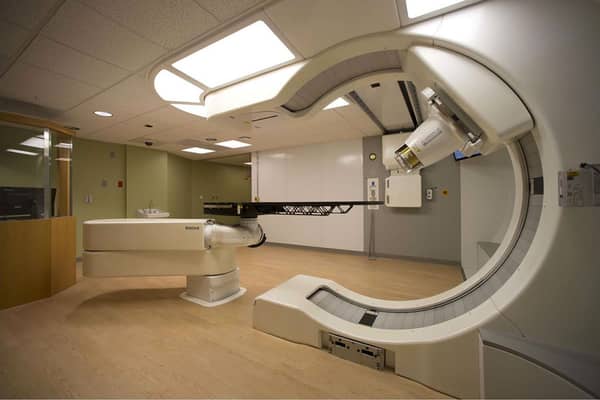
This innovative method, known as step-and-shoot proton arc therapy, was first used by physicians and scientists at Corewell Health William Beaumont University Hospital in Royal Oak, Michigan, to treat a patient
Precise radiation with minimal tissue damage compared to traditional proton therapies, the step-and-shoot technique uses a proton beam to deliver radiation more precisely and continuously to the tumour site.
The system is automated, reducing the lag time between radiation doses. In contrast, other methods require manual adjustments, making them slower and potentially less accurate.
Because the new technology allows doctors to target the tumour with greater precision, early results show that it protects nearby healthy tissue and organs, significantly reducing side effects. This outcome has been especially meaningful for 46-year-old Tiffiney Beard of Redford, Michigan, who received the treatment.
Beard was diagnosed in early 2024 with adenoid cystic carcinoma, a rare, highly invasive and often difficult-to-treat tumour in her salivary gland.
According to a radiation oncologist, Corewell Health, Rohan Deraniyagala, managing this type of tumour is very difficult because of its natural tendency to be nerve-seeking.
Deraniyagala explained that because these tumours like to target the body’s nerves, fighting them typically comes with many side effects like fatigue, jaw pain, difficulty eating or swallowing, loss of taste, headaches, and memory issues.
Tiffiney Beard was the first patient in the U.S. to be treated with the latest, highly accurate proton beam arc therapy for her rare head-and-neck cancer. Beard experienced minimal side effects after her 33 treatments and is currently cancer-free, approximately one year later.
In Beard’s case, the tumour had weaved its way into the nerves leading to her brain. But thanks to this new type of treatment, Beard continues to be side-effect-free.
After having the tumour removed, which was about the size of a gumball, I had 33 proton therapy treatments in total and, amazingly, had no side effects and didn’t miss a day of work,” Beard said. “You hear a lot of stories about radiation side effects, and I just wasn’t having any.”
Beard completed her treatment in early August last year, and as of her last checkup, she is still showing no signs of cancer and Deraniyagala confirmed she has no radiation toxicity to other areas of her body, including her brain.
“Proton beam therapies continue to evolve rapidly and while in this treatment, side effects and outcomes can vary, but Deraniyagala is hopeful that other patients will have the same experience Beard did with this treatment.
Currently, physicians and scientists at Corewell Health’s William Beaumont University Proton Therapy Centre are trialling a next-generation proton beam therapy, known as DynamicARC, that has the potential to further transform cancer treatment. Through active research collaboration with Ion Beam Application, an international proton therapy system manufacturer, Corewell Health is advancing the step-and-shoot proton arc technique by creating an even better targeted delivery system with no lag time in between radiation dosages and beam angles.