
 Get Guardian on Google
Despite receiving ₦238.4 billion in allocations between January 2025 and June 2026, Osun’s 30 LGAs still grapple with poor roads, struggling health centres, under-resourced schools and broken water systems. The leadership tussle between the ruling and opposition political parties across the 30 LGAs hasn’t just led to fratricidal killings, but also the unknown whereabouts of the huge public funds. CHRISTIANAH ALABI-AKANDE, SODIQ MOJIBOLA and OLANSHILE AKANHO write.
When Suliat Oyetunji went into labour, the health facility closest to her home in Oore, a village near Iragbiji in Osun State’s Boripe Local Council, could not provide the care she needed.
For months, she had struggled to access reliable antenatal care at the Oore Primary Healthcare Centre. Health workers, she said, were rarely available whenever she visited, leaving her to seek medical attention in Iragbiji, a town about four kilometres away.
When the time came to be delivered of her set of twins, there was no dependable care at the facility. She eventually gave birth at home.
“Whenever I went to the PHC, nurses were not always available,” she told DevReporting.
Her experience points to a troubling reality for residents of Oore where having a health centre does not necessarily mean having access to healthcare. When DevReporting visited the facility, it was locked up.

Across Osun, similar concerns emerged in communities visited by DevReporting. Yet, between January 2025 and June 2026, the state’s 30 local councils received more than N238 billion in allocations.
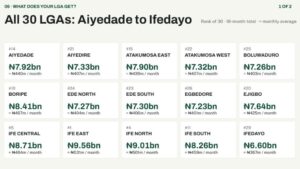
During the period under review, Boripe LGA received ₦8.41 billion, averaging about ₦467 million monthly. Ife East received the highest allocation, totalling ₦9.56 billion, while Ifelodun received ₦6.53 billion.
Despite the billions of naira allocated during the period under review, residents in several communities continue to decry deteriorating basic amenities. Some have resorted to providing or repairing basic infrastructure themselves while others struggle to access essential services.
Like Oore, like Okebode
At Okebode in Atakunmosa West LGA, the challenges facing the Abebi Afilaka Health Centre include shortages of drugs, inadequate personnel and unreliable electricity. Ayoola Odunayo, a healthcare worker at the facility, lamented the difficulties staff encounter when attending to pregnant women, particularly during childbirth.
“In fact, we use the flashlight of our phones to deliver pregnant women because there is no power supply,” she said. “We also do not have the necessary equipment or drugs. In addition, we need more beds for our patients.”
The secretary of the Okebode palace, Adebowale Adeorike, said a community indigene paid for the repair of the maternity centre after a storm damaged it in 2019.
“When it happened, we wrote to the government requesting assistance, but all we received were promises. Nothing was done,” she said.
The indigene, he said, later renamed the facility Abebi Afilaka Maternity Centre after his mother.
In Olugunna, Osogbo LGA, Folasade Adeleke said residents had lost confidence in their local health centre because of shortages of drugs and the absence of qualified personnel.
“This health centre is not a health centre. They cannot administer medications to our children if we take them there for treatment,” she said.
Ms Adeleke, who said she had lived in the community for more than 35 years, added that none of her children was delivered at the facility because residents no longer considered it a reliable option for maternal care.
Roads that leave communities stranded
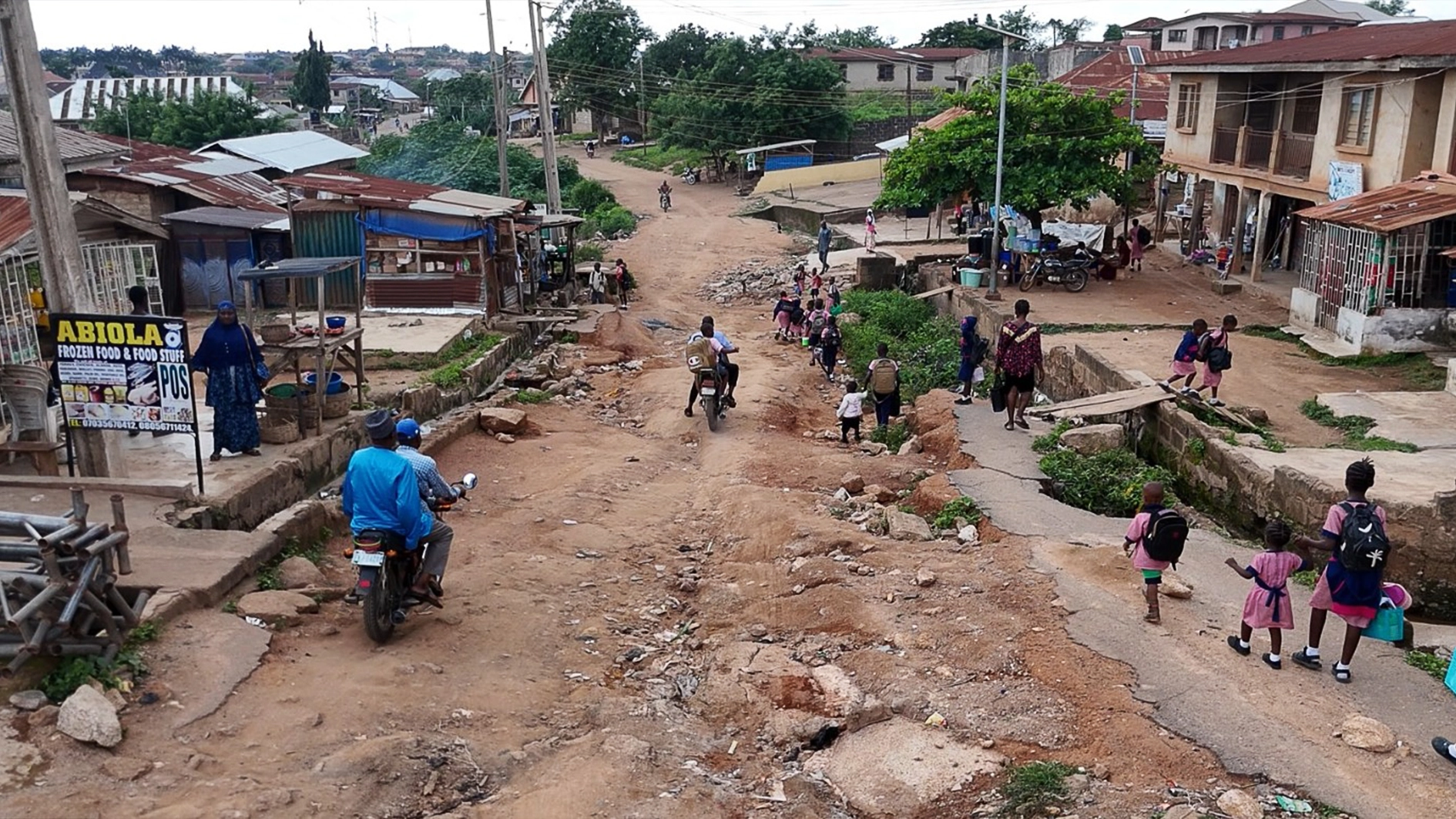
For residents of Odofin, a community in Ifelodun LGA, rainfall can bring everyday movement to a halt.
Sulaiman Adeyemi, who has lived in the community since 2002, said the absence of proper drainage makes the road vulnerable to flooding.
“There is no drainage in this community. That’s why floods take over the road. Whenever it rains, vehicular movement stops for the flash floods to wash away,” he said, adding, “Only community efforts of sand-filling the road have kept it in this shape.”
He recalled that the road connecting Odofun to Inisa, a community in Odo-Otin LGA, was last repaired over 15 years ago, when a former council chairman, Bola Ajao, intervened.
“There are big houses down the road, but bad roads have forced many residents and property owners out,” he said.
Isa Afolabi, a commercial motorcyclist, said the community’s difficulties extend beyond roads to water supply, electricity and access to healthcare.
With limited public intervention, residents have also had to contribute money to replace stolen electricity cables. The community, he added, has no public health centre and depends on private facilities for medical care.
In Ikire, Irewole LGA, Oni Oluwaseyi said a bridge had been swept away by floodwater on a road linking the high court area to Apomu in the town, leaving it in poor condition and forcing farmers to take longer routes to transport their produce to market.
“If the government can fix this road that links Apomu to Ikire, this area will rapidly develop,” he said.
In Ilobu, headquarters of Irepodun LGA, Taiwo Ishola, who said he had lived in the Konda area of the town for more than 40 years, said the community had remained in poor condition for over a decade, with rainfall worsening the situation and exposing properties to flooding.
“Whenever it rains, we are not able to use the road, and the bridge is also bad. When it rains, it destroys people’s properties,” he said.
Schools struggling to keep pupils
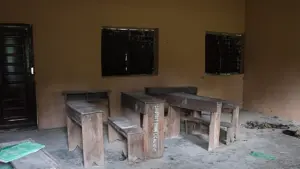
The difficulties extend to public education, where some communities say inadequate staffing and deteriorating facilities are undermining children’s access to learning. Our reporters also found public schools littered with faeces and dirt.
At Oore village, DevReporting observed that the only public school had recently been renovated but continued to face a shortage of teachers.
The Baale of Oore, Adekunle Mudashiru, said the community’s renovated school lacked enough teachers to cater for its pupils.
“We have only one teacher in the school who is also the headmaster. We need at least five teachers,” he said.
According to him, Oore has about 1,200 residents, while the school previously had approximately 120 pupils. However, some parents have withdrawn their children and enrolled them in private schools because of the shortage of teachers.
Omotayo Timilehin, a former pupil of the school, said the absence of basic learning facilities made it difficult for him to continue his education there. His parents eventually transferred him to a school in town, about 10 miles away.
In Abiri-Ikoyi, Isokan LGA, the condition of CAC Primary School has also raised concerns among residents. Tajudeen Olowookere, who finished from the school in 1999, said its condition had deteriorated considerably.
“This school was beautiful before I graduated in 1999, but the situation on the ground now is worrisome. I feel really bad. From the building you see, you cannot say this is a school now,” he said, appealing to the government to rehabilitate the school so pupils can learn in a conducive environment.

The Odofin of Ikoyi land, Adejare Abdulfatai, also decried the bad state of public schools in the community, saying many are roofless and dilapidated. He appealed to the government to come to their aid.
The situation is the same at Okebode, where residents said the community’s primary and secondary schools are also struggling with shortages of government-employed teachers.
Other irregularities
Beyond roads, healthcare and education, access to clean and reliable water remains a concern in several communities visited by DevReporting.
In Ikoyi, Ajisafe Abdulafeez said the town had not had public water supply since 2010. For years, residents have depended on wells, streams and boreholes provided through community efforts to meet their water needs.
He added that some communities in the area had also gone without electricity for two years.
At Okebode, Mrs Adeorike said a government water project had stopped functioning, forcing the community and its traditional ruler to provide an alternative.
The consequences of failing water infrastructure are also evident in local markets, where traders and customers struggle with inadequate public toilets.
Adetomiwa Bolanle, the Iyaloja of Oba Oyegunle Market in Ikire, said the market’s public water system no longer functioned properly, while its public toilet had stopped working.
“The toilet that the government made for us no longer works. There are no general toilet facilities in this market, and that’s not fair enough,” she said.
Some traders have made private arrangements to access water, but these are insufficient to meet the needs of the wider market, DevReporting gathered.
Adesokan Adeola, a trader at Obada market in Ikire, said: “People who need to defecate in this market will have to go to their houses or neighbouring houses to do so,” adding that some resort to a nearby landfill.
“The market’s access road also needs reconstruction and widening,” she added.
For traders, these infrastructure problems exist alongside declining sales and financial pressures. Mrs Adesokan, who sells textile materials, said she had diversified into other goods because of low demand.
“I sell textile materials, but I now also sell salt and condiments to prevent hunger. Everyone is complaining that there’s no money,” she said.
She recalled a time when increased commercial activity in the market provided an informal indication that public workers had received their salaries or that government allocations had arrived. That pattern, she said, had changed.
Meanwhile, the Babaloja of Olobu market, Azeez Ajagbe, said roads within the market had been washed away by floods, while public toilets and water facilities were inadequate.
BudgIT reveals gaps
The concerns raised by residents are reflected in findings by BudgIT, a civic organisation that monitors public spending and service delivery.
Between January and June 2026, the organisation tracked 28 primary healthcare centres across 10 local councils in the state. None of the facilities met all the standard benchmarks.
Head of Tracka at BudgIT, Joshua Osiyemi said only one of the 28 facilities had an ambulance, three had laboratories, and just four had doctors. 12 had functioning water facilities.
Mr Osiyemi said the findings were particularly concerning given the increased funding available to primary healthcare facilities through the Basic Health Care Provision Fund (BHCPF). According to him, funding had increased from about ₦300,000 to ₦600,000, while facilities with high patient volumes received approximately ₦800,000 quarterly.
“These are monies that should go into more service delivery, more improvement in terms of the quality of healthcare that you get,” he said.
BudgIT’s monitoring of school projects also raised questions about project delivery. Of the 13 projects monitored, eight had been completed, two were ongoing, and two had not been carried out. The organisation also reported a case in which payment had been made for the construction of a school pit latrine, but the facility had not been built.
Mr Osiyemi said BudgIT had submitted a Freedom of Information (FoI) request to the Osun State Government seeking an explanation for the project, but had yet to receive a response at the time of the interview.
Beyond the projects tracked, he said the organisation had found schools without roofs or furniture, with some pupils still sitting on the floor to learn.
Background
Beyond the service-delivery gaps identified by residents and monitoring organisations, local government administration in Osun has been hampered by a prolonged political and legal crisis over who controls the councils and their finances.
The dispute dates back to the local government election held on 15 October 2022, which produced APC chairmen and councillors across the state. The Federal High Court in Osogbo subsequently nullified the election, ruling that it contravened Sections 29 and 32 of the Electoral Act 2022.
Following the high court ruling, the Osun State Government led by Ademola Adeleke conducted another local council election on 22 February 2025, producing a new set of council officials. But shortly before the 22 February poll, a 10 February ruling by the Court of Appeal, Akure Division, had been interpreted by the APC to mean the reinstatement of its sacked LG officials.
Attempts by APC-aligned officials to reclaim council secretariats triggered violent confrontations, resulting in reported deaths, including that of Remi Abass, a former chairman of Irewole Local Council, and six others on 17 February 2025.
For the family of the deceased, the consequences of the crisis remain deeply personal. His younger brother, Abbas Oladipupo, said the family was still struggling with the loss of their breadwinner and appealed to the government to ensure that those responsible were brought to justice.
The leadership crisis in Osun was further complicated by the 11 July 2024 Supreme Court judgment affirming financial autonomy for local governments. Competing political interests sought control of council accounts and allocations, raising questions about who had the authority to manage the funds.
Meanwhile, workers under the National Union of Local Government Employees (NULGE) embarked on a prolonged industrial action, disrupting council administration. Although the workers have since returned, uncertainty over control and authority has persisted.
In June 2026, the Federal High Court in Osogbo dismissed a suit by the APC-elected chairmen seeking an extension of their tenure, ruling that their three-year tenure had ended in October 2025. The APC rejected the decision and filed an appeal.
With competing claims to authority across the state’s 30 local councils and the area council, questions remain over who is in charge, who controls the funds, and how financial autonomy can translate into effective governance. Despite billions of naira in federal allocations to the councils, transparency and accountability in the utilisation of the funds remain critical concerns.
“I can’t access LG accounts” – Auditor-General
While political actors disagree over control of local government allocations, the Auditor-General for Local Governments in Osun State, Isiaq Awotunde, says he has been unable to access the bank statements needed to audit the funds.
Mr Awotunde said more than ₦238 billion in local government allocations had accumulated over nearly two years, but he could not access the financial records needed to examine how the funds were being managed.
“As the auditor-general for local governments, I am to be a watchdog on public funds. Almost two years now, we are hearing about our money, but we cannot touch it,” he said.
He explained that during the dispute over local government administration, he had been asked to verify the authentic signatories to the councils’ accounts. After completing the verification, he said he submitted the details to the Central Bank of Nigeria (CBN) and United Bank for Africa (UBA), where, according to him, the funds were domiciled.
However, obtaining the bank statements proved difficult.
“I told the CBN to avail me of the bank statement of some particular months. They turned the letter down,” he said, adding that the bank requested the specific account number for which he sought the statement.
Mr Awotunde said he subsequently informed the state government and worked with the Ministry of Justice to submit another request to the CBN.
“I connected with the attorney-general; they gave me two lawyers; as the Ministry of Justice, we wrote another one. Till now, we have not heard from the bank,” he said.
The auditor-general argued that his professional responsibility to scrutinise public funds should not be undermined by the dispute over local government administration.
“Politically I cannot say anything about that, but based on my professional area, I must be able to access it. Whether directly or indirectly, it is public funds; we need to audit it,” he said.
DevReporting traces N238.4bn FAAC allocations to Osun 30 LGAs in 18 months
According to data generated through Amoye, a civic-tech artificial intelligence chatbot dedicated to open government and introduced by Insight Initiative for Community and Social Development (IICSD), the federal allocations to the state’s LGAs within 18 months of January 2025 and June 2026 amounted to N238.4 billion.
However, while the PDP-wing of the LGA leadership said it had no access to a penny from the allocations since its election, the APC-led leadership confirmed opening new accounts with UBA but insisted it could not confirm the exact amount paid into the accounts.
Adegoke Ogunsola is the APC-faction chairman of Irepodun LGA, who also doubles as the legal adviser to the state’s chapter of the APC-led Association of Local Government of Nigeria (ALGON).
He said: “Yes, we followed the instruction by the CBN to open accounts in commercial banks. We approached many banks but they declined to open accounts for us because the ruling party in the state warned them against dealing with us. Only UBA agreed to open the accounts for us. But even as the chairman of my LGA, I cannot tell how much is in the account, because I do not receive alerts when it is credited”.
The state’s Commissioner for Local Government and Chieftaincy Affairs, Dosu Babatunde, described the opening of new accounts for local councils as an abnormality, criticising both the CBN and the commercial bank for engaging in illegality.
Mr Babatunde said: “To run the accounts of councils, there are officials like the directors of finance and personnel management who are constitutionally authorised to run them. But the APC-led chairmen now went to look for non-staffers of local governments- strangers, maybe vulcanizers- and appointed them as councils’ treasurers, and opened new accounts for the councils, and are operating them.”
He said the state government had to approach a law court for an order to bar the bank from releasing further funds to the APC-faction chairmen, noting that the matter was beyond the state’s local government system.
Bank keeps mum
In response to an enquiry by DevReporting, UBA, through its Group Head of Media and External Relations, Ramon Nasir, said it could not comment on the matter because it was before a court.
“The case is subjudice. It is before a competent court for determination. We cannot make any comment so as not to run foul of the law. Our position on this issue has been clearly stated by our legal representatives on this issue before the courts,” Mr Nasir said.
Local government funds consumed by political interests, says Alabi
A stalwart of APC and former Speaker of the state’s House of Assembly, Mojeed Alabi, a professor, said the challenges confronting local governments had developed over several years. Drawing on his experience as a former secretary of Ejigbo Local Government in the early 1990s, he recalled when councils graded rural roads, constructed culverts, maintained health centres and maternity facilities, provided wells and awarded bursaries.
“It would be surprising to you that in Ejigbo Local Government alone, we had three graders,” he said.
Mr Alabi attributed the decline in local government performance to the growing use of council resources to accommodate political interests.
“Once you start spending a preponderance of the money to pay a political office holder, there will be little left for development,” he said, claiming that recurrent expenditure accounted for more than 80 per cent of local government spending, leaving limited resources for development projects.
“If you decide to use public funds for aggrandisement of the rulers, there will be little left for development. If you want to use it for development, there will be little left for the aggrandisement,” he stressed.
On financial autonomy, Mr Alabi said direct allocation of funds to councils would not automatically guarantee accountability without effective public oversight.
Commenting on Osun, Mr Alabi acknowledged that the political dispute over local government leadership had disrupted council administration. He said the impact of the crisis on council operations could not be ignored.
Residents take on govt responsibilities
In several communities, residents say they have had to contribute their own resources to address problems they believe should be handled through public institutions.
In Ilobu, for instance, Olufemi Saibu, a professor of economics at the University of Lagos and president of the Ilobu Development Union (IDU), said the organisation had increasingly become a means through which residents pursued infrastructure and development projects.
“In terms of infrastructure and so on, the people see IDU as the viable framework through which their aspirations to have some infrastructure can be met,” he said, adding that the union had helped facilitate infrastructure for government agencies and supported projects involving schools, primary healthcare, roads and other basic services.
Political crisis clouds LG responsibilities
Meanwhile, political actors and experts point to a prolonged dispute over who controls local government administration and resources in Osun.
Abdulrasheed Olaoluwa, a traditional titleholder in Ede, said the crisis had created uncertainty over who was responsible for running local councils.
“The current local government system has become confusing, and we don’t know what’s going on anymore,” he said.
He said the dispute had affected Ede North and Ede South local councils, creating setbacks in the delivery of projects and services.
Having previously contested and served in local government, he said councils were important because their activities and projects directly affected rural communities.
Sikiru Ajibade, the PDP-faction chairman of Irepodun Local Government, similarly blamed the political situation for limiting their access to funds.
“Since we were elected in February 2025, we have not been able to use the local government,” he said. “The elected chairmen of local governments have no access to the allocation, and that has been a major setback in terms of facilitating development”.
Mr Ajibade contrasted the situation with his 11-month tenure as caretaker chairman, during which he said his administration tarred two roads, each measuring about 1.5 kilometres, constructed a building for Federal Road Safety Corps officials and provided a public toilet with a borehole and prepaid electricity meter at a market.
For the chairman of the All Progressives Congress (APC) in Osun State, Tajudeen Lawal, a former chairman of Ife East Local Government, the political crisis had prevented local governments from exercising full autonomy.
He said, “Although allocations are being released, we do not currently have full access to those funds. What is available is largely for salary payments, and salaries alone cannot drive development.”
He also claimed that the state government was collecting revenues that local governments would ordinarily generate from markets, motor parks and other sources.
‘Local government is supposed to provide basic services’
A former Head of the Political Science Department, Obafemi Awolowo University (OAU), Damilola Agbalajobi, a professor, said local government is the tier of government expected to provide essential services closest to citizens.
“Those resources should be used to improve infrastructure, strengthen security and provide basic social services so that citizens can enjoy the dividends of democracy,” she said.
She said the political crisis in Osun had created uncertainty about who was effectively in charge of local government administration, making it harder for residents to identify who should be held responsible.
“More importantly, it raises critical questions about accountability. If funds are being allocated to local governments, where are those resources going?” she queried.
Ms Agbalajobi added that paying salaries was not, on its own, a sufficient measure of effective governance.
“Effective governance is measured by the provision of security, protection of lives and property, functional healthcare facilities, quality public infrastructure and other essential social services,” she added.