 Follow Us on Google News



 Follow Us on Google Discover

For a year, terrorists along the highway to Monguno, a major humanitarian hub in Borno, northeastern Nigeria, have been stopping trucks carrying food, seizing or burning their cargo, and sometimes distributing the stolen supplies to communities near their enclaves. HumAngle Al’amu Umar in collaboration with The Guardian, reports.
Alkali Muhammed was driving fast.
It was around 8 a.m. on a Saturday in December 2025, and the 45-year-old driver was headed to Monguno along the Maiduguri-Monguno road in Borno, northeastern Nigeria, with his apprentice and a truckload of maize. Minutes into the journey, two motorcycles, each carrying three armed men, began trailing the pickup truck. The men opened fire on the moving vehicle. A bullet struck its right rear tyre, bringing it to a screeching halt around Gasarwa, about 20 kilometres from Gajiram, the headquarters of Nganzai Local Government Area (LGA). Alkali and his apprentice jumped out and fled, leaving the vehicle and its cargo behind. The terrorists torched the vehicle, destroying the bags of maize it was carrying.
Alkali had left Maiduguri, the state capital, the previous day at 4 p.m. He often took this route, delivering grain for traders and, sometimes, for humanitarian organisations. By 7 p.m., they had reached only Gajiganna, a town in the Magumeri LGA, and could not proceed to Gajiram. “The military shut the gate to Gajiram by 5 p.m.,” he told HumAngle. The two men slept in the truck, with the bags of maize behind them. The terrorists appeared shortly after they exited Gajiram the following morning.
By the time the driver and his apprentice had created enough distance to look back, the vehicle had already vanished into the smoke. They walked for two hours and returned to Gajiram, where they found vehicles bound for Maiduguri and followed them home.
Alkali could not say for certain which terror group the men belonged to. However, HumAngle found that the Islamic State West Africa Province (ISWAP) is the most active armed group operating across northern Borno and the Lake Chad region, including along this route. A former ISWAP member, simply called Kachalla*, corroborated this, saying: “Those patrolling those corridors are from the ISWAP faction. They are strongest in most parts of northern Borno and within the Lake Chad Islands. If JAS [Jama’atu Ahlis Sunna Lidda’awati wal-Jihad] appears in those corridors, they sneak in, mostly to rob.”

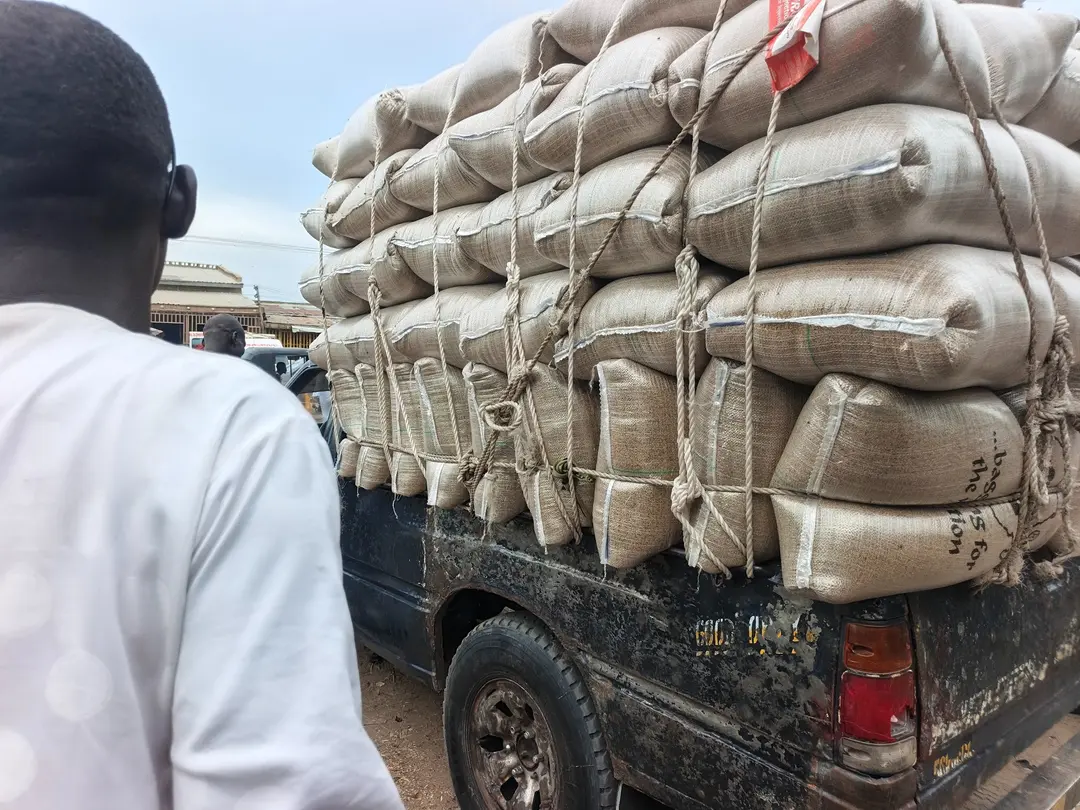
Along the Maiduguri-Monguno-Damasak routes, terrorists are increasingly frustrating food transportation as a way of demonstrating their opposition to state authorities. They stop vehicles, seize consignments and, in some cases, burn trucks. Food supplies linked to humanitarian aid and the government seem especially at risk. These dangers have forced some drivers to avoid this route, increasing transportation costs for the limited food that reaches communities already facing food insecurity. The attacks are linked to a hidden economy. Foodstuffs taken from transporters are moved into areas controlled by terrorists.
Alkali is one of many transporters and traders who have been robbed or driven off this corridor in the past year. According to multiple sources, including the former ISWAP member, these attacks form part of a strategic campaign. The group deliberately targets government and humanitarian consignments while mostly sparing ordinary traders’ goods. ISWAP insurgents seize cargo intercepted along the road and distribute it under a doctrine they call faihu, a concept in Islamic jurisprudence under which property obtained from an enemy without armed combat is left to the ruling authority’s discretion, rather than divided by the fixed rules that govern battlefield spoils.
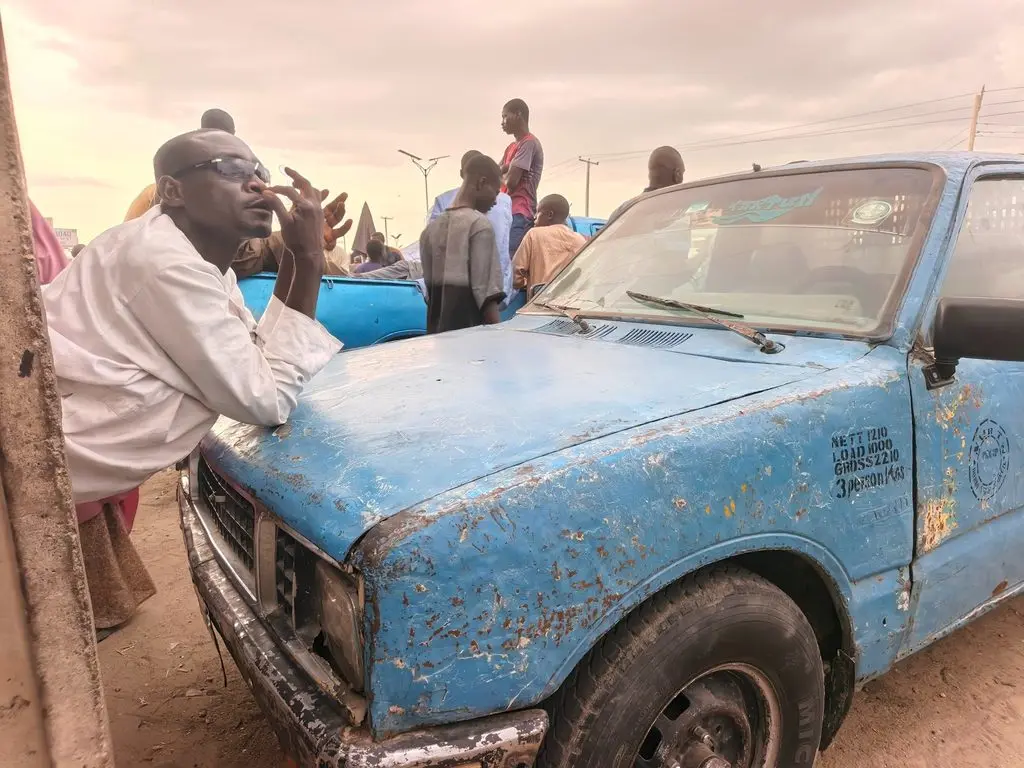
‘I have personally witnessed it’
Mustapha Modu, a grain trader who has worked at the Baga Road market for six years, confirmed Alkali’s account, noting that armed groups operating along the Maiduguri-Monguno corridor adhere to office-like hours.
“Their usual time of appearance is between 10 a.m. and 3 p.m.,” Mustapha said. “If you follow these roads around this time, you would see them. They would park their motorcycles on the road and wait for coming vehicles.”
Hassan Abubakar, a truck loader who has, on several occasions, accompanied delivery vehicles to Monguno and Damasak, also said, “They don’t harm the driver and his labourer.” Instead, drivers are directed into the bush, told to offload, and sent on their way. “Sometimes, they have their own vehicle, and we would be asked to offload to theirs.”
Mustapha has seen this during a business trip to the Niger Republic through Damasak. Two armed men in military camouflage had stopped the vehicle he was travelling in near Kareto, a largely deserted community roughly 25 kilometres from Damasak and 52 from Gubio. A truck already loaded with maize was parked where the men stood. Mustapha and the other travellers were ordered to push it off the road. They were then allowed to leave.
“We could hear some movements in the bush behind them,” Mustapha recalled. He had assumed they were the men’s colleagues. “The town is empty,” Mustapha noted, explaining why nobody came to help. He said the incident happened on July 27.
Kareto is no stranger to such attacks. In 2021, ISWAP terrorists ambushed a military convoy escorting the All Progressives Congress (APC) officials to a ward congress in Damasak on this same stretch of road. That same year, terrorists also attacked Damasak, burning a United Nations hub and three facilities belonging to international NGOs.
Targeting relief items
Along the Maiduguri-Damasak-Monguno route, traders and drivers HumAngle interviewed said they primarily targeted humanitarian and government relief materials. “They hardly burn pickup trucks like ours,” said Babagana Bura, a driver at Baga Road Motor Park who has navigated this route for 20 years. “When you see this happening, the driver is transporting a consignment for the government or NGOs.”
Since Borno State began closing displacement camps in Maiduguri in 2021 and facilitating residents’ return to their communities, the government has routinely delivered relief items to those areas. The most recent delivery went to Bama after the Government Senior Science Secondary School (GSSS) displacement camp there was shut down in July 2026. Trucks carrying ordinary traders’ grain are stopped, offloaded, and waved on, while a truck marked for government relief or humanitarian distribution gets torched.
Sources said traders suspected of links to politicians are also targeted. The day Alkali’s truck was burnt, he said, the maize he was transporting belonged to a private trader in Monguno, not the government or an aid agency. However, he could not tell for certain whether that trader had any government or political connection.
Ali Mustapha, a Monguno-based truck driver who had recently returned from the route, confirmed it from the other direction. “The most targeted vehicles are those transporting NGO consignments,” he said, standing beside his vehicle at 4 p.m., eager to leave Maiduguri before the same curfew that once stranded Alkali at Gajiganna.
The risk has sharply raised delivery costs along the route. According to drivers, transporting a trader’s ordinary full truckload costs around ₦200,000, while transporting an NGO consignment is roughly ₦500,000. “When travelling and they block us, we dare not argue,” Ali said. “We would obediently offload the items and return. You are lucky if you get to return with your vehicle.” Two of his colleagues were not so lucky. The terrorists seized their trucks, cargo, and everything else.
Kachalla confirmed the terrorists’ targeting pattern. He added that the corridor was chosen for the same reason NGOs rely on it: “This is the route organisations deliver food items to resettled communities. NGOs often ply this route, and the communities are far from Maiduguri, unlike Bama and Konduga. So, they can conveniently mount roadblocks without fear of reprisals.”
The toll has thinned out the number of people willing to drive it. Mustapha said some traders he knows have lost their livelihoods and shifted entirely to Gubio and Magumeri, routes they consider safer. Hassan stopped accompanying delivery trucks after terrorists seized the last consignment he carried about a year ago and has not gone back. Ali still takes commercial loads, but he said fewer drivers will take humanitarian ones at all.
Attacks on this corridor are not new; they have only intensified recently. In July 2022, ISWAP intercepted 40 trucks carrying the World Food Programme (WFP)’s nutritional supplies for resettled communities in Mobbar. More recently, on February 19, the terror group burnt three vehicles delivering fish to Maiduguri near Mile-forty, Magumeri. Military formations meant to secure this route have also come under sustained attack. HumAngle, for instance, reported that an assault on a base in Kukawa on March 10 killed commanding officer Lt. Col. Umar Farouq. Another attack on 29 Task Force Brigade headquarters in Benisheikh killed Brigadier-General Oseni Braimah.
What the hunger is worth
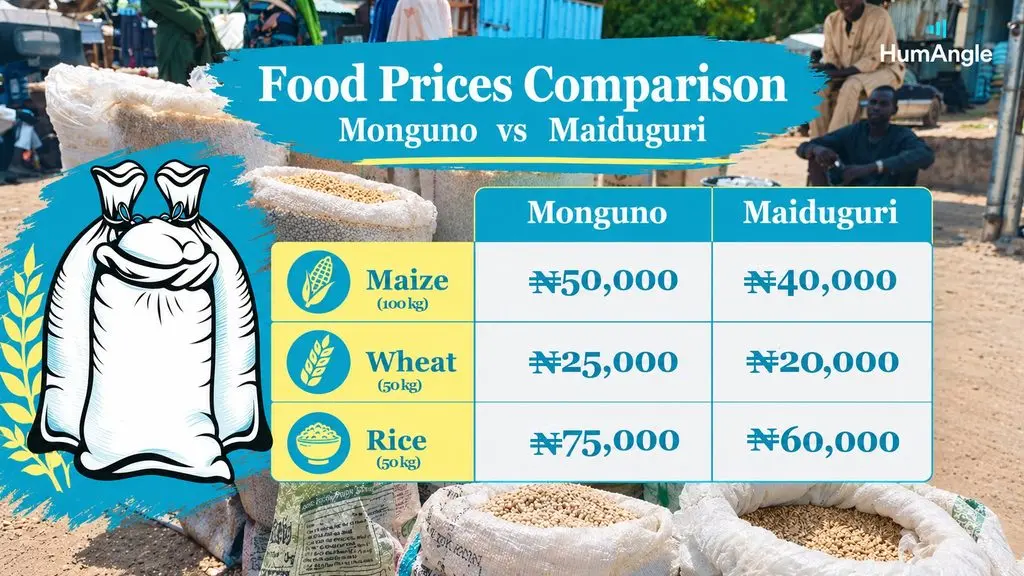
The blockade has its own economics, visible in the price of grain. According to HumAngle’s market survey and interviews with traders across Maiduguri and Monguno, a 50-kilogramme (kg) bag of wheat sells for ₦20,000 in Maiduguri and ₦25,000 in Monguno and Damasak. A 100 kg bag of wheat costs ₦40,000 in Maiduguri and ₦46,000 in Monguno and Damasak, while a 100 kg bag of maize costs ₦40,000 and ₦50,000, respectively. A 50 kg bag of imported rice sells for ₦60,000 in Maiduguri and ₦75,000 in Monguno.
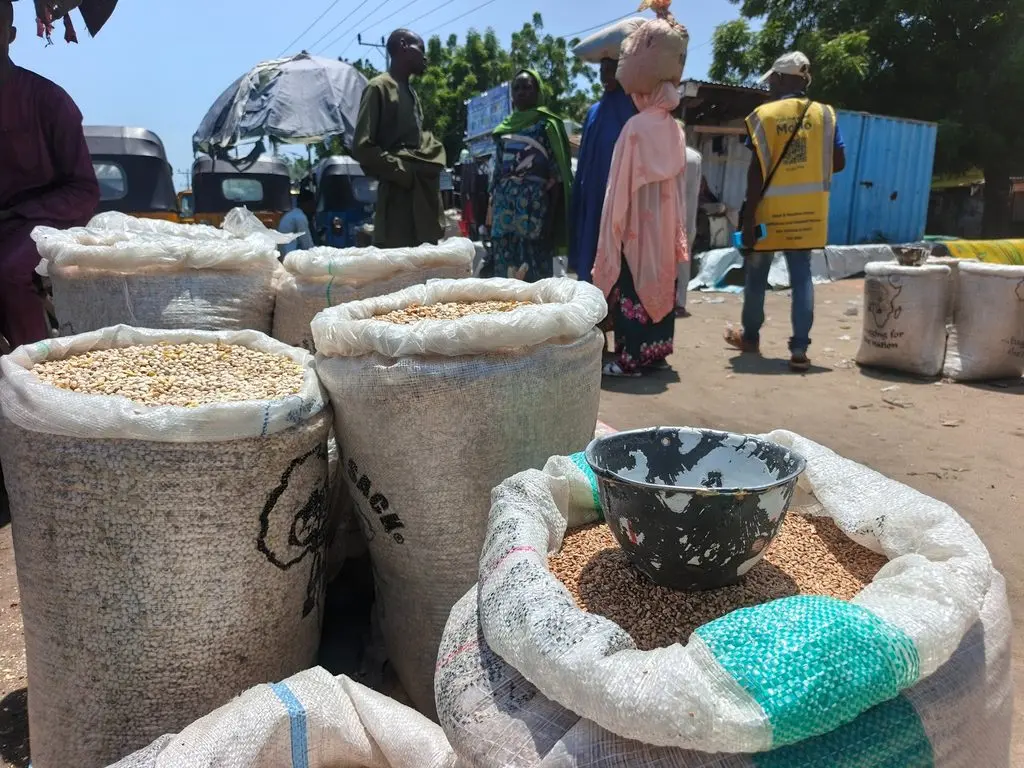
Modu Burabe, a Monguno-based grain trader, said, “People here mostly buy maize and rice. It is the most imported item, unlike millet and sorghum.” He added that 3 kg of maize costs an average of ₦1,300, while the same amount of rice costs ₦3,800.
When humanitarian organisations distribute food to displaced people in Monguno, Modu said prices briefly fall, sometimes below Maiduguri’s, because beneficiaries “divide what they received into two halves and sell one part”. When a consignment is intercepted before it arrives, none of that reaches the people waiting for it. The loss happens somewhere between the warehouse and the doorstep, and people absorb it as hunger rather than record it as theft.
The scale behind these individual losses is now severe enough that the WFP has called it the worst conflict-driven hunger crisis the region has seen in almost a decade. In a July 2 statement, the global aid organisation said more than three million people in Borno alone are acutely food insecure, with over 750,000 of them in severe hunger and more than 10,000 facing catastrophic conditions. Across the three affected northeastern states, the report adds, 6.2 million people now need food assistance, but WFP can currently reach only 740,000. The agency named the mechanism directly: attacks and illegal checkpoints are increasingly disrupting cargo movement on major routes, to the point that airlifts are becoming the only reliable way to move supplies into some locations.
The strain shows first in the programmes that depend on these roads. Aliyu Lawan, the Food Security and Livelihood Programme Coordinator at the Grassroot Initiative for Strengthening Community Resilience (GISCOR), a Maiduguri-based humanitarian organisation, said the attacks are disrupting food distribution. GISCOR has run WFP-funded projects since 2023, targeting “107,000 people in Mafa, Dikwa, and Rann” in central Borno. Those communities lie off the Monguno-Damasak corridor. However, the organisation also faces attacks on the road out of Maiduguri.
GISCOR distributes food in two ways: in-kind and by e-voucher. Under the e-voucher model, Aliyu says, the organisation contracts retailers, whom it calls vendors, to haul food from Maiduguri and distribute it after verifying beneficiaries’ token cards. Some of the retailers are traders based in the communities. “Our activities are mostly done by the retailers, not us directly,” Aliyu told HumAngle. “That means the transportation of food commodities from Maiduguri down to our locations is the responsibility of the retailers.” Relief food can, therefore, travel in a truck that looks like any trader’s.
When incidents occur, Aliyu said, “the retailers have to come back to Maiduguri, source for another funding and acquire another food commodity before transporting again to the locations.” A distribution planned to last 30 days can stretch to two months, and sometimes GISCOR has to distribute food twice.
Households pay for the gap. The ration is limited to 30 days, and families that run out before the next distribution see their nutritional needs suffer. “When we go for active case finding, to find out the nutritional status, we will be having some cases of malnutrition,” Aliyu said.
The politics of mercy
What happens to the food that is seized does not end with the terrorists who took it. Kachalla said the seized items, known as faihu, are shared, in part or in whole, with communities near the group’s territory. “When the commander is informed of a particular community with which the Daula has a good relationship, and whose youths are recruited or can be potentially recruited,” Kachalla said, “he would instruct a portion of the faihu be given to that community.” Sometimes, the commander gives everything away. He said there is no fixed formula. It is a loyalty transaction, dressed in scripture.
Kachalla said informants are central to this. They sit in the same towns and motor parks the drivers pass through. Some are drivers themselves; others are members of transport associations. They report a vehicle’s colour, arrival time, destination, and cargo before it arrives. Neither Alkali nor the traders who spoke for this story could say for certain whether they had ever been watched this way.
GISCOR recorded an attack on one of its consignments to Dikwa in 2024. The vehicle carried food, but “none of the food items was stolen,” Aliyu said, because the organisation got military reinforcement in time. Since then, the organisation assesses road conditions days ahead and obtains security clearance from the military and, more recently, an armed escort. “WFP coordinates with the military,” he said. “So, escorts would be provided even for the retailers’ commodities. With this, the issue of attacks is now minimised.”
Bakura Massa*, a Gubio-based vigilante who works in a team of armed escorts, confirmed the selective pattern of attacks the drivers and traders described. He added that his unit takes over vehicles from escorts coming from Maiduguri and hands them to another team farther along the route, in a relay-style system, until they reach their destinations.
“We don’t provide escort for individual vehicles,” he told HumAngle. “Most of the vehicles we escort are carrying consignments of organisations or the government.” For this arrangement to work, Bakura adds, the base’s military commander is contacted to provide security clearance for delivery vehicles and assign escort vehicles to them. These, he said, include soldiers, members of the Civilian Joint Task Force (CJTF) and vigilantes. Attacks have reduced in the past few days, he adds.
HumAngle wrote to the Borno State Ministry of Rehabilitation, Reconstruction, and Resettlement, seeking comment on measures put in place to counter attacks on delivery vehicles along the route. The ministry had not responded at the time of publication.
Starting over
Days after his vehicle was intercepted by terrorists, Alkali went back to retrieve what was left – a blackened frame, which he sold to a panel beater for ₦150,000 in Maiduguri. His boss promised another truck. Nearly a year on, it has not come.
“Things must have been tough on him as well,” he said.
Alkali has a wife and ten children. Now he works as a loader at the Baga Road Grain Market in Maiduguri, hauling other men’s grain for around ₦4,000 a day. It is the same market his truck used to leave, fully loaded, heading the other way.
He pulled a cigarette pack from his kaftan’s side pocket, took one out, lit it, and drew on it. “Nobody offered me anything when the truck burned,” he said, letting the smoke go. Not his client, whose maize it was. Not the government. Not his union. Only his boss offered a promise, and it’s nearly a year old now.
The road is still there, with armed men on motorcycles appearing between 10 a.m. and 3 p.m., knowing which trucks to stop and which to wave through. A ledger kept by people who have never introduced themselves to the drivers whose cargo they inspect. Somewhere beyond Maiduguri, it keeps carrying food toward communities where food is already scarce. Some of it arrives. Some of it does not. For the people waiting at the other end, that difference can be hunger. For a driver, it can be the difference between going home with his truck and walking through the bush without it.
For Alkali, it meant the difference between being a driver and becoming a labourer. He has already made that journey once. He doesn’t want to do it again.

