
 Get Guardian on Google
Can Nigeria’s universities become engines of indigenous innovation capable of powering the country’s transition to cleaner energy? As the global energy industry increasingly shifts towards cleaner and more sustainable energy sources, the need for Nigeria to develop home-grown technologies and innovative solutions to address its energy challenges has become more pressing. In a move to bridge the gap between academic research and industrial application, the Nigerian Content Development and Monitoring Board (NCDMB) and Nigeria LNG Limited (NLNG) have committed $9 million to strengthen research and technological innovation across six Nigerian universities, Ann Godwin writes.
As Nigeria intensifies efforts to transition to cleaner and more sustainable energy, attention is increasingly turning to the capacity of its universities to drive indigenous innovation, develop homegrown technologies and provide research-based solutions to the country’s energy challenges, with the Nigerian Content Development and Monitoring Board (NCDMB) and Nigeria LNG Limited (NLNG) committing $9 million to strengthen research and innovation across six universities.
The initiative, through a professorial chair endowment programme, is designed to harness the intellectual resources of Nigerian universities to develop commercially viable solutions to challenges confronting the oil and gas industry, while positioning local researchers to contribute meaningfully to the country’s evolving energy landscape.
At a time when the demand for cleaner and renewable energy is gaining momentum globally, the programme is expected to provide a platform for researchers, academics and industry experts to explore innovative approaches to energy production, efficiency, sustainability and the development of indigenous technologies. It also underscores the importance of connecting university-based research with the practical needs of the energy sector.
Beyond the financial commitment, the $9 million endowment raises important questions about Nigeria’s capacity to translate academic research into industrial solutions, reduce dependence on imported technologies and build a knowledge-driven energy sector as seen in other countries.
For instance, countries such as Denmark, Germany, China, South Korea and the United States have demonstrated how universities can become critical drivers of indigenous technological innovation and the transition to cleaner energy.
Through sustained investment in research, collaboration with industries and government support, these countries have transformed their universities from conventional centres of teaching and learning into hubs for developing technologies that address national energy challenges and create new economic opportunities.
Perhaps, this explains why the NCDMB and NLNG are investing in the initiative, seeking to bridge the gap between academic research and practical industrial solutions.
In Denmark, for instance, research at the Technical University of Denmark played a significant role in laying the foundation for the country’s globally competitive wind energy industry. Through research, testing and collaboration with manufacturers, the university contributed to improvements in wind turbine technology, efficiency and reliability. Today, Denmark is recognised for its advancement in wind power, including offshore wind development, demonstrating how academic research can support the growth of an indigenous renewable energy industry.
Similarly, Germany has leveraged its university-based and applied research institutions, particularly the Fraunhofer Institute for Solar Energy Systems, to advance solar photovoltaic technology, battery storage, hydrogen and other renewable energy solutions. Its research model places considerable emphasis on translating scientific discoveries into practical industrial applications through partnerships with private companies. China has also invested heavily in university research and development, with institutions such as Tsinghua University contributing to innovations in solar power, battery technology and energy storage, strengthening the country’s clean energy technology ecosystem.
Also, the United States provides another example of how academic discoveries can be transformed into commercially viable products through effective technology transfer, patent protection and partnerships with the private sector.
For Nigeria, the $9 million professorial chair endowment programme by the Nigerian Content Development and Monitoring Board (NCDMB) and Nigeria LNG Limited (NLNG) presents an opportunity to build a similar research-to-industry pathway.
With the growing demand for cleaner and renewable energy, the initiative would support indigenous research into solar technology, gas-to-power solutions, affordable energy storage, hydrogen development, waste-to-energy conversion and carbon management. However, its long-term impact will depend on the ability of participating universities to produce measurable outcomes, including patents, prototypes, locally developed technologies and commercially viable solutions that can be adopted by Nigeria’s energy industry.
The benefiting schools include the University of Ibadan (UI), Ibadan, Oyo State, Rivers State University (RSU), Nkpolu-Oroworukwo, Rivers State, Modibbo Adama University (MAU), Yola, Adamawa State, Aliko Dangote University of Science and Technology (ADUST), Wudil, Kano State, University of Nigeria Nsukka (UNN), Nsukka, Enugu State, and University of Abuja (UofA)(Yakubu Gowon University), Abuja, FCT.
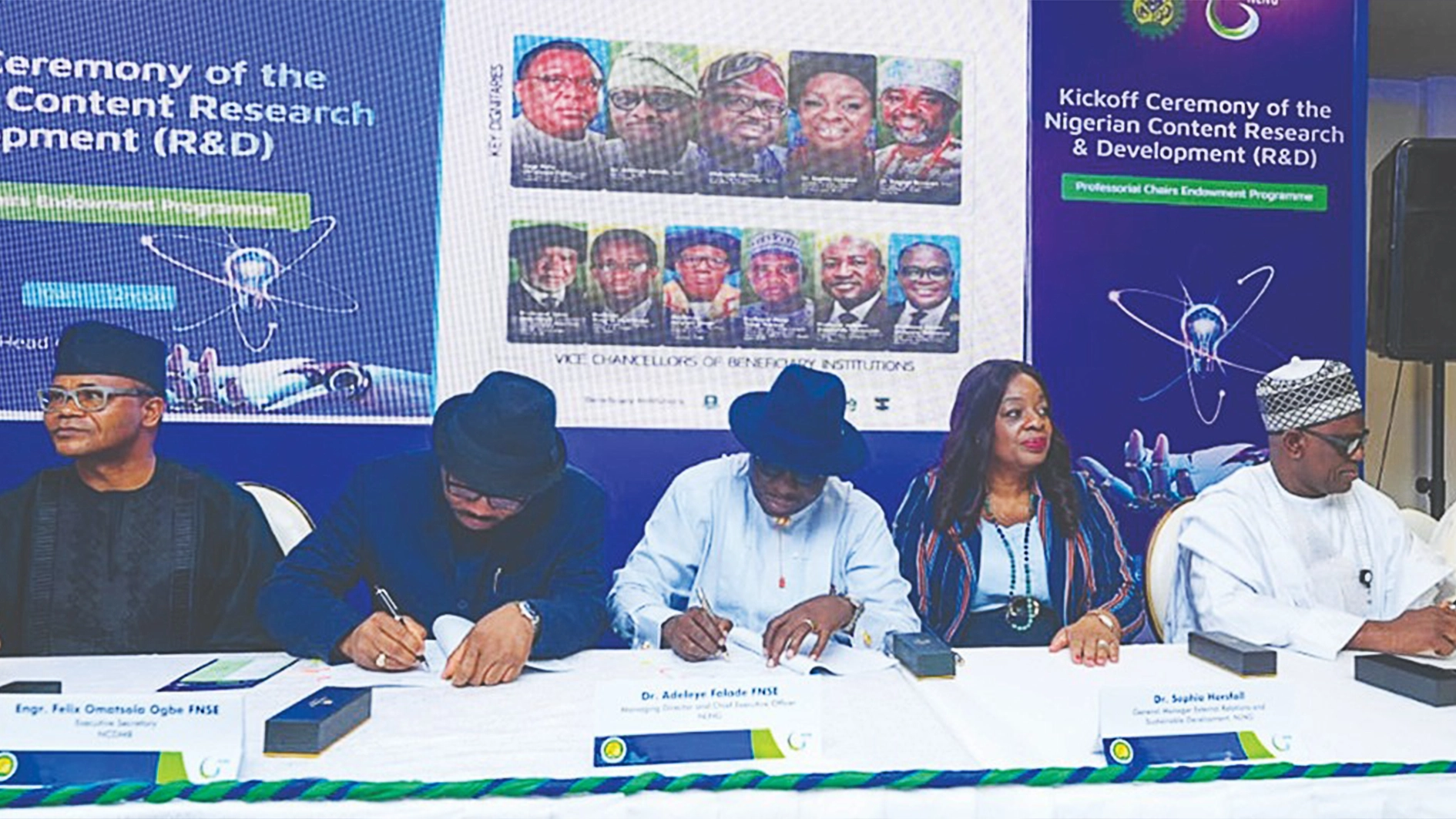
The endowment which was signed on Tuesday, November 10, 2026 at the NLNG ‘s Corporate Head Office, Port Harcourt noted that the University of Ibadan will focus on natural gas processing, pollution control and environmental management, while Rivers State University will concentrate on digital engineering, intelligent energy systems, automation and asset integrity.
Modibbo Adama University will undertake research in energy transition and the environment. Aliko Dangote University of Science and Technology will focus on sustainable energy innovation and climate-resilient food systems.
The University of Nigeria Nsukka, will specialise in green energy production and geoenvironmental engineering, while University of Abuja (Yakubu Gowon University), will focus on geoscience and satellite intelligence for resilient gas infrastructure.
Each university will work towards agreed research targets and commercialisation pathways, providing a framework for measuring progress and translating findings into practical applications. The institutions will also jointly host an information management hub to support knowledge sharing and exchange programmes.
The funding includes provision for minor civil works and infrastructure upgrades to transform identified spaces into fit-for-purpose research centres.
Proposed arrangements would enable industry professionals to contribute practical expertise in technical and non-technical disciplines while pursuing master’s and doctoral degrees. This would give students greater exposure to industry experience while strengthening the connection between postgraduate study and practical problem-solving.
This move no doubt, aligns with the ongoing 31st United Nations Climate Change Conference (COP31), discussions on accelerating the global transition to renewable energy which have remained a key focus, with emphasis on increasing investments in solar, wind, hydropower and other cleaner energy sources to reduce dependence on fossil fuels.
The conversations also highlighted the need for countries to move beyond climate commitments to practical implementation through stronger policies, sustainable investments and the development of alternative energy technologies.
A major concern has been how to finance the global energy transition, particularly in developing countries, where limited access to funding, technology and infrastructure continues to constrain the adoption of renewable energy. Participants at COP 31 emphasised the importance of mobilising affordable financing, strengthening research and innovation, and fostering partnerships between governments, industries and academic institutions to develop locally relevant solutions.
The NCDMB and NLNG initiative involving six Nigerian universities to develop local solutions through research and innovation aligns with the broader global conversation on energy transition where the collaboration seeks to bridge the gap between academia, industry and government by supporting research into alternative energy sources and translating academic findings into industry-ready products capable of addressing Nigeria’s energy needs while contributing to the global shift towards cleaner and more sustainable energy.
NLNG Managing Director and Chief Executive Officer, Adeleye Falade speaks
NLNG’s Managing Director and Chief Executive Officer, Dr. Adeleye Falade, said the ultimate goal of the programme was to establish a productive partnership between industry, academia and government, with the NCDMB representing the government and providing funding under a clearly defined framework for research and development.
He said the initiative was designed to ensure that research received adequate funding and produced industry-ready solutions capable of addressing real-life challenges.
According to him, each of the six beneficiary universities, representing the country’s geopolitical zones, would receive $1.5 million, amounting to slightly more than N2 billion at the current exchange rate.
He explained that the programme had a governance structure and review mechanism to ensure that its objectives were consistently achieved.
“What we are looking forward to is to have people coming out of academia who will be able to solve today’s problems and tomorrow’s challenges, while academic institutions continue to thrive on research, with qualified researchers funded through the partnership between NCDMB and NLNG,” he said.
Falade stressed that research and development remained the foundation of major breakthroughs across institutions and organisations, noting that those making significant advances in innovation, science and technology were investing heavily in research.
Citing an example of a female innovator whose research had produced a technology capable of reducing scanning time by about 90 per cent, he said ,a process that previously took 20 minutes could now be completed in two minutes.
According to him, the NLNG’s approach to sustainable development was centred on initiatives that created lasting value, not only for Nigeria but also for Nigerians.
The Executive Secretary of the NCDMB, Engr. Felix Omatsola Ogbe, represented by his Senior Technical Advisor (STA), Engr. Austin Uzoka, said research and development required substantial financial commitment, stressing that the collaboration with NLNG would strengthen the capacity of Nigerian universities to undertake research that addressed industry needs. He said the initiative aligned with the Board’s local content development agenda, which seeks to move Nigeria beyond basic participation in the oil and gas industry towards developing indigenous technological capabilities and creating solutions that can compete globally.
He said: “First of all, it’s about building up the triple helix, the relationship and the ecosystem between academia, government and industry, so that we can begin to develop home-grown technologies that will enable us to develop our own industries. So that’s the first.
“The second is in anticipation that we’ll solve typical problems that we encounter in the oil fields of Nigeria. So rather than bringing in experts all the time, we develop Nigerians who have the capability to do the work.
“The third one has to do with how we position ourselves for the future. R&D is not cheap, but if you don’t start now, the future is not going to be bright.
“That’s the ultimate. So right now, we need to focus on how we build capacity. Technology plays an important role in this.” He stated.
Speaking also, NLNG’s General Manager, External Relations and Sustainable Development, Dr. Sophia Horsfall, said,”We believe that sustainable development and an economy that thrives can only happen where research is taking place, where there’s innovation, and where there’s a commitment to developing Nigerian talent and technological innovations,” she said.
Horsfall said NLNG expected the programme to deliver measurable research outcomes and innovations capable of addressing not only business and industry challenges but also problems of national importance.
She added: “So this is really an example of our commitment to sustainable development, to the future of Nigeria, to the youth of Nigeria, and really to the talents that can change that shift that you’re talking about, that can really change the fortunes of this country.
The Vice Chancellors speak
Speaking, the Vice Chancellor of Yakubu Gowon University, formerly University of Abuja, Professor Hakeem Babatunde Fawehinmi, said the institution would focus on geosciences using satellite-based spatial technology.
He explained that the technology would help protect critical national infrastructure, particularly gas pipelines, through improved monitoring and surveillance.
According to him, as the energy sector transitions towards gas and cleaner energy sources, satellite technology could provide an effective means of monitoring the safety and integrity of gas pipelines across the country’s network without relying solely on paramilitary agencies and other conventional security measures.
“Rather than using paramilitary agencies and other forms of policing, one could stay in a particular station and monitor the security, safety and integrity of gas pipelines across all networks within the country,” he said.
“So we think this technology will go a long way in protecting the critical infrastructure of Nigeria.”
Also , the Vice Chancellor of Rivers State University, Professor Isaac Zeb-Obipi, described the academic collaboration as a new dawn for research and development in Nigerian universities.
“First, it will anchor research where it belongs, in solving engineering problems. Our research here at Rivers State University will not be research for publications alone, or for professors alone. We will research for production, for local content, for gas utilisation and for our environment.
“Second, it will build the next generation. Behind every chair is a team of young lecturers exposed to real industry problems. You are not just funding a professor; you are raising a school.
“Third, it will restore trust: trust that industry believes in the Nigerian university and that the Nigerian university can deliver value to the industry.”
The vice chancellor added that the partnership would help transform the research potential of Nigerian universities into practical competence and solutions for the energy industry.
On his part, the Deputy Vice-Chancellor (Academic) of the University of Ibadan, Professor Jumwatunde Arotiba, who represented the Vice-Chancellor, Professor Peter Olamakinde Olapegba, said the institution would focus on developing solutions to environmental pollution and promoting ecosystem management for the benefit of communities.
He said: “We have a track record of academic research in this area in our Department of Petroleum Engineering, Department of Environmental Health and Department of Computer Science.
“We hope to be able to solve industrial problems relating to gas pollution and air pollution, and ensure the production of our natural resources in an environmentally friendly way so that it will be beneficial to our communities.”
Similarly, the Vice-Chancellor of the University of Nigeria Nsukka, Professor Simon Uchenna Ortuanya, represented by Professor Mike Onyia, said the institution had been assigned the areas of green energy production and geo-environmental engineering, with a focus on clean energy.
He said: “We will be researching clean energy. Today, in Nigeria, we are all interested in renewable energy. Renewable energy means energy that will not harm the environment.
The Vice-Chancellor of Modibbo Adama University, Yola, Adamawa State Prof. Ibrahim Umar said its thematic research area would focus on biofuels and alternative energy sources, leveraging the region’s abundant sunshine and other natural resources to develop sustainable energy solutions.
He said the institution planned to explore alternative energy technologies, including solar and wind power, as well as the use of biofuels to develop energy storage solutions.
According to him, the university would also explore ways of converting abundant waste materials into useful energy resources, including investigating their potential for producing battery cells.
“We want to produce alternative energy using solar energy, either from the sun or wind energy. We also want to use biofuels to see how we can produce cells, lithium-cell batteries, using biofuels because we have a lot of waste all over the place,” he said.
The Google Education Lead for Western and Central Africa, Adeniyi Emmanuel, who represented Google at the event, said the company supports NLNG’s efforts to strengthen research capacity in the six selected universities, noting that some of the institutions were already Google’s partners.
He said, some universities were already adopting the company’s technologies for collaboration, teaching and learning, including its artificial intelligence tool, Gemini.
Emmanuel described the professorial chair endowment as a significant milestone for research and innovation, particularly as the programme was designed to address industry-driven challenges and practical needs.
It is however ,hoped that this initiative will translate into measurable academic and national value and accelerating the global transition to renewable energy .