
 Get Guardian on Google
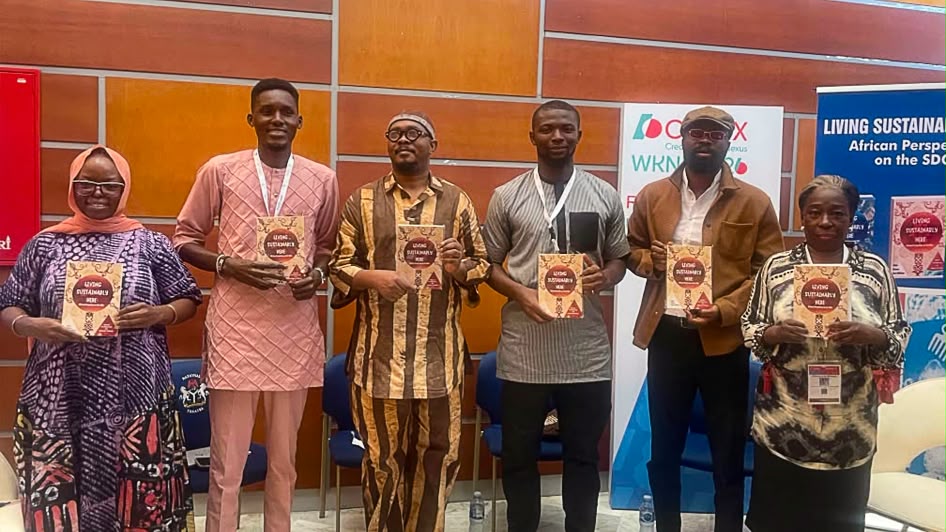
Founder and curator of Living Sustainably Here: African Perspectives on the Sustainable Development Goals (SDGs), Olatun Gabi-Williams, has called for deliberate efforts to preserve African indigenous knowledge systems, languages and cultural heritage through locally owned digital databases.
Gabi-Williams made the call at the launch of the second volume of the multi-volume anthology, titled Digitalised and Indigenous Pathways, during the CANEX WKND.
The volume explores the relationship between Africa’s indigenous knowledge systems and emerging digital technologies, with discussions covering indigenous languages, culinary heritage, conservation practices, pre-colonial ecological knowledge, engineering and traditional architecture.
Gabi-Williams said African communities must take ownership of the digital preservation of their knowledge systems to prevent their exploitation or appropriation by external interests.
She warned that placing indigenous knowledge and languages in digital datasets without retaining ownership could expose them to permanent loss of control.
“The risk is we need to own these things ourselves. We don’t want people carrying off our knowledge systems and our languages. And once they’re in data sets, they’re there forever.
“And we must make sure that we own these data sets and that we get going quickly on preserving our language and our knowledge systems in these data sets that belong to us,” she said.
She stressed the need to identify experts and prioritise endangered African languages while ensuring that widely spoken languages, including Yoruba, were also properly documented.
According to her, preserving languages requires more than recording words, as their nuances, idioms, proverbs and cultural meanings must also be captured.
She said elders and local communities had critical roles to play in the process because of their understanding of the original meanings and contexts of indigenous expressions.
Gabi-Williams also advocated the identification and mobilisation of indigenous knowledge experts across different fields to facilitate the restoration of traditional practices and determine their relevance to contemporary society.
She said traditional knowledge could complement modern sustainable practices, particularly in conservation, climate resilience and resource management.
“We can merge the two, use them to support each other, so that we can achieve sustainability more cost-effectively, more efficiently, in a more climate-resilient way, and in a way that also protects our identity, our indigenous identity,” she said.
The curator warned against the continued perception that African development must follow European models, arguing that the continent needed to rediscover and reintegrate valuable aspects of its heritage into contemporary life.
She attributed part of the disconnect between Africans and their indigenous heritage to colonialism, which, she said, undermined confidence in traditional institutions, cultural practices and indigenous knowledge.
According to her, generations exposed to missionary education were often taught to regard aspects of their cultural heritage as inferior, making the restoration of indigenous knowledge an important part of reconnecting contemporary Africans with their history.
Gabi-Williams, however, expressed optimism that renewed access to information through digital platforms was encouraging greater interest in traditional knowledge, including among older generations.
She said there was a need to bridge the gap between contemporary African society and the experiences of its ancestors by engaging people who still possess indigenous knowledge and ensuring that useful aspects of that heritage were transmitted to younger generations.
She noted that although some traditional practices might no longer be applicable because of changes in the environment and society, their historical significance and underlying knowledge should still be documented and preserved.
Gabi-Williams also urged African governments to establish structured programmes for identifying indigenous knowledge experts and integrating them into relevant ministries.
She proposed that such experts should work with government institutions responsible for areas including conservation, languages, visual arts and mineral resources to investigate traditional practices and determine how they could contribute to present-day development.
On the preservation of cultural artefacts, she said traditional objects, including totems, heirlooms and sacred items, should be understood within the knowledge systems and worldviews that gave them meaning.
She argued that indigenous experts should be engaged to reconstruct the original meanings and cultural contexts of such objects, rather than treating them merely as historical or decorative items.
According to her, understanding the significance of the artefacts would help contemporary Africans reconnect with their heritage and identify aspects of traditional knowledge that remain relevant.
She said the objective was not necessarily to revive every traditional practice but to preserve the knowledge, understand its historical context and identify what could be adapted to present-day realities.
Gabi-Williams added that Africa should move beyond being a consumer of knowledge from other parts of the world and begin sharing its own indigenous contributions with the international community.
On the contribution of the CANEX book fair to Africa’s publishing industry, Gabi-Williams described the initiative of the African Export-Import Bank (Afreximbank) as an emerging platform for strengthening the continent’s literary and intellectual landscape.
She cited the CANEX Prize for Publishing in Africa, which offers $20,000 to the winner and $2,000 to each runner-up, as an important source of financial support for independent publishers.