 Follow Us on Google News
 Follow Us on Google Discover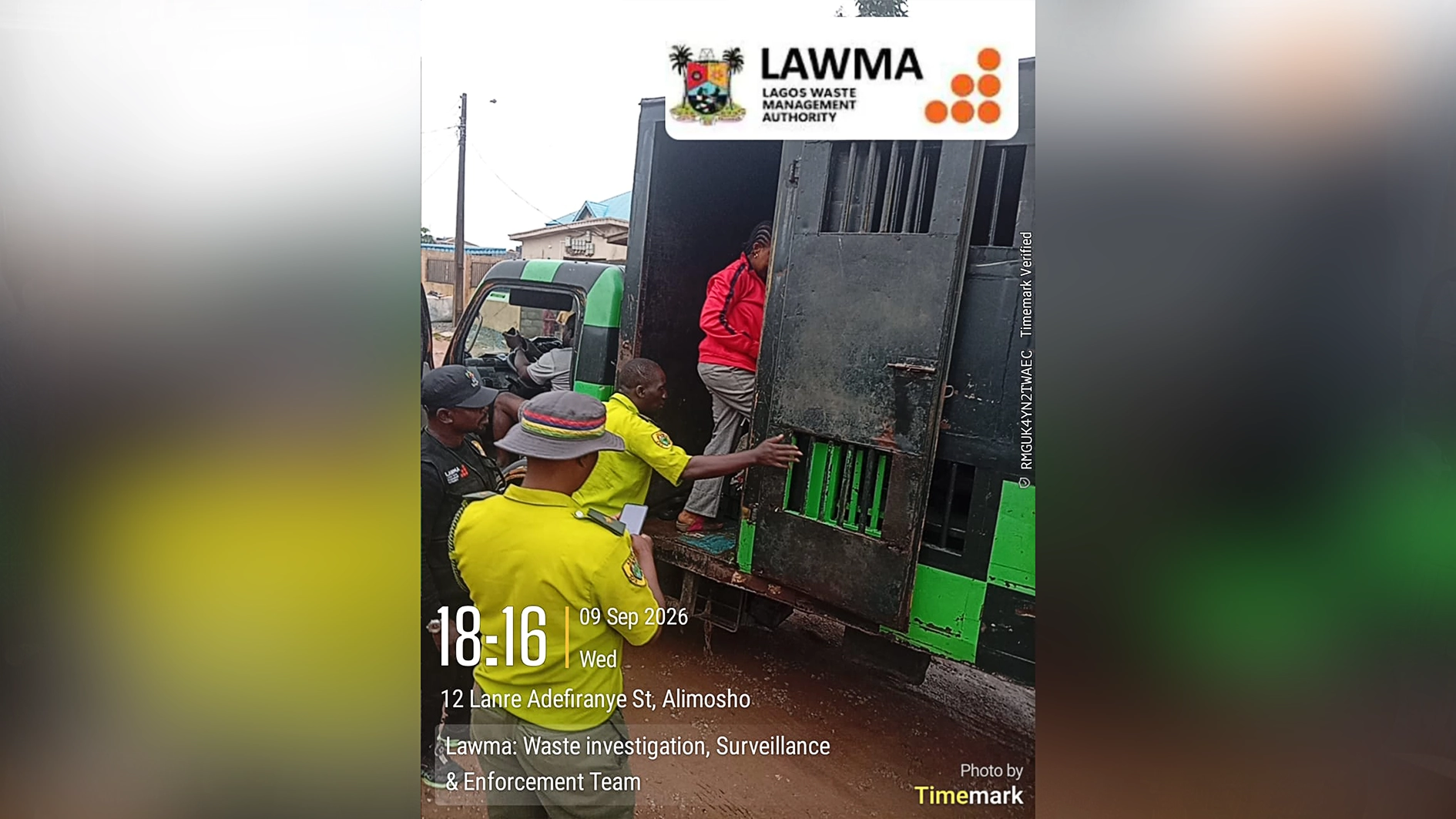
At the height of a Lagos downpour, a plastic bottle tossed into a drainage channel can seem like a small, almost insignificant act. For the person throwing it away, it may be nothing more than getting rid of an empty container. But for a family living downstream, that same bottle can become part of a blockage that turns a heavy rainfall into a flooded street, a damaged home or a night spent trying to keep water out.
This is the human face of Lagos’ sanitation problem.
The consequences of indiscriminate waste disposal are rarely experienced by the person who drops the refuse.
They are often borne by someone else — a trader whose goods are damaged by floodwater, a commuter stranded by a flooded road, a family forced to wade through dirty water, or a child exposed to an unhealthy environment.
Yet whenever Lagos’ streets become dirty or drains become clogged, the conversation often returns to one familiar question: where is government?
There is a comforting version of the Lagos waste debate in which government is responsible for everything. If a street is dirty, government has failed. If a drainage channel is filled with plastic bottles, government has failed. If someone empties a refuse bag on a road median at midnight, somehow government is still expected to take the blame.

Government certainly bears enormous responsibility for environmental sanitation. It must provide an efficient waste-management system, ensure regular collection, maintain infrastructure and enforce environmental laws.
But a city of more than 20 million people cannot be kept clean exclusively by workers employed to clean up after everybody else.
At some point, behaviour becomes policy.
That reality lies at the heart of one of the most difficult questions facing environmental management in Lagos: can government create a clean city without first creating a culture that rejects dirty behaviour?
The evidence suggests that the answer is no.
In April 2025, the Lagos Waste Management Authority (LAWMA) disclosed that more than 300 people had been apprehended for waste-related offences during intensified surveillance operations conducted with the Lagos State Environmental Sanitation Corps. The offences included illegal dumping, some of it carried out under the cover of darkness.
The troubling aspect of that figure is not simply the number of people arrested. It is the behaviour that made the arrests necessary in the first place.
Every person who dumps refuse into a canal understands, at some level, that somebody else may eventually pay the price. Every business that deposits waste on a road median transfers its private responsibility to the public.
Every household that refuses formal collection and quietly disposes of its waste elsewhere effectively asks responsible residents to subsidise its behaviour.
The consequences go far beyond an untidy street.
A plastic bottle thrown into a drainage channel may remain there during the dry season, but when heavy rainfall arrives, it can become part of a blockage that contributes to flooding. A refuse pile beside a road can obstruct traffic, attract rodents and create unhealthy conditions for residents. Indiscriminate dumping can also contaminate water and degrade entire neighbourhoods.
In Lagos, therefore, sanitation is not merely about appearance. It is closely connected to public health, flooding, environmental protection and the quality of life of millions of people.
A recent incident in Meiran illustrates why residents themselves must become active participants in protecting the environment.
On September 9, 2026, LAWMA, working with the Kick Against Indiscipline (KAI) and the Mobile Police, arrested a resident allegedly caught dumping waste into a drainage channel during rainfall. The operation followed a tip-off from members of the public.
LAWMA Managing Director and Chief Executive Officer, Dr Muyiwa Gbadegesin, commended those who provided the information, describing their action as an example of responsible citizenship and support for efforts to protect the environment.
The suspect was taken to the KAI headquarters for further investigation and prosecution in accordance with the law.
Gbadegesin urged Lagosians to embrace the principle, “If you see something, say something,” stressing that environmental protection requires active participation from communities and residents.
The message is important because government cannot be everywhere.
Nobody can police every gutter. Nobody can place a camera beside every canal. Nobody can patrol every street at 2 a.m. waiting for people to dump refuse.
LAWMA says 1,061 people have, at various times, been engaged in enforcement and waste-policing functions within its broader operations. But enforcement alone is an expensive way to create civic culture.
The more sustainable solution is to make environmental responsibility part of everyday citizenship.
That begins with the basics.
Every household should have an appropriate bin and patronise its assigned waste collector. Businesses should provide adequate receptacles rather than allowing packaging and food waste to migrate onto surrounding streets.
Markets should have functioning collection arrangements, while construction debris should be handled separately. Recyclable materials should also progressively be separated at source.
More importantly, residents must understand that throwing waste into a drain is not merely an untidy act. It can obstruct the flow of stormwater and contribute to flooding somewhere else.
The plastic bottle carelessly discarded during the dry season can become part of another family’s flood problem when the rains arrive.
Environmental communication must therefore evolve.
For years, sanitation campaigns have relied heavily on admonitions such as “Do not dump refuse,” “Keep Lagos clean” and “Obey environmental laws.” Those messages remain necessary, but they are no longer sufficient.
People are more likely to change behaviour when they understand the consequences of their actions and when responsible behaviour offers a tangible benefit.
This is where recycling could achieve what decades of sanitation slogans have struggled to accomplish. If a household discovers that separated plastics have economic value, waste acquires a different identity.
If neighbourhood associations can earn from aggregated recyclable materials, residents have another reason to sort their waste. If schoolchildren grow up understanding sorting, reuse and environmental responsibility, a different culture can gradually emerge.
LAWMA Academy has collaborated with the Lagos State Universal Basic Education Board on environmental education for schoolchildren, while recycling and waste-sorting initiatives form part of the state’s broader sustainability programme.
Such programmes may ultimately prove more valuable than another generation of fines. Children who learn that drainage channels are not dustbins are less likely to become adults who need enforcement officers to tell them so.
Government, however, must not use civic responsibility as an excuse for its own shortcomings.
Residents cannot be lectured about proper disposal when collection is persistently unavailable. Businesses cannot be compelled to use approved services that are unreliable. Environmental enforcement must not become arbitrary, selective or punitive without due process.
Rules must apply equally to roadside traders, affluent estates, major companies and government facilities.
Responsibility has to run in both directions.
Government must build and maintain an effective waste-management system. Citizens must stop sabotaging it.
The environmental legacy worth pursuing is therefore larger than clean streets. It is a city where cleanliness gradually becomes normal rather than something produced by periodic government intervention; where the first instinct after consuming bottled water is not to throw the container from a moving vehicle; where businesses understand that the pavement outside their premises is part of their environment; and where communities regard illegal dumpsites as unacceptable rather than inevitable.
It is also a Lagos where reporting somebody who dumps waste is regarded as protecting the neighbourhood, rather than interfering in another person’s business.
Government can employ sweepers. It can purchase trucks. It can clear black spots. It can arrest offenders and prosecute them. It can return to the same locations repeatedly to remove waste.
But there is one thing government cannot sustainably do: follow more than 20 million people around Lagos, picking up after them.
The cleaner city everyone wants will therefore require something beyond government policy.
It will require a different relationship between Lagosians and Lagos itself — one in which environmental responsibility is not seen as the government’s job alone, but as a shared duty of citizenship.
Because ultimately, the person whose house floods, whose business is disrupted or whose neighbourhood becomes unsafe may not be the person who threw the bottle into the drain.
And that is precisely why keeping Lagos clean cannot be somebody else’s responsibility.

