 Follow Us on Google News


 Follow Us on Google Discover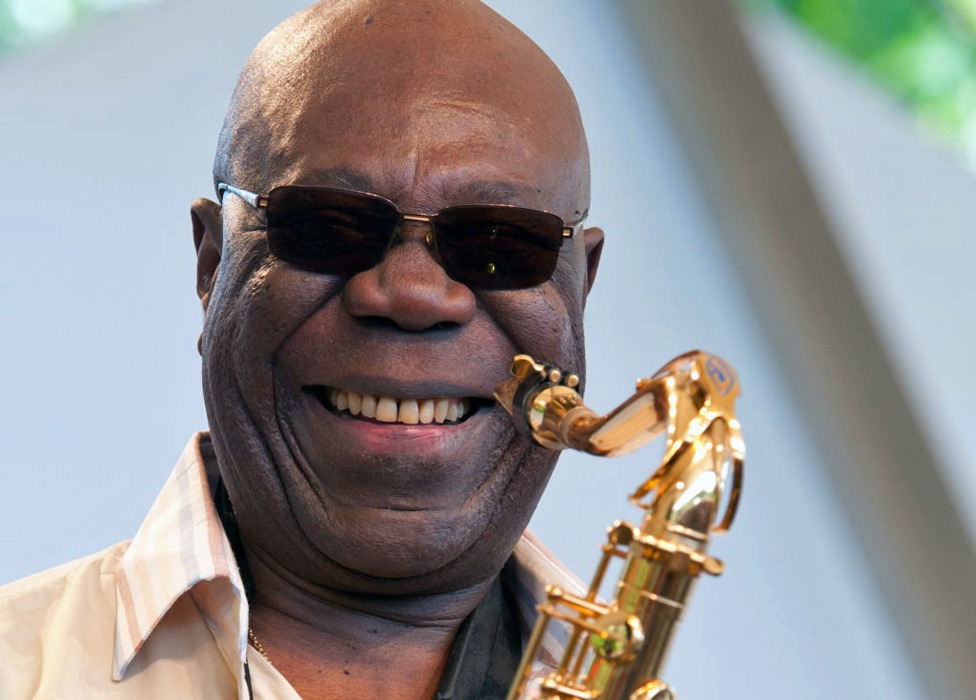
By Onome Amawhe
From the night Lagos finally honoured him to his friendship with Fela Kuti, his musical kinship with King Sunny Adé and the extraordinary journey of “Soul Makossa,” Manu Dibango’s life was a story of an African musician who refused to remain inside borders.
There was something almost poetic about Manu Dibango standing on a stage in Lagos in November 2016.
By then, the Cameroonian saxophonist was 82 years old. His bald head, dark glasses, enormous smile and golden saxophone had become instantly recognisable across continents. He had played in Europe, America and Africa; collaborated with some of the most important musicians of his age; produced one of the most consequential African records ever made; and heard a phrase from that record travel into the music of Michael Jackson and, decades later, Rihanna.
Yet that evening at the All Africa Music Awards, AFRIMA, at the Eko Hotel & Suites, Lagos offered him something unexpectedly intimate.
He received AFRIMA’s Legendary Award.
Then Dibango told the audience something remarkable: despite all the honours accumulated during his long international career, it was the first music award he had received in Africa.
It is difficult to imagine a more fitting city for the moment.
Lagos belonged to another branch of the enormous musical family tree of which Dibango had become one of the patriarchs. It was Fela Kuti’s city, King Sunny Adé’s city, Tony Allen’s city; a place where highlife had collided with jazz, funk, Yoruba percussion, juju and politics to produce some of the twentieth century’s most enduring African music.

Dibango understood that world intimately.
Nigeria was not simply another stop on his touring itinerary.
It was part of his musical geography.
The man who kept crossing borders
Manu Dibango’s story is almost impossible to tell as the story of one country.
He was born Emmanuel N’Djoké Dibango in Douala, Cameroon, in December 1933. His parents were devout Protestants, and music first entered his life through the church rather than the nightclub. He sang in the choir, experimented with instruments and eventually developed the curiosity that would define almost everything he later did.
Sent to France as a teenager in 1949, he initially studied piano. The saxophone came later, almost accidentally, after a friend put one in his hands in the early 1950s. It changed his life.
From France he moved into the jazz world of Belgium, where he encountered Joseph Kabasele — Grand Kallé — one of the architects of modern Congolese popular music.
That encounter pulled Dibango deeper into Africa.
He joined Kabasele’s African Jazz and spent time in Léopoldville, today’s Kinshasa, in the great era when Congolese rumba was helping invent a new postcolonial African modernity. Kabasele’s orchestra was associated with Indépendance Cha Cha, the exuberant anthem of Congolese independence, and Dibango found himself inside a musical movement in which jazz, Cuban music and African rhythmic traditions were being remade into something entirely new.
That ability to inhabit several worlds without surrendering himself to any one of them became his great gift.
Jazz musician?
Certainly.
African traditional musician?
Yes.
Funk pioneer?
Absolutely.
But Dibango also played rumba, highlife, reggae, soul, salsa, gospel and chanson. He could move from a small jazz ensemble to a large orchestra without losing his identity. The Guardian’s obituary would later describe the sheer breadth of his music, while noting that he disliked being reduced simply to an “African musician.” He preferred something broader: an artist who happened, unequivocally, to be African.
That distinction mattered.
Dibango did not present African music as folklore preserved behind glass. He treated it as a living language capable of arguing with James Brown, conversing with Duke Ellington, dancing with Congolese rumba and reinventing itself inside a Paris nightclub.
And then came “Soul Makossa.”
The B-side that conquered the world
Great cultural revolutions sometimes arrive disguised as accidents.
“Soul Makossa” was never supposed to become one of the most influential African records ever made.
In 1972, Dibango recorded music connected with Cameroon’s football campaign. “Soul Makossa” appeared as the B-side. Somehow, copies reached DJs in New York.
And something happened.
American dance floors discovered it.
The song’s architecture was irresistible: taut rhythm guitar, bass, percussion, horns and Dibango’s immense saxophone sound moving across the groove. Above everything floated that strange, unforgettable vocal phrase built around makossa, the Cameroonian dance rhythm.
The record moved from underground clubs into the American charts and helped introduce an African dance record to audiences that had seldom encountered African popular music on its own terms.
The Museum of Modern Art has described “Soul Makossa” as the first African pop recording to reach the Western Top 40.
Its importance was larger than chart position.
Listen carefully and you can hear something coming.
Disco.
Funk.
The breakbeat culture from which hip-hop would emerge.
The internationalisation of African dance music.
Long before “Afrobeats” became an industry category and global pop stars sought African collaborations as a matter of course, Dibango demonstrated that a record constructed from an African rhythmic imagination could enter the Western mainstream without ceasing to sound African.
And then one of the world’s biggest musicians heard it.
From Dibango to Michael Jackson
Ten years after “Soul Makossa,” Michael Jackson released Thriller.
On “Wanna Be Startin’ Somethin’,” listeners heard the now-famous concluding chant:
“Mama-say, mama-sa…”
Its ancestry led back unmistakably to Dibango.
The dispute eventually produced an out-of-court settlement. Years later, the lineage became more complicated when Rihanna’s 2007 hit “Don’t Stop the Music” used the Jackson interpolation. Dibango pursued another legal claim, although that later action was unsuccessful.
The episode can be treated as celebrity trivia.
It is more important than that.
It belongs to a much older argument about African creativity and global popular culture: who gets credited when an African idea travels?
African music has supplied global popular music with rhythms, melodies, instruments and aesthetic vocabularies for generations. Yet authorship has not always travelled with the sound.
Dibango’s insistence on recognition was therefore significant.
He understood that influence should not mean disappearance.
The African source deserved a name.
Lagos, Fela and two different ideas of the African musician
Nigeria entered Dibango’s musical life from several directions, but perhaps the most fascinating was Fela Anikulapo-Kuti.
The two men were contemporaries and musical relatives without ever being artistic twins.
Dibango remembered Fela as a friend and spoke admiringly of his compositions. He said he would travel from Cameroon to Lagos and visit Fela at the Shrine, describing the journey between the neighbouring countries almost casually: Lagos was close enough to feel like visiting someone next door.
Yet their temperaments were very different.
Fela transformed his music into a political weapon. His records attacked military governments, multinational corporations, colonial psychology, corruption and elite hypocrisy. Eventually the distinction between musician and political dissident virtually disappeared.
Dibango chose another road.
He admired Fela’s music but had little desire to inherit Fela’s permanent confrontation with power.
What fascinated him was the construction of Afrobeat itself — the mixture of Yoruba rhythmic foundations, highlife, jazz and the funk revolution associated with James Brown. In Fela, Dibango recognised what he himself had spent his career pursuing: the possibility of making modern African music by absorbing the world without being swallowed by it.
That makes their relationship more interesting than a conventional collaboration.
They represented two models of postcolonial African musicianship.
Fela made music into insurgency.
Dibango made music into cosmopolitanism.
Fela rooted himself stubbornly in Lagos.
Dibango kept moving — Douala, France, Brussels, Kinshasa, Abidjan, Paris, New York and beyond.
Yet the routes kept intersecting.
Dibango would eventually interpret Fela’s “Lady,” taking one of Afrobeat’s defining compositions into his own musical universe. His 1994 Wakafrika project included a version of “Lady” among an extraordinary gathering of African songs and musicians.
It was less imitation than conversation.
One giant acknowledging another.
Then there was King Sunny Adé
Nigeria’s place in Dibango’s world extended beyond Fela.
King Sunny Adé participated in Wakafrika, one of Dibango’s most ambitious statements about African musical interconnectedness.
The 1994 album assembled an astonishing cast: Youssou N’Dour, Salif Keita, Angélique Kidjo, Papa Wemba, Ladysmith Black Mambazo, Peter Gabriel, Geoffrey Oryema, Touré Kunda and others.
King Sunny Adé appeared prominently, including on Dibango’s interpretation of Babatunde Olatunji’s “Jingo.”
That single recording contains layers of African history.
Olatunji was Nigerian.
Sunny Adé was Nigeria’s great juju modernist.
Dibango was Cameroonian.
“Jingo” had meanwhile travelled through Santana and the international rock world before being reclaimed inside another African conversation.
This was classic Dibango.
Music went out into the world and returned carrying additional passports.
He did not worry much about keeping genres pure.
He was interested in what happened when they met.
His affection for Nigerian music
Dibango’s Nigerian connection was also personal.
In a long retrospective interview late in his life, he spoke warmly about Nigerian music, particularly its highlife inheritance. He described Nigeria, Ghana and South Africa as places possessing extraordinary musicians steeped in jazz and rhythmic sophistication.
That observation reveals something important about him.
Dibango belonged to a generation of African musicians who understood the continent through musical routes rather than contemporary national compartments.
Accra talked to Lagos.
Lagos talked to Douala.
Douala talked to Kinshasa.
Kinshasa talked to Abidjan.
African records crossed borders even when politics did not.
Musicians listened to shortwave radio, carried records between cities, borrowed riffs, rebuilt rhythms and created local versions of international forms.
Dibango was almost the perfect embodiment of that Africa.
He was born Cameroonian, educated partly in France, transformed by Belgian jazz culture, apprenticed inside Congolese music and eventually embraced by audiences from New York to Lagos.
His passport said one thing.
His saxophone said something much larger.
The strange significance of that Lagos award
Which brings us back to Lagos in 2016.
At the Eko Hotel, the audience saw an elderly man carrying a saxophone.
But standing before them was nearly seven decades of African musical history.
He had lived through colonial Cameroon.
He had watched African countries become independent.
He had participated in the rise of modern Congolese music.
He had watched jazz become funk and funk become disco.
He had created a song that entered American club culture.
He had heard Michael Jackson transform his chant into global pop.
He had recorded with some of Africa’s greatest musicians.
And now an African institution was finally formally calling him a legend.
That mattered to Dibango.
His comment that the AFRIMA honour was his first music award received in Africa carried a quiet poignancy.
There is a familiar African paradox hidden inside that moment.
Sometimes the continent exports greatness before fully recognising it.
Artists leave home, receive validation in Paris, London or New York, and only later return as figures already certified by somewhere else.
Dibango’s career complicated that pattern because he never psychologically abandoned Africa. Africa remained material rather than branding — rhythm, memory, language, friendship and musical vocabulary.
So the Lagos honour felt less like welcoming a foreign celebrity than acknowledging a relative who had spent decades carrying pieces of the continent around the world.
More than “Soul Makossa”
The danger with an enormous hit is that it can become a prison.
“Soul Makossa” was so successful that it threatened to reduce Dibango’s immense career to one recording.
But he never stopped experimenting.
He worked with reggae musicians Sly and Robbie in Jamaica. He recorded with Herbie Hancock. His collaborators and associates ranged across African and international music, including Hugh Masekela, Tony Allen, Salif Keita, Peter Gabriel and Ladysmith Black Mambazo. He made music for film, television and orchestras. He played keyboards and vibraphone as well as saxophone. He worked with everything from quartets to large ensembles.
In 1984, he participated in Tam Tam Pour l’Éthiopie, the African-led famine-relief recording conceived partly as an answer to Western charity projects that many African artists felt represented the continent too passively.
That episode also reveals the politics inside Dibango’s apparent geniality.
He was not Fela.
But that did not make him apolitical.
His politics lay partly in insisting that Africa could represent itself.
The same principle animated his music.
The sound of a continent refusing categories
Perhaps that is the best way to understand Manu Dibango.
He was an enemy of the box.
African music.
Jazz.
World music.
Makossa.
Funk.
Any of these labels describes him.
None contains him.
Even his physical presence contradicted solemnity. Photographs frequently show the famous grin, the dark glasses and saxophone. He could appear almost avuncular until he began to play. Then came that muscular tone — warm one moment, abrasive the next — riding above percussion with astonishing authority.
He possessed something many technically gifted musicians never acquire:
a recognisable musical voice.
You did not need album credits.
A few bars could tell you Manu Dibango had entered the room.
The last improvisation
Dibango died in Paris on March 24, 2020, aged 86, after contracting Covid-19, becoming one of the first globally prominent musicians lost to the pandemic.
The circumstances gave his death an eerie historical weight. A musician whose life had been defined by movement died at the beginning of a moment when borders were closing, aircraft were being grounded and stages were falling silent.
But music does not obey lockdowns.
“Soul Makossa” continued playing.
So did Wakafrika.
So did the records from Kinshasa, Paris, Jamaica and countless other places through which Dibango passed.
And somewhere inside Michael Jackson’s Thriller, one can still hear the ghost of that Cameroonian B-side.
Somewhere inside Nigerian music history is the image of Dibango visiting Fela’s Shrine.
Somewhere inside Wakafrika is King Sunny Adé’s voice meeting Dibango’s saxophone.
And somewhere inside that Lagos night in 2016 is an old man receiving an African trophy, perhaps wondering why it had taken so long.
There is an even larger story here.
Before today’s language of Afrobeats, global collaborations and African cultural soft power, musicians such as Manu Dibango were already constructing a borderless African popular culture.
They did it without streaming platforms.
Without social media.
Without algorithms.
They carried records.
They caught aeroplanes.
They entered nightclubs.
They met other musicians.
And they played.
Manu Dibango’s greatest achievement, therefore, may not simply be that he gave the world “Soul Makossa.”
It is that he demonstrated what could happen when an African musician regarded the entire world as available musical territory while never losing the sound of home.
When Manu Dibango lifted his saxophone, Douala could meet Kinshasa, Paris could meet New York, and Cameroon could meet Nigeria.
And somehow, unmistakably, it all still sounded like Africa.

